


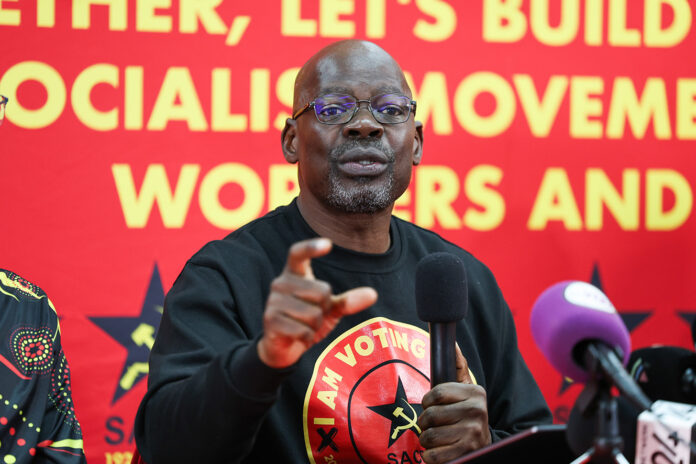
The SACP has fingered the ANC for allegedly declining an alternative resolution to their now toxic war over the reds contesting elections on their own.
The fallout came to a head this week, with the ANC sending letters to all dual members of the SACP, asking them to choose whom they will campaign for ahead of the local government elections.
In retaliation, the SACP leaked a document by the two formations revealing they had proposed a middle ground on how they can coexist even when contesting elections independently from each other.
SACP general secretary Solly Mapaila claimed that the ANC had rejected the “common electoral approach” proposal because of its malice to bully the reds into submission and attempt to force their hand to abandon their election contestation.
The document acknowledges that the two cannot agree on the SACP congress resolution to contest elections independently from the ANC, which the reds insist is “binding”.
According to the document, jointly penned by the ANC-SACP technical drafting team on electoral coordination, the two formations can continue in a healthy alliance despite their disagreements over communists contesting elections.
The documents reveal that three options were placed on the table, each with different implications. The first option, deemed the preferred one, proposes a “coordinated approach” between the ANC and SACP to the elections while contesting independently.
The second option favours parallel but complementary contestation between the long-time allies boasting a more than a century-old relationship, which is deemed viable only under specific conditions.
The third option proposed in the paper appears to be the one that has eventually emerged by accident, which is uncoordinated contestation, deemed, as admitted in the document, as “high risk and not advisable”.
Mapaila charged that the SACP had insisted on the first option of a coordinated common approach, an assertion Mbalula has poured cold water on, accusing the SACP of having amnesia because they are fixated on having their way.
That proposal, which was the best on the table, would have demonstrated “a strong expression of strategic unity” and would not have problematised the dual membership system that is now in tatters.
“Where organisational capacity and political terrain allow, the ANC would focus on consolidating ward victories, while the SACP mobilises a disciplined working-class PR vote – including voters who might otherwise abstain or scatter.
“This model aligns closely with the long-standing tradition of presenting a unified political front to the electorate, while acknowledging tactical adjustments required under current realities,” reads the document.
“The viability of this model depends on functional ANC structures with legitimate local leadership, active SACP presence capable of disciplined mobilisation, shared messaging that avoids signalling competition and structured municipal-level coordination through the alliance secretariat.
“This option is most applicable in strong and safe municipalities, where progressive forces already hold the confidence of the electorate, and in competitive municipalities with sufficient organisational cohesion to sustain discipline.”
But because of the refusal by either side to compromise, the third option automatically became the default, which could be deemed as equal to suicide bombing by both parties.
This is because the technical drafting team had acknowledged that going this route would “risk splitting the working-class vote, handing advantage to reactionary forces, destabilising municipal governance, and undermining the alliance’s moral and political authority”.
Mapaila blamed the ANC, saying it had tried to “cajole” the SACP through deceptive means.
Had roles been reversed, he said, the SACP would have elected to go with the first option of a coordinated common electoral approach.
“We proposed the concept of coordinated elections, meaning we would sit together and say this is how we are going to approach the elections; you will be on the ballot and you will be on the ballot,” Mapaila said.
“The ANC rejected that because they just want to control us. If the roles were reversed, we would ask them to have a coordinated election process as the alliance because we are one people, so one programme.”
Mbalula confirmed that the SACP raised the common coordinated approach but blamed them for it not getting the nod.
“The communist party raised the issue of a common electoral approach, and we said we are open to that. And I hear [Mapaila] say we rejected, but we were in a meeting just last week. What kind of bipolar is this?
“I do not remember the ANC rejecting this; we have rejected the issue of the party standing on its own.”
- The ANC and SACP are in conflict over the SACP contesting elections independently, with ANC asking dual members to choose whom to support.
- The SACP leaked a document showing they had proposed a coordinated electoral approach as a middle ground, which the ANC allegedly rejected.
- Three options were proposed for electoral coordination: coordinated approach (preferred), parallel but complementary contest, and uncoordinated contest (considered risky).
- The uncoordinated contest option has become the default due to a lack of compromise, risking vote splitting and weakening both parties.
- Both sides accuse each other of bad faith; ANC denies rejecting coordination, while SACP claims ANC wants to control them and refuses collaboration.


