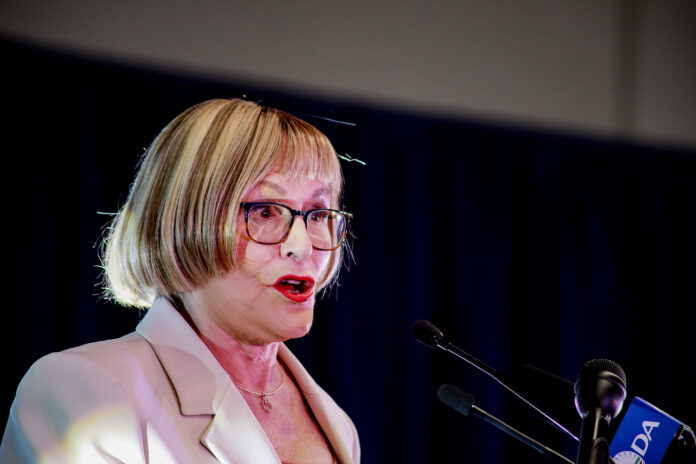
DA federal council chair Helen Zille says the election of billionaire Patrice Motsepe to become ANC president would result in a smooth and non-disruptive
transition of power at the Union Buildings.
Motsepe has been touted as the potential successor to his brother-in-law, President Cyril Ramaphosa, both in the ANC and the state, in a campaign that is gaining traction under the slogan “PM27 Savumelana”. While stressing that it is not her place to interfere in ANC internal processes, Zille offered her perspective on what such a leadership change could mean for the country.
She believes it means stability and continuity, as the two men come from the same market-friendly school of thought.
“I perceive that a transition from president Ramaphosa to president Motsepe would not be disruptive; it would be a smooth process,” Zille told Sunday World, adding that there was nothing unusual about the prospect of a businessman leading the country, given Ramaphosa’s own background in business.
She noted that Motsepe and Ramaphosa are closely linked, both politically and personally, but cautioned that the outcome would ultimately depend on whether the dominant faction within the ANC could maintain unity.
“Well, we had a president from business, which is president Ramaphosa. From what I know, Patrice Motsepe is his brother-in-law, so they are very closely related, but it depends on whether that faction of the ANC can maintain their peace. Patrice Motsepe will be a seamless transition from what we have now and the future,” he said.
However, Zille also criticised the ANC’s internal electoral culture, alleging that money, rather than conviction, plays a decisive role in leadership contests, a practice she warned has entrenched corruption within the party’s democratic processes.
Sunday World previously reported that a printing company in Johannesburg, where T-shirts branded with the supposed Motsepe campaign slogan were being printed in batches of thousands, has been doing the rounds. The T-shirts are expected to be distributed to ANC members sympathetic to the campaign.
ANC national executive committee member Bejani Chauke, a former advisor to Ramaphosa who was deeply involved in the successful CR17 campaign that propelled Ramaphosa to power, is reportedly involved in efforts to have Motsepe succeed him.
Motsepe has poured cold water on talk of him launching a 2027 leadership bid, but managers and supporters of PM27 are pressing ahead in the hope that he will raise his hand at the right time.
In an interview with political strategist Brutus Malada for the Sunday World Podcast, Zille still did not miss the opportunity to raise her discontent about Ramaphosa making decisions without consulting GNU partners. She suggested that the president no longer solely has the prerogatives to make decisions, as this disregards key provisions of the GNU agreement.
“There is a whole section on sufficient consensus that the ANC just ignores. There is also an agreement on proportionality, and there is also a portion on access to be part of the coalition.”
According to the statement of intent, which was signed by political parties just moments before Ramaphosa was voted in as the president in the National Assembly in 2024, sufficient consensus is possible when parties to the GNU representing 60% of seats in the assembly agree.
This would mean that such an instance would only occur if the DA and ANC agree. This, however, weakens the powers of the ANC as the majority party in the coalition arrangement and curtails the voice of smaller parties.
“I must say that the ANC does not respect the document it signs. That is where the big cultural difference is between the ANC and the DA. When we sign a document, we believe that our word is our bond and that we have to stick to it.”
According to Zille, senior ANC figures often behave as though the party’s electoral size entitles it to impose decisions unilaterally, sidelining its coalition partners in the process. “Sometimes I get the feeling that ANC people have not read the document and do not know what it says. They feel that they are the bigger party and can impose. No, you cannot govern without us.”
Her comments come amid ongoing tensions within the GNU, particularly around fiscal policy and economic reform. Zille revealed that the DA came close to walking out of the coalition during the dispute over a proposed value-added tax (VAT) increase, a move the party strongly opposed.
However, Zille defended the DA’s decision to remain in the GNU, arguing that political leverage is lost the moment a party walks away prematurely.
“You do not walk out when you are about to win. You stay inside; you flex your muscle.”
- For full interview check the Sunday World Podcast on YouTube.