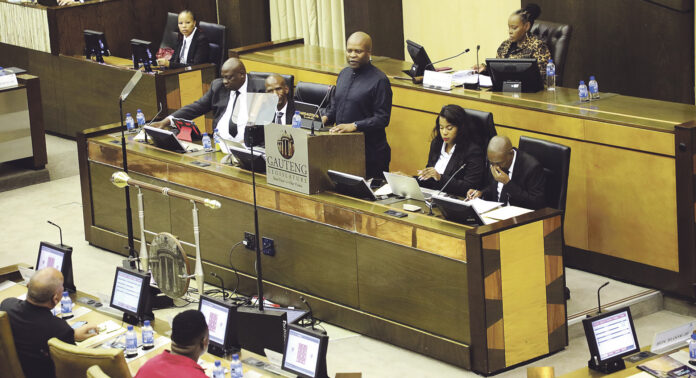
The Gauteng economy is expected to grow slightly faster than the national average in the current financial year, offering cautious optimism for South Africa’s economic hub. Gauteng Finance and Economic Development MEC Lebogang Maile made the announcement during the provincial budget presentation on Tuesday. He confirmed that the economy is projected to expand by 2.1% in 2026.
The province’s gross domestic product by region exceeds R2.4-trillion, meaning Gauteng accounts for 33% of South Africa’s total GDP and more than 10% of the entire Sub-Saharan Africa region.
Maile indicated the gains in the labour market, with more than 250 000 jobs created in the province in 2025 – 95 000 of which were recorded in the second quarter. The period between March and June 2025 was highlighted as the highest job creation mark when compared to other provinces.
“There are currently just over six million people employed in Gauteng. Trade and construction were among the leading sectors for job creation, demonstrating that despite the difficult climate we find ourselves in, businesses continue to have confidence in the capacity of the province to turn things around,” said Maile.
However, he warned that economic activity across municipalities remains uneven, as data contained in the 2026 Socio-Economic Review and Outlook shows that both metropolitan and district municipalities continue to face deep economic and structural challenges that have limited investment and job opportunities in local economies.
“As the Gauteng provincial government, we fully understand that we must decisively intervene and work with partners in the public, private and civil society sectors to support our economy in order to regain momentum by capitalising on sectoral strength and improving the investment climate in the province,” he said.
He added that the province had adopted the Gauteng City Region Economic Growth and Development Plan, which will be launched on March 19.
While Gauteng is expected to grow modestly faster than the country as a whole, South Africa’s broader economic outlook remains subdued.
Maile said the domestic economy continued to face the combined effects of global shocks, structural bottlenecks, and policy challenges, which have hindered growth in key sectors such as manufacturing and agriculture. However, there are signs of gradual improvement.
He pointed to stabilising electricity supply, easing inflation, and lowering interest rates as factors supporting a more positive outlook. Improvements in logistics and transport operations, particularly at ports and freight rail corridors, are also helping to improve conditions for businesses by reducing delays, lowering shipping costs, and enhancing supply chain efficiency.
The country recently received a boost after the Financial Action Task Force removed South Africa from its grey list, signalling progress in strengthening its anti-money laundering systems.
Despite these gains, growth is expected to remain modest. According to the National Budget, the South African economy is projected to expand by 1.6% this year, rising slightly to 1.8% in 2027 and 2% by 2028.
According to Maile, the economy will require sustained structural reforms to move toward a stronger and more inclusive growth path.
“It is through sustained implementation of ongoing structural reforms, including improvement in infrastructure service delivery and policy certainty, that we can place the economy on a higher and more inclusive growth trajectory over the medium term,” he said.