


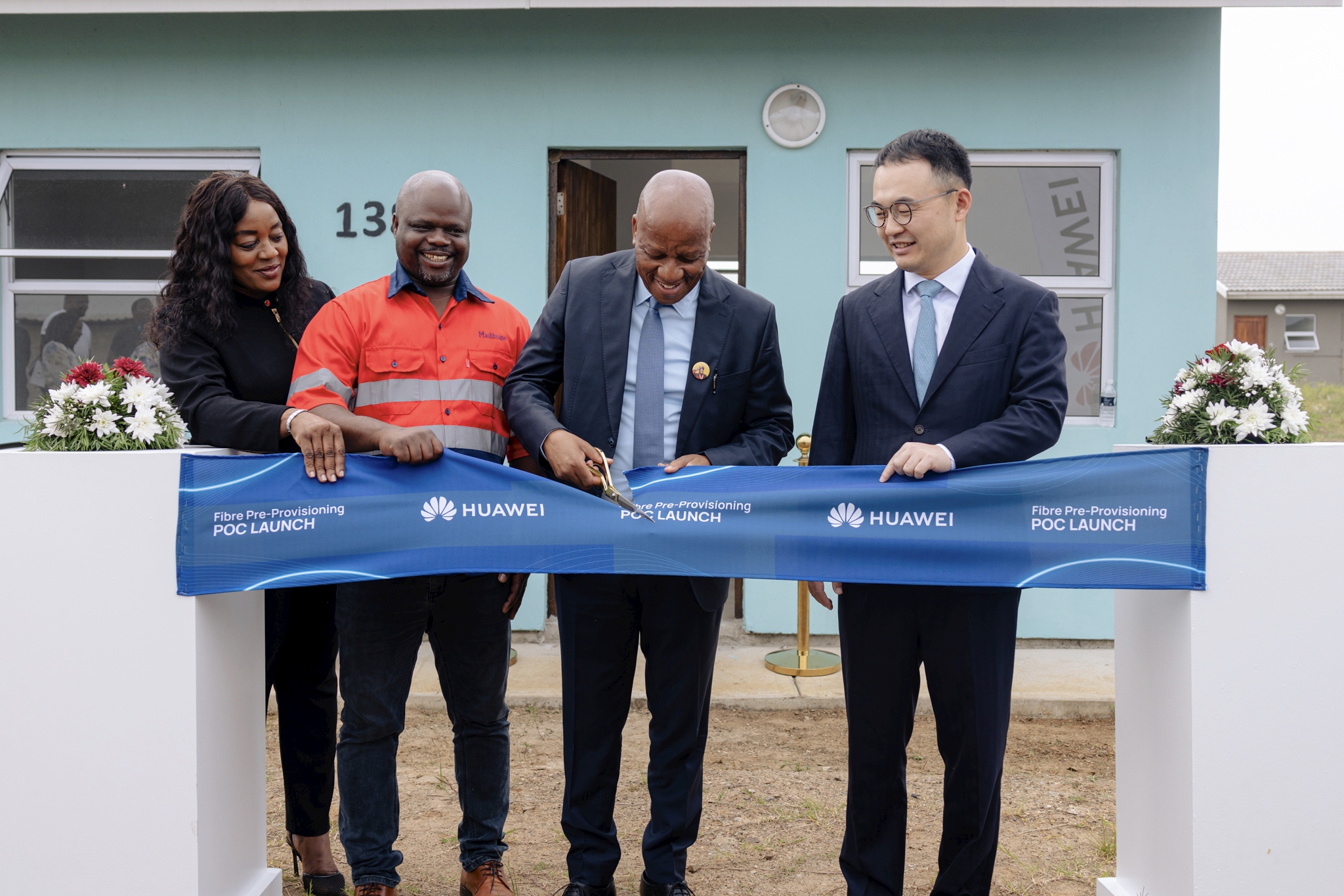
The KZN government, Openserve and Huawei launched a fibre Pre-Provisioning Proof of Concept on October 22, to build digital readiness in Empangeni.
The project is being rolled out at the Phase 1A Empangeni IRDP Mega Housing development in uMhlathuze Municipality, where 405 houses are under construction.
The physical infrastructure for fibre is being installed in the houses while they are being built, so that the homes will be ready for high-speed connectivity once services are deployed.
The Empangeni development is among the first in South Africa to use the Pipe and Box method to put the infrastructure for future connectivity in place while homes and other essential infrastructure are under construction.
This makes connectivity part of the community’s core infrastructure, so that services can be switched on more quickly and affordably once they are deployed.
The broader vision is to plan human settlements with digital infrastructure in mind, considering connectivity alongside housing, water, electricity and other essential infrastructure from the early stages of development development.
KwaZulu-Natal Premier, Thamsanqa Ntuli
Delivered the keynote address on the province’s digital connectivity and inclusive development.
“Build the pathway today, connect the community tomorrow,” he said.
“While this proof of concept does not itself provide fibre services, it establishes the physical infrastructure that will make future connectivity possible.
“Just as we plan for roads, for water and for electricity, so too must we plan for connectivity.”
The project brings together Provincial Government, the KZN Department of Human Settlements, uMhlathuze Local Municipality, Huawei and Openserve, combining public-sector planning and housing delivery with world-class technology and network infrastructure.
The provincial government, through the Premier’s office, provides leadership and strategic oversight.
Each partner plays a pivotal role
The Department of Human Settlements contributes its expertise in settlement planning and development.
The uMhlathuze Local Municipality leads local coordination, including infrastructure requirements, approvals and stakeholder engagement.
Huawei provides technical advice, programme support and knowledge transfer.
Openserve contributes telecommunications infrastructure and expertise in network deployment, including planning for future connectivity.
Together, the partners demonstrate how public and private sector expertise can combine to create communities ready for the digital future.
Proceedings opened at the Phase 1A site with a walkthrough of a house in the development phase, showing the fibre installation after which the Premier then cut the ribbon, officially opening the project.
uMhlathuze Local Municipality Mayor Xolani Ngwezi
In his welcome address, Mayor Ngwezi spoke about the project and its significance for the city.
“Today marks an important milestone in our journey as the City of uMhlathuze to become a smart, connected and inclusive city,” he said. “A connected city is a competitive city. A connected resident is an empowered resident.”
KZN Department of Human Settlements chief director Lindani Khoza
“Just as roads connect people physically, fibre infrastructure connects communities digitally,” said chief director Khoza, who described the POC as a new way of thinking about infrastructure delivery.
“Instead of treating connectivity as an afterthought, we are integrating it into the earlier stages of planning and development.”
Chief director of digital government at the Department of Communications and Digital Technologies Rendani Musetha
Echoing this sentiment, chief director Musetha placed the project in the context of national broadband policy.
“Why should we build houses today and think about connectivity only tomorrow?” he asked.
“A fibre cable has little meaning on its own. Its value comes from what it enables.”
Openserve enterprise and public sector executive Pearl Schrimpton
“When the government builds a home, a connection to the digital economy should be built in, just like water, just like electricity, just like the road,” Schrimpton said, speaking about Openserve’s role in planning the network infrastructure for future connectivity.
“Our commitment to this project is simple: we build it properly, we measure it openly and we will share what we learnt with our partners in government, so that the country can decide on facts rather than assumptions.”
Huawei South Africa Deputy CEO Charles Cheng
Reflecting on the partnership, of which is providing technical advice, programme support and knowledge transfer to the project, CEO Cheng spoke about the role of technology in digital inclusion.
“This initiative is a shining testament to the power of the public and private partnerships,” he said.
“It’s a pioneer step. It is our firm belief that fibre pre-provisioning must become a standard policy at a national level, integrated into municipality building codes and national housing strategy across South Africa.”
Huawei solution manager Li Yanbang
“If we do the fibre pre-provisioning during or before the road construction, it saves cost and also avoids the damage to the road,” said manager Yanbang, who presented the POC.
“We want to find a way that we can get more affordable connectivity to every South African household.”
Broader practical learning opportunity
Beyond Empangeni, the project provides a practical learning opportunity for government, municipalities, developers and network operators.
Insights gathered on site will inform how fibre is planned, costed and installed in future housing developments, helping guide similar projects to support digitally inclusive, fibre-ready communities across South Africa.
Communities with fibre-ready infrastructure in place are better positioned to benefit as services become available.
Connectivity can expand access to education, healthcare and participation in the digital economy.
Lessons from Empangeni are expected to inform the national integration of digital infrastructure into human settlements, as government and industry partners evaluate the model for broader adoption.
About Huawei
Founded in 1987, Huawei is a leading global provider of information and communications technology infrastructure and smart devices.
With 213 000 employees operating in more than 170 countries, we serve more than three billion people worldwide.
Huawei is committed to bringing digital to every person, home, and organisation for a fully connected, intelligent world.
Last year, Huawei generated 880.9 billion Chinese yuan in revenue, reinvesting 21.8% (CNY192.3 billion) into research and development, with about 53.7% of its employees working in R&D.
As a private company fully owned by its employees, Huawei focuses on customer-centric innovation and open collaboration to create lasting value and drive technological breakthroughs globally.
Further information
For more information, please visit Huawei online at www.huawei.com or follow us on:
http://www.huawei.com/za/
https://www.facebook.com/HuaweiSAR
http://www.linkedin.com/company/Huawei
http://www.google.com/+Huawei
http://www.youtube.com/Huawei
For additional information please contact:
Vanashree Govender
vanashreegovender@huawei.com
— This article is sponsored by Huawei
- The KZN government, Openserve, and Huawei launched a fibre Pre-Provisioning Proof of Concept on October 22 at the Phase 1A Empangeni IRDP Mega Housing development in uMhlathuze Municipality, where 405 houses are under construction.
- The project installs physical fibre infrastructure in houses during construction to enable ready high-speed connectivity once services are deployed, using the Pipe and Box method.
- Partners involved include the KwaZulu-Natal government, KZN Department of Human Settlements, uMhlathuze Local Municipality, Huawei, and Openserve, each contributing planning, technical expertise, and infrastructure deployment.
- The initiative aims to make digital infrastructure a core part of human settlements alongside traditional utilities and is expected to inform national policy on integrating fibre pre-provisioning into housing development.
- The project serves as a learning opportunity to guide future fibre infrastructure planning in South Africa, enhancing digital inclusion and connectivity access for communities.


