


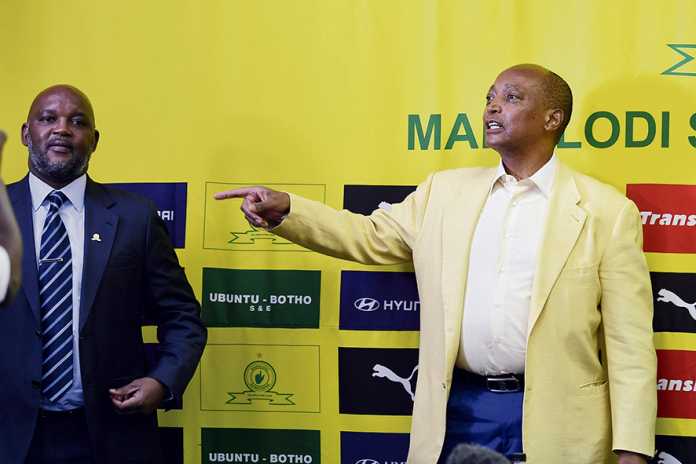
Mamelodi Sundowns will not be receiving the R7.9-million ordered to be paid to them by former coach Pitso Mosimane and MT Sports anytime soon, as their case was referred to the Supreme Court of Appeal on Tuesday.
“Having regard to the standard, the applicant must be satisfied to succeed. I [Judge Shaanaz Mia] am persuaded that there are reasonable prospects of success that another court will come to a different conclusion,” Judge Shaanaz Mia said, as quoted in the High Court transcript seen by Sunday World during the final judgment of the appeal of the multimillion-rand legal fight.
“In view of the structural inequality consideration rooted in the constitutional enquiry and public policy, there is a compelling reason why the appeal should be heard.
“In the result, I grant the following order: The application for leave to appeal is granted to a Full Court of this Division with costs to be costs in the appeal.”
Court ruling in 2025
According to the judgment dated August 19, 2025, Judge Shaanaz Mia at the South Gauteng High Court had ruled the defendants (MT Sports and Mosimane) shall pay
R7, 912,905.00 in agents’ commission fees, plus 7% interest per annum from 10 May 2021 until the date of payment.
However, Mosimane and MT Sports director Moira Tlhagale, through their legal representatives, Mabuza Attorneys, headed by top legal eagle Adv Tembeka Ngcukaitobi SC, appealed the judgment.
Some of the arguments presented by Mosimane and MT Sports legal representatives stated that the ruling was unfair and that the court lacked jurisdiction.
“The appellants [MT Sports and Pitso Mosimane] contend that a court a quo materially misdirected itself,” the court document read.
“In summary, it is submitted that the court misconstrued the two-stage inquiry into reasonableness by failing to assess whether the clauses were contrary to public policy on their face.
“The court failed properly to consider material evidence relating to the circumstances of termination. The court failed to give adequate reasons for decisive issues, and the court lacked jurisdiction.”
The high-profile legal battle is on the issue of the PSL defending champions demanding that Mosimane and MT Sports director Moira Tlhagale pay back commission in agent’s fees in the region of R8.6-million.
This is after Mosimane surprisingly left Sundowns to join African giants Al Ahly in 2020, just four months into his new four-year contract with the Brazilians.
- Mamelodi Sundowns are unlikely to receive the R7.9 million commission owed by former coach Pitso Mosimane and MT Sports soon, as the case has been referred to the Supreme Court of Appeal.
- Judge Shaanaz Mia of the South Gauteng High Court ruled that Mosimane and MT Sports must pay the amount plus interest, but also granted leave for them to appeal the judgment.
- Mosimane and MT Sports, represented by Adv Tembeka Ngcukaitobi SC, argue the ruling was unfair, lacked jurisdiction, and involved misdirection by the lower court.
- The dispute centers on Sundowns demanding repayment of nearly R8.6 million in agent commission fees after Mosimane abruptly left the club in 2020 to join Al Ahly shortly after signing a four-year contract.
- The legal battle continues with the appeal to be heard by the Supreme Court of Appeal, prolonging resolution of the multimillion-rand commission dispute.


