


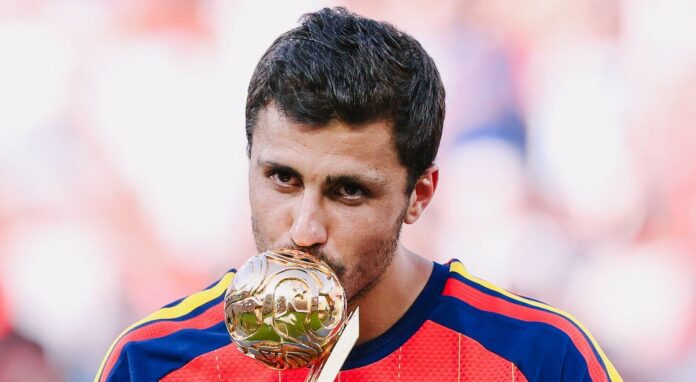
The architects of Spain’s footballing model explain how the country’s distinctive, winning style of play was forged.
The Spanish men’s national team has underscored their status as the 21st century’s standout national team by adding two Fifa World Cup stars to their crest. The classes of 2010 and 2026 may differ somewhat, not least because football itself has changed, but there is an unmistakable thread linking the two – a shared understanding of the game.
According to Fifa, the success of the Spanish model has not been confined to the men’s game. The women’s side also clinched the coveted crown in 2023 and they also belong in the same conversation.
Alexia Putellas explained in a recent interview with Fifa that she sees lots of similarities between the men’s and women’s teams, which, after all, are part of the same ecosystem from the youth ranks through to the senior set-up.
David Gutierrez, Director of the National School of Coaches at the Spanish Football Association (RFEF), traces the imperious Iberians’ success back to one particular individual and year: Luis Aragones in 2008. Jose Francisco Molina, who served as the RFEF’s sporting director for men’s football from 2018 until the end of 2022, shares the same view.
“He was the one who realised the sorts of players that Spanish clubs were producing – which, at the end of the day, is where you have to draw your talent from. Clubs develop players and the national team call them up, and he decided to bring that crop of players together – that’s where it all began for the national team and the association. Since it proved so successful, we started pursuing that style of play,” Molina told Fifa.
“He made us all realise that, genetically, we’re probably neither the fastest nor the strongest, but there’s one area where we excel – which we emphasise heavily when we’re educating coaches – and that’s understanding how to play together as a unit,” Gutierrez added.
The RFEF’s current sporting director, Aitor Karanka, believes that the way Spain develops coaches is pivotal to understanding the nation’s success. “Spanish coaches draw on their training and cultivate an understanding of the game in players from a very young age, not only with a view to developing individual talent but also thinking about the collective performance. The methodology centres on possession-based drills and building a skill set that enables the players, regardless of their natural ability, to interpret the game from a young age.”
When you watch Spain play, that is perhaps the most striking feature: everyone seems to have an acute feel for what’s happening around them and an exceptional ability to read the game so that they have more than mere instinct to go off. Initially, during Aragones’s tenure, which ran from 2004 to 2008, La Roja’s evolution was rooted in Barcelona’s youth academy, which provided the backbone of the 2010 side and remains key to understanding Spanish football. This year’s World Cup-winning cohort, however, is much more varied, with players like Rodri and Fabian Ruiz in the engine room, neither of whom have ever turned out for Los Blaugranas.
“It’s all down to the players and the coaches, but of course that all stems from the clubs – the work everyone puts in, from the top flight to lower down the pyramid – because there are so many clubs and academies that do such a fantastic job in developing young players,” Molina reiterated.
A robust methodology is also key to the strides taken by the Spanish national teams. The late Jose Manuel Ochotorena, who served as a goalkeeping coach under Rafael Benitez – one of the first high-profile Spanish managers to have success abroad – recounted some years ago that the English players at Liverpool were not overly enamoured with the Madrid-born tactician’s training sessions because he would frequently interrupt them to explain a particular concept.
He recalled how they had wanted to maintain a high tempo without stopping play, whereas the Spanish members of the squad appreciated the more reflective side of the game and the tactical input they were receiving.
That emphasis on methodology and tactical education has been a recurring theme among Spanish coaches who have worked overseas. Karanka highlighted how Spain’s approach influenced his own work during his time in England. “If you watch the English Premier League at the moment, there are several Spanish coaches and they follow our methodology. I was the first foreign coach at Middlesbrough, and when I first arrived I had to change the system and get the players used to the idea that it shouldn’t take five or ten seconds to reach the opposition’s box, and instil a philosophy that would shape our patterns of play.”
Gutierrez described the structure of the Spanish FA’s coaching courses. “Everything is underpinned by an understanding of the game, so that the coaches have the necessary tools and the players aren’t constrained by a rigid framework; they should understand all the attacking and defensive aspects of our sport. With that grounding, they can adapt to events on the pitch. It isn’t about knowing what’s going to happen next, but for the players to generate those situations and create those spaces for themselves.”
Molina, who is currently at the helm of the Honduras national team, believes that this approach improves players’ decision-making and ability to adapt. “Natural talent plays a part, but it’s something you have to work hard on. When you have a clear idea of how you’re going to play, where your team-mates are likely to be positioned, what runs they’re going to make and where the spaces are likely to open up, decision-making becomes much easier. It doesn’t always play out the way you expect, but that’s what you aim for – to create those situations – and that’s something you can work on.”
Those concepts came to life in constructing Pedro Porro’s goal against France in the semi-finals at the North American showpiece, which doubled La Roja’s advantage: a long sequence of passes and pinpoint movements by every player.
“You can’t produce that kind of combination play and open up those spaces in a more restrictive set-up. It’s about understanding every facet of the game so that we do a lot of running, but above all make intelligent runs and use the ball effectively,” Gutierrez said.
“This isn’t something those of us who are currently involved have come up with. It’s been honed within the association over a number of years, starting from when the players are really young and coming through the academies, because we’re fortunate enough to have some great clubs that want to develop players that are proactive and have a high footballing IQ.”
-www.fifa.com
- Spain's distinctive and successful football style originates from Luis Aragones' 2008 vision, focusing on bringing together locally developed players and emphasizing teamwork over individual physical attributes.
- Both the men's and women's national teams share a unified footballing ecosystem, with Spain's methodical coaching and player development pathways contributing to their international successes, including women's 2023 World Cup victory.
- Spain's coaching methodology prioritizes possession-based play and comprehensive tactical understanding from a young age, enabling players to read the game intelligently and perform as a cohesive unit.
- The foundational influence of Barcelona’s youth academy shaped the 2010 men's team, while the 2026 World Cup-winning squad is more diverse, reflecting Spain's widespread club-level development.
- The Spanish football system fosters adaptability, decision-making, and intelligent movement through rigorous coaching education, creating players capable of dynamic, high-IQ gameplay demonstrated in key moments like Pedro Porro’s goal against France.


