


Huawei has made a strong case for AI-ready optical networks, warning that traditional infrastructure may struggle to keep pace with the rapid rise of artificial intelligence (AI) and data-heavy applications.
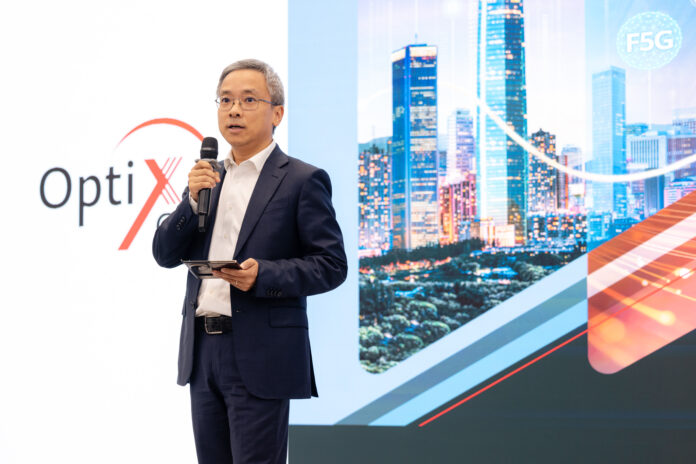
Speaking at the OptiX Club 2026 event in Johannesburg on Tuesday, the technology giant brought together more than 120 customers, partners, and industry stakeholders to unpack how AI is reshaping enterprise connectivity needs.
Opening the session, York Ning, director of Huawei South Africa’s ICT marketing and solution sales department, emphasised that networks remain the backbone of the AI era.
He said that fast, reliable, and high-quality optical networks are critical to unlocking the full potential of AI technologies.
Huawei outlined four key priorities guiding its local strategy: faster backbone networks, more stable industry networks, seamless campus connectivity, and enhanced security through optical technologies.
Core layer of digital ecosystems
The company has already made progress, including deploying South Africa’s first 800G backbone network with Broadband Infraco and a 100G private power network with Eskom.
Dr Bello Moussa, CTO for Huawei Southern Africa’s enterprise government and public utility division, said fibre infrastructure is increasingly becoming the core layer of digital ecosystems.
He described F5G Advanced as the next phase of fixed-network evolution, enabling lower latency, improved reliability, and broader application across industries.
Huawei believes fibre is no longer just a data pipe but a platform that supports advanced services and scalable AI capabilities.
This includes its “one fibre, one network, one smart home” model, designed to integrate connectivity with user experience and service delivery.
The company also highlighted how AI is transforming network economics. According to Huawei solution architect Skyler Wang, the next wave of growth for internet service providers will focus less on speed packages and more on delivering intelligent, consistent user experiences.
In campus environments, Huawei is pushing its Fibre-to-the-Office (FTTO) and Intelligent FTTO solutions, combining fibre, Wi-Fi 7 and digital platforms to improve operations across sectors such as education, healthcare and hospitality.
Fibre sensing capabilities
At the infrastructure level, Huawei stressed the importance of high-capacity optical transport networks.
Solution architect Alwin Yin noted that industries such as energy, rail, and government require greater bandwidth to support mission-critical services.
Beyond connectivity, Huawei demonstrated fibre sensing capabilities that can detect faults and disruptions in real time, potentially reducing costly downtime.
Customer case studies were also featured, including local internet provider Net Nine Nine, which is using Huawei technology to expand fibre access in underserved township communities.
As AI adoption accelerates globally, Huawei’s message is clear: future-ready networks will need to be intelligent, scalable, and built on robust optical foundations to meet growing demand.
- Huawei emphasized that AI-ready optical networks are crucial for supporting the rapid growth of AI and data-heavy applications, warning traditional infrastructure may fall short.
- The company highlighted four priorities in South Africa: faster backbone networks, more stable industry networks, seamless campus connectivity, and enhanced security through optical technologies.
- Huawei has made significant progress locally, deploying South Africa’s first 800G backbone network and a 100G private network with major partners like Broadband Infraco and Eskom.
- The firm promotes fibre infrastructure as a foundational digital ecosystem layer, introducing models like “one fibre, one network, one smart home” and solutions such as Fibre-to-the-Office combined with Wi-Fi 7.
- Huawei showcased advanced capabilities like fibre sensing for real-time fault detection and stressed the need for intelligent, scalable networks to meet future AI-driven demands.


