


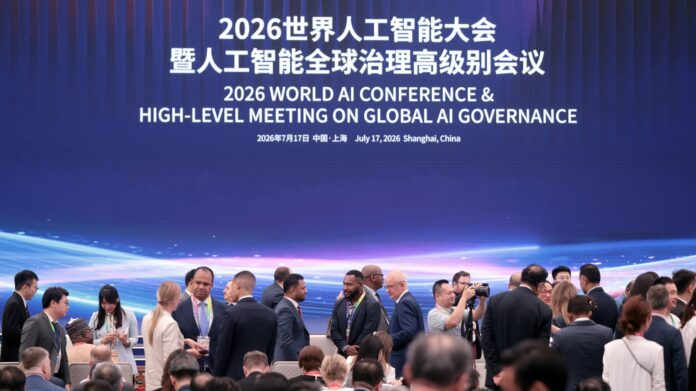
Artificial intelligence has spent the past three years chasing increasingly powerful models. A walk through the exhibition halls at the 2026 World Artificial Intelligence Conference (WAIC) in Shanghai makes it clear that the industry’s priorities are changing.
The largest crowds gather around humanoid robots and the latest foundation models. But across the exhibition halls and forums, the conversation has broadened. AI agents capable of completing complex tasks, embodied intelligence, computing infrastructure, scientific applications and AI governance have emerged as recurring themes. Together, they point to a broader transition: AI is moving from demonstrating what models can do to deploying them in the real world.
China is using this year’s conference, which runs from July 17 to 20, to showcase the transition. Alongside new technologies, it is emphasising industrial applications, open collaboration and international governance. On the eve of WAIC, representatives of 29 countries signed the Agreement on the Establishment of the World Artificial Intelligence Cooperation Organisation in Shanghai, reflecting growing efforts to coordinate AI development as the technology becomes increasingly capable.
More than any individual product launch, that shift defines this year’s conference.
From large models to AI agents
Perhaps the biggest change at WAIC this year is that AI is no longer being presented primarily as a chatbot. Instead, AI agents appear throughout the conference, with forum discussions and exhibition demonstrations increasingly focusing on systems capable of planning, reasoning and completing multi-step tasks with limited human intervention.
The emphasis marks an important shift for the industry. During the generative AI boom, progress was largely measured by benchmark scores and conversational ability. Increasingly, developers are asking a different question: Can AI independently complete useful work? That shift — from answering questions to accomplishing tasks — runs through much of this year’s conference and leads to the next frontier: bringing AI into the physical world.
From the digital world to the physical world
Humanoid robots remain among WAIC’s most popular attractions but the demonstrations themselves tell a different story from previous years. Rather than simply showcasing robots that can walk or dance, exhibitors are increasingly emphasising machines capable of perceiving their surroundings, manipulating objects and collaborating with people in factories, warehouses and other real-world environments.
That evolution reflects the growing importance of embodied intelligence. It also reflects China’s approach to AI development. Rather than treating robotics solely as a research challenge, many demonstrations focus on industrial deployment, highlighting how AI can be integrated into manufacturing, logistics and other sectors where China has significant industrial strengths.
Together, AI agents and embodied intelligence suggest that the industry’s ambitions now extend well beyond digital assistants. Bringing AI into the real world, however, also requires something less visible: computing infrastructure.
From models to computing infrastructure
While robots and AI agents attract the headlines, another thread runs through many of the discussions at WAIC: computing infrastructure. Several forums focus on AI chips, intelligent computing centres and inference systems, reflecting growing recognition that increasingly autonomous AI requires a different kind of computing foundation.
The challenge is no longer simply training larger models. AI agents must continuously reason, robots must respond in real time and scientific AI demands enormous computing resources. The requirements are shifting attention toward computing efficiency, scalable infrastructure and inference capabilities — technologies that receive far less public attention than foundation models but increasingly determine whether advanced AI can be deployed at scale.
That infrastructure is enabling what may be the conference’s most significant transition: moving AI from demonstrations to deployment.
From demonstrations to deployment
Perhaps the strongest signal emerging from WAIC is not a single technology but where AI is being applied. Across WAIC, discussions increasingly focus on scientific computing, healthcare, manufacturing and industrial design, illustrating how AI is moving beyond consumer-facing applications into fields where it can improve productivity and accelerate research.
The emphasis also aligns with China’s priorities. Rather than presenting AI as a tool for generating text or images, many exhibitors frame it as a technology for upgrading manufacturing, advancing scientific research and supporting the real economy. In other words, the industry’s attention is shifting from what AI can generate to where AI can deliver value.
As AI becomes embedded in more critical systems, however, deployment raises another challenge: ensuring these increasingly capable technologies remain trustworthy.
Innovation and governance
The more capable AI becomes, the more frequently governance appears in the conversation. The theme extends well beyond policy forums. As AI agents interact with software platforms, robots operate in physical environments and AI systems become integrated across industries, questions surrounding data security, digital identity, privacy protection and system reliability become practical rather than theoretical.
China has increasingly positioned WAIC as a venue for discussing technological innovation and international AI governance. The signing of the agreement establishing the World Artificial Intelligence Cooperation Organisation reflects that ambition.
Xiao Qinghai, the chief technology officer of Fisherman Info, said deeper integration among AI models, computing platforms and application services would require stronger safeguards throughout the AI life cycle. Technologies that protected sensitive data, verified digital identities and improved the trustworthiness of AI systems, he said, would become increasingly important as AI deployment accelerated.
Beyond the next model
Every major AI conference captures a snapshot of where the technology stands but WAIC 2026 offers something more.
Rather than focusing on a single breakthrough, this year’s conference reveals an industry entering a new phase in which success is increasingly measured not by the size of a model but by whether AI can be deployed safely, efficiently and at scale. The shift is visible throughout WAIC, from AI agents and embodied intelligence to computing infrastructure, industrial applications and international governance.
Taken together, the developments suggest that the next chapter of artificial intelligence will be defined less by building ever-larger models than by integrating AI into the real world.
- The 2026 World Artificial Intelligence Conference (WAIC) in Shanghai highlights a shift from focusing on powerful AI models to deploying AI in practical, real-world applications.
- Key themes include AI agents capable of completing complex tasks independently, embodied intelligence in robotics for industrial use, and enhanced computing infrastructure to support AI deployment.
- China emphasizes industrial applications, open international collaboration, and AI governance, marked by the signing of the World Artificial Intelligence Cooperation Organisation agreement by 29 countries.
- The conference showcases AI integration into sectors like manufacturing, scientific research, and healthcare, signaling a move beyond consumer-facing AI towards improving productivity and advancing the real economy.
- Governance and trustworthiness of AI systems gain prominence alongside technological innovation, addressing data security, privacy, and reliability as AI becomes embedded in critical systems.


