


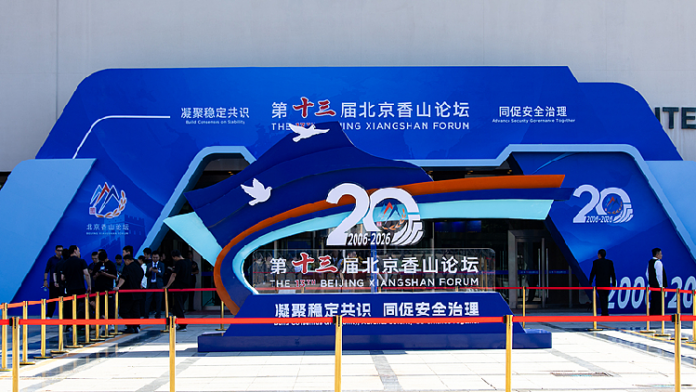
Chinese Minister of National Defence Dong Jun called for joint efforts to address common security challenges as an international security forum concluded on Thursday.
Dong made the remarks during separate meetings in Beijing with defence officials from the Democratic People’s Republic of Korea, Mauritania, Gabon and Somalia, who attended the 13th Beijing Xiangshan Forum.
Nearly 2,000 official representatives, scholars and observers from more than 100 countries, regions and international organizations gathered from Tuesday to Thursday for the forum.
READ: Turkish FM says newly signed trilateral defence deal not aimed at Iran
Dong stressed that in the current interdependent world, the deeper cooperation among countries, the safer the world will be, pledging that the Chinese military is willing to contribute to safeguarding international fairness and justice, as well as global peace and stability.
“We should bear in mind the security and well-being of all humanity, respect one another, and enhance exchanges and mutual learning, while working to make the international security order more just and equitable,” he noted.
Themed “Build Consensus on Stability, Advance Security Governance Together, this year’s forum marks the 20th anniversary of the Beijing Xiangshan Forum, which was launched in 2006 as a “track-two” think-tank exchange.
The participants held in-depth discussions on a range of issues, including the trend toward a multipolar world and the international order, major-country relations and strategic stability, sea lane security and maritime security governance, and risks and regulation surrounding the military application of emerging technologies.
Many participants believed multilateralism, which the forum has emphasised, gives more countries a greater role in shaping security governance while taking broader security concerns into account, aligning with the Global Governance Initiative (GGI) proposed by China in 2025.
Carlos Branco, a researcher at Universidade Autonoma in Lisbon and a retired major general of Portugal, said the GGI rests on five principles: adhering to sovereign equality, abiding by international rule of law, practising multilateralism, advocating the people-centred approach, and focusing on taking real actions.
READ: WATCH | Bombed Iranian school becomes memorial for the children killed
“It shows that China’s policy is to uphold the existing international order centred on the UN,” Branco told Xinhua.
Senior Colonel Zhang Chi of China’s National Defence University said the forum has created opportunities for countries and regions to engage on an equal footing.
“On this platform, representatives can engage in equal dialogue and seek common ground while setting aside differences, helping build an important consensus around stability,” Zhang said.
“Given the current international environment, we particularly need to build consensus for stability, as security and stability are the common aspirations of the international community,” said Li Shuyin, director of the Beijing Xiangshan Forum Secretariat Office.
The Beijing Xiangshan Forum seeks to resolve differences and promote cooperation through dialogue, Li said, adding that the forum has become an international public security good provided by China and shared by the world, and an important platform for advancing cooperation under the Global Security Initiative.
- Chinese Minister of National Defence Dong Jun called for joint efforts to address common security challenges during the 13th Beijing Xiangshan Forum.
- Nearly 2,000 representatives from over 100 countries, regions, and international organizations attended the forum held from Tuesday to Thursday.
- The forum, marking its 20th anniversary, focused on topics including multipolarity, international order, strategic stability, maritime security, and military applications of emerging technologies.
- Participants emphasized multilateralism and alignment with China's proposed Global Governance Initiative (GGI) for 2025, based on five key principles.
- The Beijing Xiangshan Forum aims to promote dialogue, resolve differences, and advance global security cooperation under the Global Security Initiative.


