


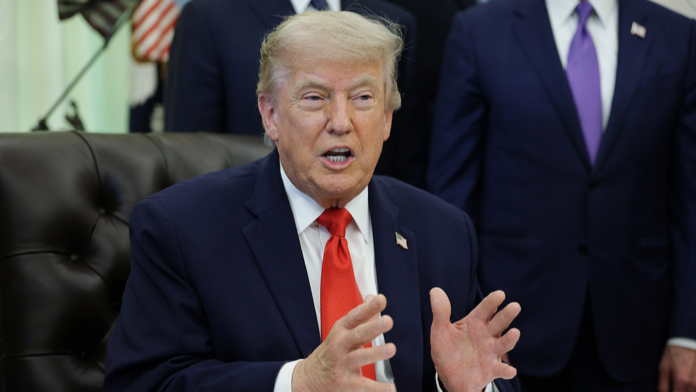
US President Donald Trump said on Sunday that negotiations with Iran would begin Monday afternoon, noting that Saudi Arabia, the United Arab Emirates (UAE) and Qatar had asked the United States to call off planned strikes because “they think there’s a deal”.
“There’s a deal on (the Strait of) Hormuz, and then there will be a deal on the nuclear, or you might call it the denuclearisation of Iran,” Trump told reporters on Air Force One en route to Joint Base Andrews in Maryland.
Trump did not provide details of where negotiations would take place or who would be involved.
Asked if there was a deadline for Iran to come to an agreement, Trump said in response: “Would I rather make a deal? I’m not looking to kill people because people die, a lot of people die, and we don’t want that.”
Oil prices fell on Monday in early Asia trade after Trump announced the new negotiations, with West Texas Intermediate dropping 4.7% to $80.72 per barrel.
Iran said it was nearing a deal with Oman over a new route through the strait, where a tanker reported an explosion nearby on Sunday, underscoring the continued volatility of the strategic waterway.
Iran-Oman deal on path of being finalised
Iranian Foreign Minister Seyed Abbas Araghchi said during a cabinet meeting on Sunday that negotiations between Iran and Oman on the Strait of Hormuz have progressed and are on the path of being finalised.
Elaborating on the Iran-Oman talks in an interview with state-run IRIB TV, Iranian foreign ministry spokesman Esmaeil Baghaei stressed that reaching an agreement between the two countries is not related to the waterway’s reopening or continued closure.
Baghaei said Iran and Oman are working to designate a “new route” in the strait within a traffic separation scheme format that can ensure both sides’ sovereign rights as well as Iran’s national interests and security.
Baghaei added that Iran-Oman negotiations had “no link to the Strait of Hormuz being opened or closed. That is a separate discussion.” Maritime trade tracking firm Kpler said Friday that traffic through Hormuz had dropped sharply.
On Sunday, a tanker off the coast of Oman reported hearing an explosion near the vessel, the United Kingdom Maritime Trade Operations (UKMTO) Centre reported, adding that the vessel and crew were all safe.
‘Exchange of views’
Iranian lawmaker Hassan Ghashghavi, spokesman for the parliament’s national security commission, said on Sunday that mediators were trying to revive the US-Iran memorandum of understanding that was agreed in June.
That agreement was not intended as a final peace deal, but as a stepping stone to negotiations on a comprehensive agreement, though it did include provisions on Hormuz.
“They know that the main issue and, in fact, the key to the matter right now is the issue of the Strait of Hormuz, so yes, there is an exchange of views,” Ghashghavi said.
Posting on X, Iranian President Masoud Pezeshkian said: “We must strive to compel the enemy to adhere to what it has signed. The security of the country, region and our allies will improve with this MoU.”
On June 18, Iran and the United States signed a memorandum of understanding, under which they were scheduled to hold negotiations within a 60-day period to reach a final agreement. However, the talks’ fate hangs in the balance due to heightened tensions and recent military confrontation between the two countries.
- US President Trump announced Iran-US negotiations to begin Monday, influenced by regional requests from Saudi Arabia, UAE, and Qatar to pause planned strikes.
- Discussions focus on a deal concerning the Strait of Hormuz and Iran's nuclear program, with no specifics on location or participants disclosed.
- Iran is close to finalizing a maritime agreement with Oman on a new route through the Strait of Hormuz, aiming to protect sovereignty and security without impacting waterway status.
- Iranian parliamentary officials noted efforts to revive the June memorandum of understanding with the US, seen as a foundation for broader future agreements.
- An explosion near an Oman coast tanker highlights ongoing instability, while oil prices dropped following the announcement of renewed negotiations.


