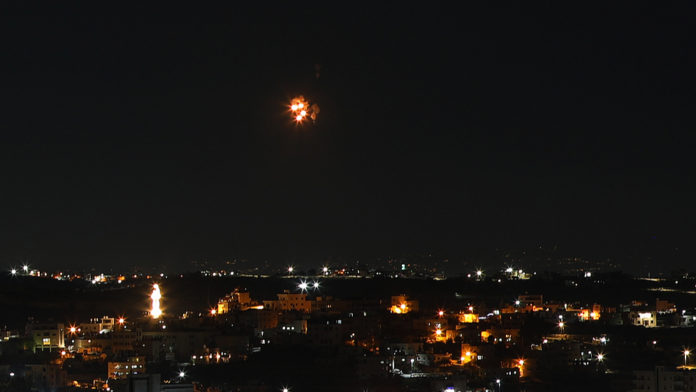
The massive US-Israeli strikes, which have killed Iran’s Supreme Leader Ayatollah Ali Khamenei, entered a third day on Monday.
The Israeli military said it launched “large-scale strikes” on Tehran on Monday after Iran’s Islamic Revolutionary Guard Corps (IRGC) launched the ninth wave of its operation, targeting US military assets across the Middle East.
The IRGC claimed it had targeted the US aircraft carrier USS Abraham Lincoln, but the Pentagon said the “missiles launched didn’t even come close”.
Iran’s retaliatory attacks took their toll. The Pentagon said that three US service members have been killed and five seriously wounded in the US operation against Iran.
Two US officials, speaking on condition of anonymity, told Reuters the US service members were killed on a base in Kuwait.
Trump predicts four-week operation
US President Donald Trump said the US operations “will continue until all of our objectives are achieved; we have very strong objectives” in a six-minute video message on Truth Social, without specifying what the objectives are.
Trump said 48 senior Iranian officials have been killed in the operation, and the US forces have sunk nine Iranian warships and largely destroyed Iran’s navy headquarters.
As for the death of US service members—the first casualties of his second term—Trump said of the possibility of more US casualties: “That’s the way it is”.
In an exclusive phone interview with Britain’s Daily Mail, Trump said the military strike against Iran will take four weeks.
“It’s always been a four-week process. We figured it will be four weeks or so. It’s always been about a four-week process, so—as strong as it is, it’s a big country, it’ll take four weeks—or less,” the British newspaper quoted Trump as saying.
In another interview with The Atlantic magazine on Sunday, Trump said Iran’s new leadership wanted to talk to him and that he has agreed.
“They want to talk, and I have agreed to talk, so I will be talking to them. They should have done it sooner. They waited too long,” Trump was quoted as saying.
The US military expanded targets across Iran on Sunday and said it destroyed the headquarters of the IRGC.
Iran stresses right to defend itself
Iranian Foreign Minister Seyed Abbas Araghchi told ABC News on Sunday that no country’s leader has the right to tell Iran not to respond to the ongoing US-Israeli massive strikes on Iran, in response to Trump’s earlier warning that Iran should not retaliate.
Araghchi said Iran has every right to defend itself, and the Iranian forces “are capable enough to defend our country”.
Iranian President Masoud Pezeshkian said on Sunday that “Iran considers it its legitimate duty and right to avenge the perpetrators”.
On the same day, Ali Larijani, the powerful head of Iran’s Supreme National Security Council, warned that “today we will hit them with a force that they have never experienced before”.
In Israel, an Iranian missile attack killed at least nine people and injured dozens more in the central city of Beit Shemesh on Sunday, after a death the previous day near Tel Aviv.
Three people were also injured on one of the main roads of Jerusalem.
A transitional leadership council composed of Pezeshkian, the head of the judiciary, and a member of the powerful Guardian Council had temporarily assumed the duties of supreme leader following the killing of Khamenei while a permanent successor is found for the supreme leader.
Reactions from US and its allies
Back in the US, Hakeem Jeffries, the top Democrat in the House of Representatives, said the deaths of the US servicemen were the result of a “reckless decision” and that there was no threat to “justify this type of preemptive military strikes”.
A Reuters/Ipsos poll that concluded on Sunday showed 27% of Americans approved of the strikes, while 43% of the respondents disapproved and 29% were not sure.
About nine in 10 respondents said they had heard at least a little about the strikes.
The UK, France, and Germany have issued a joint statement, saying they will take steps to defend their interests and those of their allies in the region, potentially through enabling necessary and proportionate defensive action to destroy Iran’s capability to fire missiles and drones at their source.
The US and its Arab allies, including Bahrain, Kuwait, Saudi Arabia, and the United Arab Emirates, on Sunday condemned Iran for launching a wave of retaliatory strikes on Gulf states hosting US troops in a joint statement.
“The targeting of civilians and of countries not engaged in hostilities is reckless and destabilising behaviour,” said the statement.
As the clashes entered a third day, experts are increasingly concerned that the situation could spiral into a broader crisis.
Li Zixin, assistant research fellow at the China Institute of International Studies, told CMG that the current conflict between the US, Israel, and Iran is likely to escalate, with the potential for regional instability and widespread consequences.
Li highlighted the ongoing retaliation from Iran on US military assets in the region as evidence of the conflict evolving into a “multilateral crisis”, threatening the broader regional security framework.
Zhou Dewu, a former deputy editor-in-chief of Ta Kung Pao, told CGTN that if the next Iranian leader is unwilling to reconcile and prefers to engage in asymmetric “terrorist tactics” to drag the US into a prolonged struggle, it would be akin to opening Pandora’s box, and a new wave of terrorism could be imminent.
Zhou also noted the strategic importance of the Strait of Hormuz, stating that its closure could disrupt one-fifth of global oil shipments, causing a surge in oil prices and fueling US inflation.
He suggested that rising oil prices could potentially trigger anti-war sentiments within the US.