


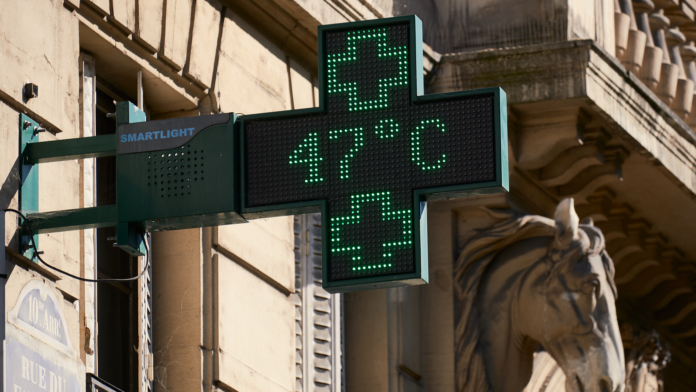
Europe is experiencing a summer of unprecedented heat.
The EU’s Copernicus Climate Change Service reported that Western Europe recently experienced its hottest June on record. In the UK, the Met Office said the country had recorded eight days with temperatures above 34ºC this year, surpassing the previous annual record.
Extreme heat is no longer an occasional weather event. It is becoming a growing challenge for public health, urban infrastructure and daily life.
As temperatures rise, one demand is increasing rapidly: cooling.
A hotter world is driving demand for cooling
For decades, many European homes relied on natural ventilation and building designs suited to colder climates rather than widespread air conditioning. But repeated heatwaves are changing attitudes.
This summer, demand for cooling equipment has increased across Europe. A China-Europe freight train departing Guangzhou, Guangdong Province, south China, recently carried 55 containers of air conditioners and household appliances to Poland and other European destinations. Between April and June, more than 100 000 portable air conditioners and related components were shipped via the China-Europe Railway Express.
The trend reflects a wider global reality: as the planet warms, cooling is increasingly becoming part of climate adaptation.
But it also raises a difficult question: Does using more air conditioners undermine climate goals?
The problem is not cooling itself but how cooling is provided
Air conditioning has long been criticised for its environmental impact. The concerns are real: Cooling requires electricity. Older refrigerants could contribute significantly to global warming if they leak.
However, international organisations argue that the debate is more complicated.
The United Nations Environment Programme says cooling is essential for human health, food security, economic productivity and climate resilience. Its report Keeping Cool: A Global Cooling Watch Report emphasises that the challenge is not eliminating cooling but making it sustainable.
The International Energy Agency has also warned that global demand for air conditioning will continue to rise as temperatures increase. Without efficiency improvements, cooling-related electricity demand could surge dramatically. But with high-efficiency technologies, cleaner power systems and better building design, emissions can be significantly reduced.
In other words, the environmental impact of air conditioning depends largely on energy sources, equipment efficiency and refrigerant management, rather than simply whether people use air conditioners.
From air conditioning to sustainable cooling
Countries are increasingly exploring ways to make cooling cleaner and more sustainable.
Modern inverter air conditioners can significantly reduce electricity consumption compared with older models, while newer refrigerants such as R-32 and R-290 have much lower global warming potential than many refrigerants used in previous generations.
Beyond individual appliances, countries are also integrating renewable energy, energy storage and smart cooling systems into buildings and urban infrastructure. In places including China, rooftop solar power is being combined with efficient cooling technologies to reduce emissions. Since cooling demand often peaks during sunny and hot periods, solar-powered cooling offers a promising way to align renewable energy generation with rising electricity needs.
Cooling is also a public health issue
The debate over air conditioning is not only about energy — it is also about protecting people.
The World Health Organisation has identified extreme heat as a major climate-related health risk, particularly for older people, children and those with health conditions.
As heatwaves become more frequent, many experts argue that access to cooling should be viewed as part of climate resilience, alongside heat warning systems, urban greening and better building design.
The future challenge is therefore not simply choosing between using air conditioning and protecting the environment.
The real task is creating a new model of sustainable cooling — one that allows societies to stay safe in a warmer world while reducing emissions.
As Europe and the rest of the world adapt to rising temperatures, cooling may no longer be seen as the opposite of climate action. With cleaner energy and smarter technologies, it could become part of the solution.
- Europe is experiencing unprecedented summer heat, with Western Europe recording its hottest June ever and the UK breaking temperature records.
- Rising temperatures have led to a rapid increase in demand for cooling equipment, including air conditioners, with large shipments coming from China to Europe.
- Air conditioning's environmental impact depends largely on the energy sources used, equipment efficiency, and refrigerant management, rather than the mere use of air conditioners.
- Sustainable cooling solutions are being adopted, such as inverter air conditioners, low-global-warming-potential refrigerants, and integrating renewable energy like solar power into cooling systems.
- Access to cooling is crucial for public health amid heatwaves, and sustainable cooling is increasingly viewed as essential for climate resilience, balancing human safety and emissions reduction.


