


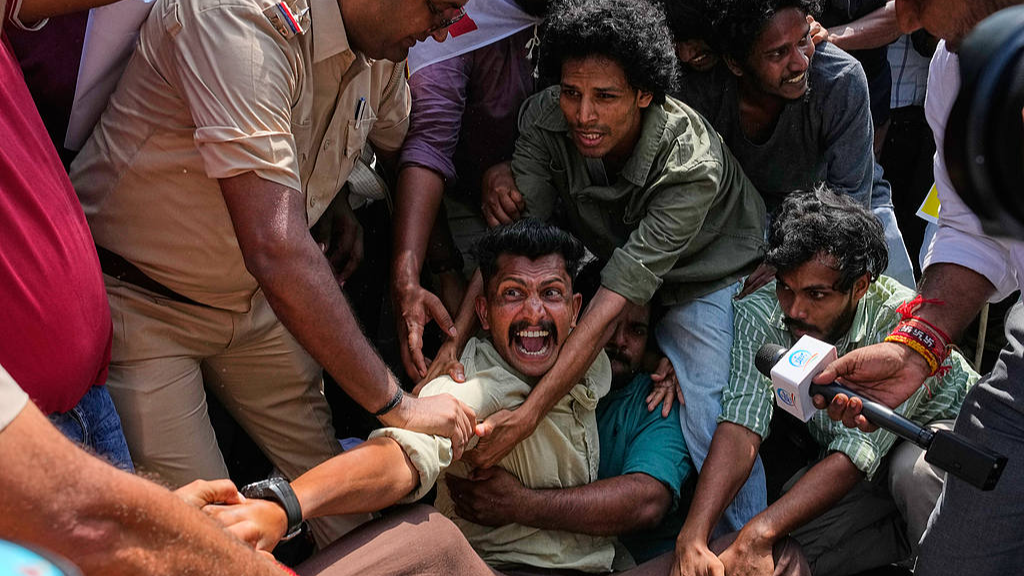
Indian police detained more than 2 000 protesters and the founder of a youth-led movement in New Delhi on Saturday as authorities imposed sweeping security restrictions to prevent a demonstration demanding the resignation of the country’s top election official, Reuters reported.
Thousands of police and paramilitary personnel were deployed across the capital, mobile internet services were suspended in the central business district, and dozens of metro stations and markets were closed before the planned rally organised by the Cockroach Janta Party (CJP), an unregistered youth-led political movement, also known as the “Cockroach” movement.
The protest targeted Chief Election Commissioner Gyanesh Kumar over a revision of voter lists that critics say disproportionately benefits Prime Minister Narendra Modi’s ruling Bharatiya Janata Party (BJP).
The movement had planned to gather thousands of people at Jantar Mantar in central Delhi, but security forces sealed off the area before the demonstration began.
Local media reported that about 400 protesters were detained in India’s financial hub, Mumbai, and that CJP founder Abhijeet Dipke and other key leaders (including Saurav Das and Ashutosh Ranka) were intercepted and detained directly from their flights upon landing in New Delhi. Police did not immediately comment on the detentions.
UN Human Rights spokesperson Thameen Al-Kheetan urged Indian authorities to engage in “meaningful dialogue” to address the “broadly held” concerns expressed.
The Indian mission to the UN in Geneva said in a statement that the Indian Constitution guarantees citizens the right to peaceful assembly. However, it stressed that citizens should exercise this right “subject to reasonable restrictions in the interest of public order.”
Voter-list revisions spark allegations of disenfranchisement
The protests centre on a major revision of India’s electoral rolls that has intensified scrutiny of the country’s election administration.
The Election Commission has said the revisions aim to remove duplicate, false and outdated entries, including those associated with deceased voters or people who have moved. However, critics say the process has been opaque and risks excluding large numbers of eligible voters.
Reports indicate that around 130 million names were removed during the exercise, affecting roughly a tenth of the electorate. The Election Commission has said eligible voters whose names were wrongly deleted can re-enroll.
Critics have also raised concerns about stricter requirements for Form 6, which is used to apply for new voter registration or certain changes to voter records. They argue that young adults registering for the first time, people who have recently moved and migrant workers may struggle to provide extensive supporting documents, including records linked to their parents’ past registrations.
Opposition parties allege that the changes have disproportionately affected voters critical of the Modi government and may have influenced recent state election results won by the BJP, casting a shadow over electoral integrity in the world’s largest democracy.
Kumar has not publicly commented on the allegations. The Election Commission and the BJP have denied wrongdoing, maintaining that the revisions are intended to improve the accuracy of voter lists.
The BJP has attributed its electoral success to Modi’s popularity and India’s economic growth, accusing opposition parties of spreading misinformation.
High unemployment rate among young people
The near-daily protests come just months after demonstrations over exam paper leaks forced his education minister to quit. It also comes before important state elections beginning in early 2027.
The movement includes the CJP, student organisations such as the National Students’ Union of India (NSUI), and opposition figures associated with the Indian National Congress, commonly known as the Congress party.
The name “CJP” emerged from an online response to a remark by India’s Chief Justice Surya Kant, who compared some unemployed young people to “cockroaches” and “parasites”. The movement adopted the label as a form of self-mockery and turned it into a vehicle for youth mobilisation.
In July, the CJP rallied to protest over alleged examination paper leaks, culminating in the resignation of Education Minister Dharmendra Pradhan.
The movement also comes amid high youth unemployment.
The State of Working India 2026 report by Azim Premji University found that unemployment among graduates aged 15 to 25 was nearly 40%. Also, around 25% of Indians aged 15 to 29 were not in education, employment or training, according to India’s Periodic Labour Force Survey Annual Report 2025.
Analysts have pointed to a mismatch between India’s expanding pool of educated young people and the availability of suitable jobs. While sectors such as information technology have generated significant wealth, critics argue that the country has not created enough employment opportunities, particularly in manufacturing, to absorb its growing workforce.
Against this backdrop, the voter-list controversy has become a focal point for wider concerns among young people about political representation, economic opportunity and the responsiveness of public institutions.
A political analyst quoted in local coverage commented that the government should suspend the disputed revision process immediately and make it more transparent to help restore public confidence in the electoral system.
- Indian police detained more than 2,000 protesters and Cockroach Janta Party (CJP) founder Abhijeet Dipke in New Delhi ahead of a planned rally demanding the resignation of Chief Election Commissioner Gyanesh Kumar.
- Authorities imposed extensive security measures by deploying thousands of police and paramilitary personnel, suspending mobile internet in central business districts, and closing metro stations and markets.
- The protest targeted alleged voter list revisions said to disproportionately benefit Prime Minister Narendra Modi's Bharatiya Janata Party (BJP), with around 130 million names removed during the exercise.
- Critics argue that stricter requirements for voter registration documents have disenfranchised young adults, migrants, and recently moved individuals, raising concerns over electoral integrity.
- The youth-led movement, including CJP and student organisations, emerged amid high unemployment rates among young Indians, with nearly 40% unemployment for graduates aged 15 to 25.


