


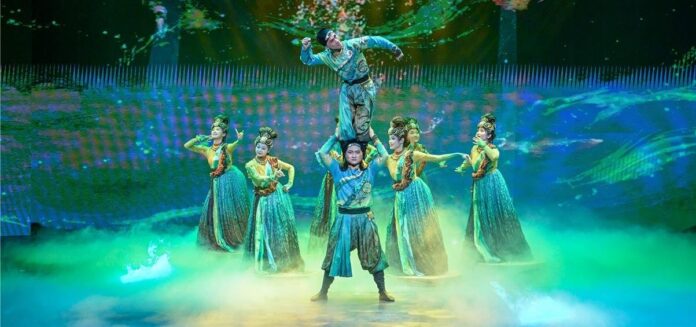
The applause may still echo inside auditoriums, but China’s performing arts companies are increasingly finding new audiences far beyond theatre walls.
Across the country, dance troupes, opera companies and performing arts groups are embracing livestreaming platforms to bring their productions directly to viewers’ smartphones. What began as an experiment in digital engagement has grown into a booming sector, creating new opportunities for performers while introducing traditional art forms to millions of people who may never set foot inside a theatre.
At Guangzhou Song and Dance Theatre in Guangdong Province, dancers now perform not only for audiences seated in front of them, but also for thousands watching online. Viewers respond instantly through comments, emojis and virtual gifts, turning performances into interactive experiences that blur the line between stage and audience.
For dancer He Mu, the digital stage became a lifeline.
A second chance in the spotlight
After suffering a serious knee injury in 2025, He feared her performing career might be paused indefinitely. Having spent more than two decades on stage, the prospect of stepping away from dance was difficult to accept.
When her theatre launched a livestreaming programme, however, she found a new way to connect with audiences.
The transition was not easy. Accustomed to performing for audiences seated at a distance, He had little experience working in front of cameras or interacting with viewers online. Initially armed with only a few Dunhuang-inspired dance routines, she entered the livestream studio unsure of what to expect.
What followed surprised her.
Viewers responded enthusiastically, encouraging her to experiment and improvise. Freed from the strict choreography of traditional performances, He discovered a more intimate and spontaneous form of artistic expression.
“The viewers were incredibly enthusiastic,” she recalled.
Tradition finds new life online
The growing popularity of arts livestreaming is helping traditional Chinese culture reach a new generation.
One example is Poetic Dance: The Journey of a Legendary Landscape Painting, a celebrated production inspired by a 900-year-old Chinese landscape scroll. During one livestream, a simple turn of a dancer’s face toward the camera captivated viewers, helping attract tens of thousands of online audience members within minutes.
Lead performer Meng Qingyang believes livestreaming offers a practical way for modern audiences to experience the arts.
“Attending the theatre requires planning and travel,” she said. “Livestreaming allows people to enjoy performances whenever they have a spare moment.”
Yet the appeal goes beyond convenience.
The production’s visual language, inspired by classical Chinese paintings, reflects cultural values rooted in restraint, simplicity and harmony. For many viewers, these performances offer a connection to China’s artistic heritage.
One Beijing resident, unable to secure a ticket to see Poetic Dance, watched online instead.
“We Chinese people come from landscapes like these,” she said.
Young audiences reconnecting with culture
According to Li Mingchong, a researcher at the Guangzhou Academy of Social Sciences, livestreaming is part of a broader cultural shift among younger Chinese audiences.
Raised during a period of increasing prosperity and global engagement, many young people are simultaneously embracing international influences while rediscovering traditional cultural forms.
Digital platforms are proving effective at bridging those worlds, allowing centuries-old art forms to thrive in modern spaces.
The numbers reflect that growing demand.
According to the China Association of Performing Arts, livestreams featuring multiple performers generated more than 15 billion yuan (about $2.1 billion) in revenue during 2025.
By June 2026, 57 professional performing arts troupes were running regular livestream programmes on Douyin, China’s version of TikTok. Together, they had conducted more than 16 000 broadcasts, attracting around 320-million views.
Reinventing performance for the phone screen
Success online has required more than simply pointing a camera at the stage.
When Shaanxi Song and Dance Theatre in Xi’an first began livestreaming its productions, audience engagement was disappointingly low. Viewers often left after only a few minutes.
Livestream manager Huang Xiaoyu quickly realised that performances designed for large theatres do not always translate well to small screens.
Professional arts organisations have since adapted choreography, costumes, lighting and music to suit vertical smartphone viewing. Close-up camera angles highlight facial expressions and emotions that would otherwise be lost in traditional theatre settings.
The transition has also challenged performers.
“At first, I was so nervous that my face literally twitched while I was dancing,” said Shaanxi dancer Wang Lan.
Over time, practice and audience encouragement helped her gain confidence on the digital stage.
Expanding careers and revitalising theatres
The rise of livestreaming is creating opportunities beyond performance itself.
Demand is growing for livestream directors, camera operators, composers and production specialists capable of blending artistic presentation with digital broadcasting.
Performing arts companies are also using livestreams to build relationships with audiences between shows through behind-the-scenes content, artist discussions and educational features.
Importantly, online success is translating into real-world ticket sales.
An opera and dance ensemble in Jiangsu Province recorded more than one million impressions per broadcast within weeks of launching its livestream programme. During the May Day holiday period, the increased online visibility helped sell out theatre performances.
The stage has grown larger
For He Mu, livestreaming represents more than a technological innovation or a new revenue stream.
Many viewers now return regularly, asking questions about performances, discussing artistic details and even checking on her recovery when her knee pain flares up.
The connections have inspired her to create and share work of her own, expanding her artistic journey in unexpected ways.
Although she still dreams of returning fully to the theatre, she no longer sees livestreaming as a substitute for the stage.
Instead, she views it as an extension of it.
“The stage has not disappeared,” she said. “It has simply expanded.”
- Performing arts companies in China are increasingly using livestreaming platforms to reach viewers beyond traditional theatre audiences, transforming performances into interactive online experiences.
- Dancer He Mu, after a serious knee injury in 2025, found new opportunities through livestreaming, allowing her to engage with audiences and explore more spontaneous artistic expression.
- Livestreaming has helped traditional Chinese cultural performances, such as "Poetic Dance: The Journey of a Legendary Landscape Painting," reach large online audiences and connect younger viewers with heritage arts.
- By June 2026, 57 professional performing arts troupes on Douyin had conducted over 16,000 livestream broadcasts, attracting approximately 320 million views and generating significant revenue.
- Performing arts companies have adapted choreography, costumes, and production elements for smartphone viewing, boosting audience engagement and translating online popularity into increased ticket sales.


