


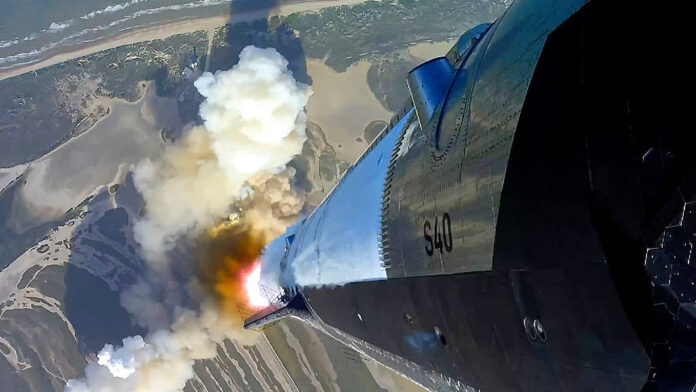
SpaceX’s Starship rocket lifted off from Texas on Friday and deployed its first 20 upgraded Starlink satellites into suborbital space, one of many testing goals in the company’s 13th test mission as it races to begin routine service with the rocket by the end of the year.
The roughly 122m Starship rocket system blasted off around 6.50pm ET (10.50 GMT) from SpaceX’s Starbase company town, with the Super Heavy first stage booster sending its Starship upper stage on a suborbital trajectory. The roughly hour-long mission will conclude with Starship’s reentry through Earth’s atmosphere and a splashdown in the Indian Ocean.
As Starship approached 26 400km/h in space some 10 minutes into its flight, the Super Heavy booster returned to Earth and impacted the Gulf of Mexico harder than expected, SpaceX said, though it had reignited more engines than its botched return in May during a previous test flight.
The Starship test flight is SpaceX’s 13th since 2023, featuring a new version of the rocket crucial to the company’s plans to expand Starlink, land humans on the moon for Nasa and eventually deploy thousands of artificial intelligence-processing satellites in orbit.
Twenty minutes into its spaceflight, Starship began deploying 20 Starlink V3 satellites, dispensing them one by one via the ship’s “Pez”-like payload deployment. Flying over a shadowed Earth, thunderstorms with flashes of lightning were visible in the background 190km below, according to a camera fixed to the rocket and streamed live by SpaceX.
A crowd of SpaceX engineers in SpaceX’s Hawthorne, California, facilities could be heard on the live stream cheering at the rocket’s mission milestones, at one point chanting “USA”.
While in space, the Starlink satellites — a new “V3” version with greater bandwidth capabilities — will deploy solar arrays and antennae to briefly connect with SpaceX’s Starlink network of some 10 000 satellites orbiting above.
The Starlinks are the first to be deployed by Starship, though they will follow the ship’s suborbital trajectory into Earth’s atmosphere and burn up.
Some of them have spotlights and cameras that will record Starship’s heat shield as it hits intense atmospheric friction later in the mission, giving SpaceX key testing insight into how well the rocket survives its return from space.
SpaceX plans to use Starship by the end of 2026 to begin launching thousands of Starlink V3 satellites, expanding the constellation’s capacity to be able to connect directly to mobile devices such as cellphones. The current network connects only to Starlink-branded dishes.
- SpaceX’s Starship rocket launched from Texas, successfully deploying 20 upgraded Starlink V3 satellites into suborbital space during its 13th test mission.
- The Super Heavy booster returned to Earth but impacted the Gulf of Mexico harder than expected, despite improved engine reignition compared to a previous test flight.
- The roughly hour-long mission concluded with Starship’s reentry and splashdown in the Indian Ocean, providing crucial testing data on heat shield performance.
- The new Starlink V3 satellites have enhanced bandwidth and onboard cameras to monitor atmospheric reentry, but they will burn up along with the rocket’s suborbital path.
- SpaceX aims to routinely use Starship by the end of 2026 to launch thousands of Starlink V3 satellites, enabling direct connectivity to mobile devices beyond current dish-only connections.


