


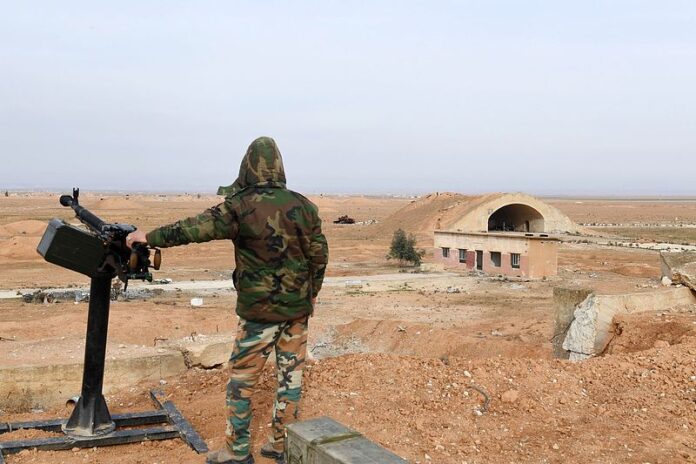
The Israel Defence Forces has fired towards a militant who was in the final stages of preparing an attack in southern Syria, citing threats to its soldiers, days after Israeli strikes on a Syrian airbase near the Turkish border, the IDF says.
The strike place as tension between Israel and Türkiye has intensified after Ankara’s request for an Interpol Red Notice against Israeli Prime Minister Benjamin Netanyahu.
Analysts view the Interpol move as a reflection of the widening rift between the two countries in recent years but see the action as largely symbolic.
Rising Türkiye-Israel tension over Syria
Türkiye has requested the issuance of an Interpol Red Notice for Netanyahu after an arrest warrant issued against him last month on a charge of “genocide”.
The Interpol request was made in connection with a Turkish criminal case over the interception of activists aboard the Global Sumud Flotilla, which set sail from Türkiye in May in a renewed attempt to break Israel’s blockade of Gaza, Turkish Justice Minister Akin Gurlek said on Friday.
The flotilla was intercepted by Israel. Those on board were subsequently deported.
The Israeli Prime Minister’s Office responded by accusing Türkiye of “hypocrisy” and referring to President Recep Tayyip Erdogan as an “anti-Semitic dictator”, saying Erdogan was seeking to extend what it called his “aggression” against Israel into Syria. The statement added that Israel would continue to act against what it described as threats to its security.
Türkiye’s Communications Directorate hit back, describing the Israeli statement targeting Erdogan as “outrageous ravings” devoid of historical fact and political seriousness.
It accused the Netanyahu government of using “cheap politics” for electoral gain and seeking to portray Türkiye as a new threat, warning that efforts to escalate tension for domestic political competition posed risks to regional and global peace and stability.
The diplomatic exchanges followed Israeli airstrikes targeting the Abu al-Duhur military airport in Idlib Province in north-western Syria, which caused material damage but no casualties, on Tuesday. The airport, a major Syrian airbase, is situated near routes linking parts of Idlib, Aleppo and Hama provinces.
Israel said the airstrike was aimed at preventing a potential Turkish military deployment at the Syrian airbase, which it said would pose a threat to its security. Ankara has denied any such deployment.
On Saturday, Israeli Defence Minister Israel Katz said in a statement that the strikes on the Syrian military airport were in response to “clear intelligence” received about Türkiye’s intentions to carry out actions there that would endanger Israel’s security.
Katz said the Israeli military had recommended several times to attack the airport, rejecting claims by the Israeli opposition that the operation was carried out for political reasons before Israel’s general elections on October 27.
Israeli Foreign Minister Gideon Sa’ar said on Saturday that while tension with Türkiye remained high over the Syrian issue, Israel had no intention of escalating tension and “always prioritises” diplomatic solutions. He said Israel would never accept Türkiye establishing a base in Syria.
Syria condemns Israel ‘in strongest terms’
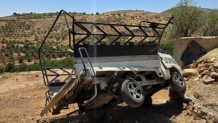
Syrian state news agency SANA reported on Saturday that a civilian was injured when an Israeli drone targeted a car in the town of Beit Jinn in south-western Damascus. The injured person was transferred to a hospital.
The report did not identify the person targeted or provide details about the circumstances surrounding the strike.
After the attack, Syria’s foreign affairs authority condemned “in the strongest terms” what it described as the Israeli occupation forces’ targeting of a civilian vehicle, saying the attack resulted in several injuries among civilians.
The authority said the attack constituted “a blatant violation” of Syria’s sovereignty and territorial integrity and a flagrant breach of international law, adding that it came amid repeated Israeli attacks on Syrian territory.
The Britain-based Syrian Observatory for Human Rights said it had documented 57 Israeli attacks on Syrian territory since the beginning of 2026, including six air attacks and 51 ground attacks.
Tension ‘largely at diplomatic, rhetorical levels’
Analysts said the deterioration of Turkish-Israeli relations was expected to remain largely at the diplomatic and rhetorical levels. Since Türkiye was a member of Nato, it seemed improbably that Israel would engage in a direct military confrontation with a Nato country.
Türkiye and Israel were major regional powers and the United States would not like to see a serious conflict between the pair, they said.
Canan Tercan, a Turkish political analyst at Istanbul Aydin University, said Israel’s concerns over Türkiye’s growing role in Syria were central to the latest tension.
“Türkiye’s presence in Syria for training purposes is entirely at the request of the Syrian government,” Tercan said, noting that Ankara had no territorial ambitions and sought to support Syria’s unitary state structure.
Tercan also linked the escalating rhetoric to Israel’s domestic political environment, saying Netanyahu faced increasing pressure before the country’s October election and might seek to maintain a hardline security narrative.
In response to Türkiye’s request for an Interpol Red Notice for Netanyahu, Tercan said the move could raise questions about the international standing of the Israeli prime minister.
“The issuance of an international Red Notice is a critically important development,” she said, questioning how a political leader sought under an international Red Notice could continue to represent Israel on the international stage.
Omer Behram Ozdemir, an analyst at Ibn Haldun University, noted that despite the military provocations, Ankara would probably maintain a strategy of restraint and focus on long-term institutional rebuilding in Syria rather than direct confrontation.
He said Israel’s strikes were intended to expand the conflict and wear down its counterparts, while Türkiye’s continued focus on rebuilding Syria’s security institutions could strengthen Ankara’s regional influence.
- The Israel Defence Forces fired at a militant in southern Syria who was preparing an attack, citing threats to Israeli soldiers.
- Türkiye requested an Interpol Red Notice for Israeli Prime Minister Benjamin Netanyahu over a Turkish criminal case related to the Global Sumud Flotilla incident.
- Israeli airstrikes targeted the Abu al-Duhur military airport in Syria to prevent a potential Turkish military deployment, which Ankara denies.
- A Syrian civilian was injured in an Israeli drone strike on a car in Beit Jinn, leading Syria to condemn the attack as a violation of its sovereignty.
- Analysts believe the Türkiye-Israel tensions will mainly remain at diplomatic and rhetorical levels due to NATO membership and regional dynamics.


