


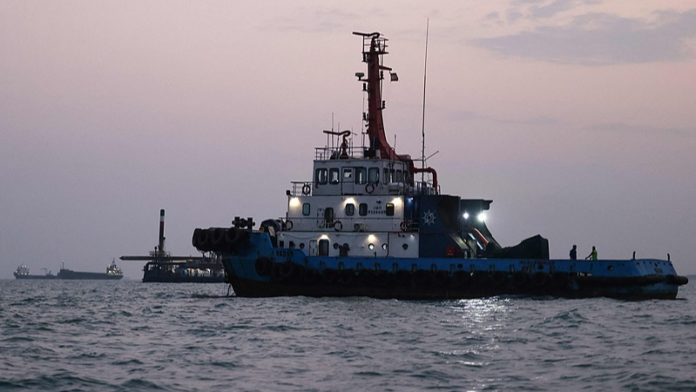
Iran launched retaliatory strikes on three oil tankers after US attacks on three Iranian tankers earlier on Saturday, with the confrontation over the Strait of Hormuz intensifying in the latest exchange of fire since renewed hostilities flared up between the two sides last week.
The navy of Iran’s Islamic Revolution Guard Corps (IRGC) said on Saturday that it had targeted three oil tankers in the Strait of Hormuz and three US-affiliated vessels elsewhere in retaliation for the US attacks on Iranian tankers.
The three tankers that were struck in the strait were crossing the waterway through the “unauthorised” route, the navy said in a statement published on the IRGC’s official news outlet Sepah News, adding that three other vessels were hit in other regions.
The navy also urged all vessels in the Gulf and near the Strait of Hormuz to refrain from being “deceived” by the US Army and any suspicious movements to transit the waterway through “unauthorised” routes or they would be targeted.
IRGC confirms it attacked two US warships
The IRGC confirmed early on Sunday that its aerospace forces attacked US warships with several ballistic missiles within the preceding hours: an aircraft carrier and a destroyer belonging to the US Navy, adding that the US vessels had harassed Iranian ships and participated in the naval blockade against the country.
The two US warships “were forced to flee the conflict zone” after “sustaining damage and fearing further attacks”, it said in a statement.
That came after the US Central Command (Centcom) said hours ago on social media that US forces struck three Iranian crude oil carriers in response to the IRGC’s ballistic missiles toward two US Navy warships patrolling regional waters.
In a statement on Saturday, Centcom said that no American personnel were harmed in the attacks.
The US military “permanently disabled” the IRGC crude oil carriers M/T Downy off the coast of Kharg Island and M/T Stark 1 near Jask, and “completely destroyed” the unladen crude oil carrier M/T Kylo in the Gulf of Oman, according to Centcom. The statement said the Kylo was struck in multiple critical locations to render it inoperable after its crew was directed to abandon ship.
After the incident, Ebrahim Zolfaghari, the spokesperson for Iran’s main military command, Khatam al-Anbiya Central Headquarters, warned the US against continuing its attacks on Iranian vessels as well as the naval blockade against the country.
“If the malice and insecurity against and harassment of Iranian ships, as well as the anti-Iran naval blockade continue, the strikes by the armed forces of the Islamic Republic of Iran against US military vessels in the region will become more severe than before and there is a possibility of their expansion,” Zolfaghari said in a statement carried by Iranian media.
The exchange of attacks followed an escalation in the past week that threatens to deepen a conflict that has continued since the US and Israel launched strikes on Iran on February 28, disrupting global energy supplies and drawing opposition from a majority of Americans before congressional elections in November.
Brent crude futures closed at their highest level since July 24 at $96.28 (R1 500) a barrel on Friday as tension in the Middle East drive global supply concerns.
- Iran's Islamic Revolution Guard Corps (IRGC) launched retaliatory strikes on three oil tankers in the Strait of Hormuz and three US-affiliated vessels elsewhere after US attacks on three Iranian tankers.
- The IRGC confirmed its aerospace forces attacked two US warships, an aircraft carrier and a destroyer, with ballistic missiles, causing damage and forcing the vessels to flee.
- US Central Command (Centcom) stated it struck three Iranian crude oil carriers, permanently disabling M/T Downy and M/T Stark 1 and destroying M/T Kylo, with no American personnel harmed.
- Iran warned the US that continued attacks on Iranian vessels and the naval blockade would result in more severe and expanded strikes by Iranian armed forces.
- The exchange of attacks follows escalations since US and Israeli strikes on Iran on February 28, amid rising global energy supply concerns reflected in Brent crude futures reaching $96.28 a barrel.


