
As the global economy faces mounting uncertainties and domestic structural adjustments continue, China’s economic resilience has become a major topic for discussion.
The country’s Jiangsu Province offers a glimpse into why its economy demonstrates resilience and vitality despite a complex external environment.
In 2025, China’s total GDP surpassed about $20.16-trillion. And Jiangsu stands out as a key pillar, contributing roughly one-tenth to the national total. Over the past four years, the province’s economy crossed four successive trillion-yuan milestones, steadily expanding its scale while maintaining strong momentum.
On Thursday, at the 14th National People’s Congress, China’s national legislature, President Xi Jinping stressed that economically strong provinces must maintain solid foundations and strong resilience against external shocks, so that they can help stabilise the national economy.
Manufacturing supports economic resilience
A defining feature of Jiangsu’s economic performance is the combination of scale and quality. Xi called on the province to continue strengthening its economic resilience by improving its internal capabilities and integrating more deeply into China’s unified national market.
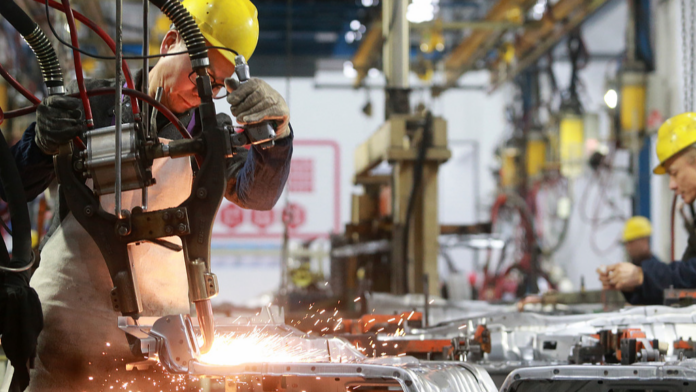
Manufacturing remains central. Jiangsu’s manufacturing high-quality development index has ranked first nationwide for five consecutive years, reflecting both industrial sophistication and strong innovation capacity. From advanced equipment and integrated circuits to new energy and biomedicine, the province’s industrial ecosystem has helped it remain competitive amid global supply chain adjustments.
Millions watched provincial soccer league in 2025
Domestic demand is also showing vitality. A striking example is the viral popularity of the provincial football league known as the “Su Super League,” which attracted more than 2.43 million spectators in 2025. The phenomenon shows how sports, culture and tourism can activate consumption and unleash the potential of the domestic market.
Meanwhile, Jiangsu remains one of China’s most open economies. During the 14th Five-Year Plan period, the province attracted more than $119-billion in actual foreign investment, ranking first nationwide.
By actively participating in domestic and international dual circulation, Jiangsu demonstrates how China strengthens its domestic market while staying open and integrated into the global economy.
Modernisation that benefits all
Economic growth alone is not the ultimate goal. Xi emphasised that Chinese modernisation is defined by common prosperity for all.
He pointed out that it means addressing key questions such as how to achieve high-quality and full employment, how to increase incomes for urban and rural residents, and how to further improve public services and social security.
Many of these concerns were addressed in the draft government work report, submitted to lawmakers for deliberation on Thursday. It outlined a range of livelihood-focused policy measures.
Employment remains a top priority. The government will expand work-for-relief programmes to help people struggling to find jobs. Meanwhile, flexible workers and those in new forms of employment, such as delivery personnel and ride-hailing drivers, will gain broader access to more inclusive social security programmes.
Raising incomes, boosting consumption
Boosting consumption and raising incomes are also key policy goals. China will implement an income growth plan for urban and rural residents, aimed at increasing earnings for low-income groups, expanding property income channels, and improving remuneration and social security systems.
According to the report, 250-billion yuan in ultra-long special treasury bonds will support consumer goods trade-in programmes, while a special fiscal-financial coordination fund of 100-billion yuan will facilitate domestic demand expansion.
Policies such as promoting spring and autumn school breaks and encouraging staggered paid leave for employees are also expected to stimulate service-sector consumption and tourism.
Social welfare support
As for public services and social security issues, the draft report said the minimum basic old-age benefits for rural and non-working urban residents will be raised by 20 yuan per month. Care service vouchers for older people will pay for those affected by moderate and severe functional impairments.
The government also plans to expand maternity insurance coverage, guarantee maternity leave, accelerate the development of inclusive childcare services, and introduce housing policies that better support families with two or more children.