


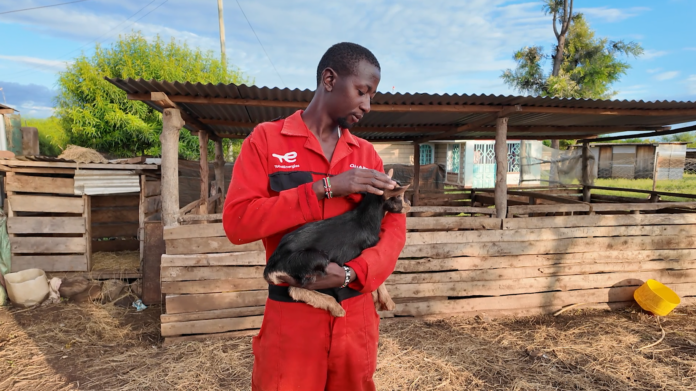
On the fertile slopes of central Kenya, a quiet agricultural transformation is taking shape. As population growth and inheritance-driven land subdivision continue to reduce farm sizes, many smallholder farmers are rethinking traditional dairy farming.
Increasingly, they are turning to high-yielding dairy goats, which require less land while offering a reliable source of milk and income.
The shift is being driven by artificial insemination (AI), a technology allowing farmers to improve the genetics of their herds without owning breeding bucks.
The result is healthier animals, higher milk production and a growing source of income for thousands of rural households.
For decades, goat breeding depended on borrowing or transporting animals over long distances to access breeding bucks, a practice that often spread diseases, encouraged inbreeding and reduced productivity.
Today, farmers are embracing AI to access superior breeds such as Anglo-Nubian, Saanen and German Alpine goats, which produce significantly more milk while requiring far less land and feed than dairy cows.
“I started goat farming a decade ago with local breeds,” says farmer Purity Wambui.
“Back then, we had to travel long distances to find a buck for mating. Diseases spread easily, many kids died and milk production remained low. After agricultural officers introduced us to goat artificial insemination, everything changed. Today, I keep three improved dairy goat breeds, with some producing up to four litres of milk a day.”
Kenya’s livestock sector contributes about 12% of the country’s GDP and supports millions of households, according to government data. Dairy goats are increasingly becoming an attractive option, particularly for women and young farmers who own limited land.
Fighting disease through better genetics
Livestock experts say artificial insemination is solving some of the biggest challenges facing goat farmers.
According to Dr Catherine Mulonzi, Director of Livestock and Fisheries in Kirinyaga County, the traditional use of communal breeding bucks resulted in widespread inbreeding and transmission of reproductive diseases such as brucellosis.
“Farmers have embraced goat AI because it has significantly reduced inbreeding and reproductive diseases,” she says.
“Inbreeding reduces milk production and often leads to deformities in offspring. Through artificial insemination, farmers are improving productivity while lowering production costs.”

The improved genetics are supplied through the Kenya Animal Genetic Resources Centre (KAGRC), a state corporation responsible for preserving and distributing high-quality livestock genetics across the country.
Bringing Modern Science to Small Farms
Inside KAGRC’s Goat AI Centre, every semen sample undergoes rigorous laboratory testing before reaching farmers.
Scientists examine sperm motility, morphology and concentration to ensure only high-quality genetic material is distributed.
“Our objective is to improve both milk and meat production by providing farmers with the best genetics available,” says Dr Dominic Chirchir, the manager of the Goat AI Centre.
“Artificial insemination not only improves productivity but also reduces venereal diseases and eliminates the cost of keeping breeding bucks, which can be expensive for small-scale farmers.”
The centre has been expanding access to improved breeds as Kenya seeks to modernise its livestock sector and strengthen food security.
A growing economic opportunity
The impact is visible across Kirinyaga County, where 58 dairy goat farmer groups comprising more than 60 000 farmers now rear improved dairy goats. County officials say the region has emerged as one of Kenya’s leading hubs for dairy goat production.
For many households, especially women, dairy goats offer a practical alternative to dairy cattle.
“A dairy cow can cost up to 200 000 Kenyan shillings (R25 500), which many rural families cannot afford,” says Dr John Gachara, the Kirinyaga county executive committee member for agriculture.
“Five dairy goats can produce milk equivalent to one dairy cow while requiring much less space and capital. This has become an important economic empowerment programme, particularly for women and vulnerable households.”
Goat milk also commands premium prices of between 100 and 120 Kenyan shillings a litre, often nearly double the price of conventional cow’s milk in many local markets.
Demand remains strong among households seeking an alternative dairy product, as well as niche markets including some hospitals and health-conscious consumers.
Higher prices, steadier incomes
Farmer Peter Njoroge says dairy goats have transformed his family’s livelihood.
“I keep 21 dairy goats and sell my milk to a processor for 100 shillings per litre,” he says.
“Before AI, diseases spread easily through breeding bucks and our goat kids were weak. Today, kidding rates have improved, our animals are healthier and we earn a reliable income every month.”
Looking ahead
Kirinyaga Governor Anne Waiguru says the county will continue investing in artificial insemination programmes to further improve dairy goat productivity.
“When we introduced dairy goats, many farmers were getting only about two litres of milk from their cattle while milk prices remained low,” she says.
“Through artificial insemination and improved breeds, we are working towards increasing dairy goat yields from the current average of around two to as much as five to seven litres per day.”
As climate change, shrinking farmland and rising production costs reshape African agriculture, dairy goats are emerging as a resilient solution for smallholder farmers.
From laboratory science to village farms, Kenya’s growing use of artificial insemination is demonstrating how improved livestock genetics can help increase productivity, strengthen food security and create new economic opportunities for rural communities.
- Smallholder farmers in central Kenya are increasingly adopting high-yielding dairy goats instead of traditional cattle due to shrinking farm sizes and land subdivision.
- Artificial insemination (AI) technology allows farmers to improve goat genetics, resulting in healthier animals, higher milk production, and disease reduction without the need for breeding bucks.
- The Kenya Animal Genetic Resources Centre (KAGRC) provides high-quality goat genetics, ensuring rigorous testing of semen to improve productivity and reduce venereal diseases.
- Dairy goats are more affordable and require less space than cows, offering women and vulnerable households a practical economic empowerment opportunity with premium prices for goat milk.
- Kirinyaga County leads Kenya's dairy goat production with over 60,000 farmers involved, and ongoing investments aim to increase milk yields further amid challenges like climate change and rising production costs.


