


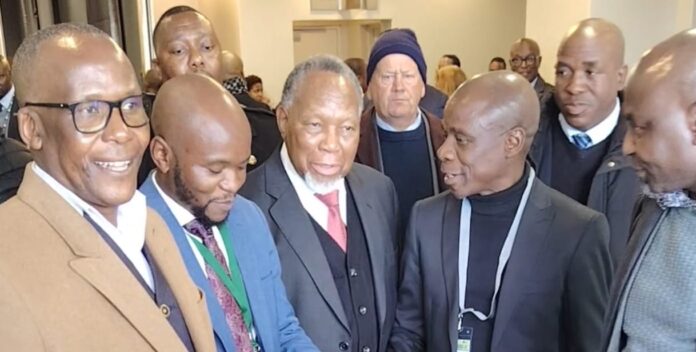
Former president Kgalema Motlanthe has urged black-owned companies to focus on growing the economy, rather than seeking empowerment stakes in established businesses.
Motlanthe made the remarks while delivering the keynote address at the Black Business Council (BBC)’s Annual Black Business Summit in Kempton Park on Wednesday.
His speech focused on growing the South African economy through economic empowerment, re-industrialisation and localisation in the era of artificial intelligence (AI).
Motlanthe argued that the discourse on AI is ultimately about ownership of the means of production and black business should play a role in owning the new technologies.
“It is a discourse on power and owning the means of production, and strategic deployment of capital as much as it concerns the question of who shall possess the productive instruments of the coming age.”
Motlanthe said the crucial question today is not whether previously excluded groups have been empowered.
“The deeper question is whether we have enough of an economic base upon which empowerment can be sustained and reproduced over generations.”
He acknowledged criticism of Black Economic Empowerment (BEE), including claims that it has at times benefited politically-connected individuals, that some transactions have delivered limited broad-based transformation, and that empowerment has become a compliance exercise rather than a tool for building capability.
Also Read: Agriculture, finance, property worst BEE performers, reveals report
Despite this criticism, Motlanthe said the empowerment project has not failed.
“Perhaps the more fundamental failure is that we have not sufficiently grown the economy (over the past 30 years).
“Where growth is sluggish, manufacturing capacity eroded, infrastructure degraded, domestic demand constrained, and new industries scarce, the space for genuine empowerment contorts.
“We are then reduced to contesting the redistribution of an economy that doesn’t expand. The problem is not that too few have been empowered, it is that we have not generated sufficient new capital, new enterprises, new industries and new markets to reproduce empowerment across successive generations.”
Motlanthe said this requires a shift in orientation, with the Black Business Council and the broader community of black-owned enterprises moving beyond transactional deals.
“They must move from the acquisition of ownership stakes to the formation of capital, from empowerment deals to industrial development, from the status of beneficiary to that of producer, from consumption to investment, and from individual accumulation to the construction of institutions capable of reproducing black productive capital across time.”
Also Read: Fight against B-BBEE shows remnants of racism – Godongwana
- Former president Kgalema Motlanthe urged black-owned companies to focus on growing the economy rather than seeking empowerment stakes in established businesses.
- Motlanthe highlighted the importance of black business owning new technologies in the era of AI as a matter of power and control over production.
- He stated that the deeper issue is whether there is a sufficient economic base to sustain and reproduce empowerment over generations.
- Motlanthe acknowledged criticisms of Black Economic Empowerment, including that it has sometimes benefited politically connected individuals and become a mere compliance exercise.
- He called for a shift from transactional empowerment deals to industrial development and investment to build institutions capable of sustaining black productive capital.


