


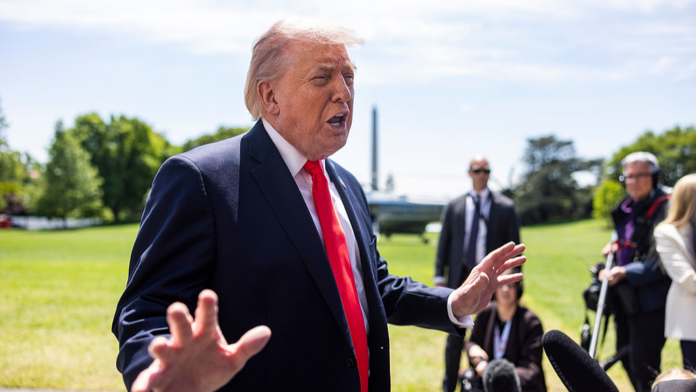
US President Donald Trump said on Saturday that he is reviewing a new peace proposal from Iranian negotiators but warned that resuming strikes in Iran remains “a possibility”.
“I will soon be reviewing the plan that Iran has just sent to us, but I can’t imagine that it would be acceptable,” Trump told reporters.
Earlier on Saturday, a senior Iranian diplomat confirmed that Tehran had submitted its proposal for peace talks with the US through Pakistan, leaving the decision to Washington to choose between diplomacy and confrontation.
Iran’s Deputy Foreign Minister for Legal and International Affairs Kazem Gharibabadi emphasised that Iran has always favoured interest-based diplomacy but remains ready to repel any “aggression” against the country and its people.
Iran’s counterproposal
According to Iran’s semi-official Tasnim News Agency, Tehran delivered a 14-point counterproposal in response to a nine-point US plan.
While Washington’s plan calls for a two-month ceasefire, Tehran is proposing a 30-day timeline to resolve key issues, insisting that talks focus on “ending the war” rather than a temporary truce.
Iran’s demands include the withdrawal of US forces from areas near its borders and guarantees of non-aggression. The proposal also outlines economic measures such as lifting the naval blockade, releasing frozen Iranian assets, easing sanctions and providing compensation.
Additionally, it calls for an end to hostilities in multiple regions, including Lebanon, and the creation of a new governing mechanism for the Strait of Hormuz, a vital global oil shipping route.
Tehran ‘awaits US’ response’
Iran is now awaiting a formal response from US officials.
Meanwhile, Iranian Foreign Minister Seyed Abbas Araghchi has briefed Asian and European counterparts on Tehran’s latest proposal. In separate calls on Friday and Saturday, Araghchi discussed regional developments and a potential ceasefire with officials from Türkiye, Qatar, Saudi Arabia, Egypt, Iraq, Azerbaijan, Russia, South Korea, Japan, France, Italy and the EU’s foreign policy chief, Kaja Kallas.
Araghchi reiterated that Iran did not initiate the conflict and remains open to diplomacy if the US abandons its “maximalist approach”, threats and provocative actions. He added that Iran’s armed forces are fully prepared to defend the country against any threat.
Since joint attacks by Israel and the US on Tehran on February 28, Iran has tightened control over the Strait of Hormuz, blocking safe passage to vessels linked to Israel or the US.
Companies ‘must not pay Iran for strait passage’
On Saturday, the US Treasury Department’s Office of Foreign Assets Control (OFAC) warned that any shipping company paying Iran for passage through the Strait of Hormuz – including payments framed as charitable donations – could face US sanctions.
According to OFAC, such payments may take the form of cash transfers, digital assets, debt offsets, informal exchanges, or other in-kind payments, including donations to the Iranian Red Crescent or Iranian embassies.
It is currently unclear whether any companies or countries have made such indirect payments. Reports suggest that at least $2-million has been paid to Iran for the passage of a single vessel through the strait.
- US President Trump is reviewing a new peace proposal from Iran but warns that strikes remain a possibility.
- Iran submitted a 14-point counterproposal via Pakistan, calling for a 30-day timeline to end the war, US troop withdrawal, lifting sanctions, and a new governing mechanism for the Strait of Hormuz.
- Iran expects a formal US response and has briefed multiple Asian and European countries on its proposal, emphasizing its readiness to defend itself if necessary.
- Iran tightened control of the Strait of Hormuz after attacks by Israel and the US in February, blocking vessels linked to the US and Israel.
- The US Treasury warned companies against paying Iran for strait passage, threatening sanctions on payments including charitable donations or indirect transfers.


