


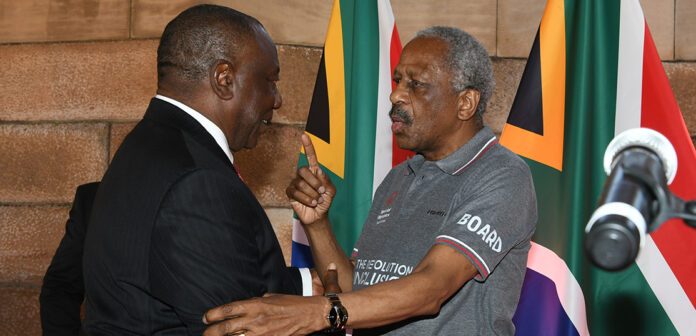
A legal opinion by the law firm of ANC veteran Mathews Phosa advised that beleaguered President Cyril Ramaphosa avoid premature combat with the courts and Parliament over the raging scandal of the theft of dollars from his game farm.
Sunday World understands that a copy of the legal opinion was obtained by an advisor of Ramaphosa’s ahead of the family meeting on Monday where the President told the nation he would not resign over the scandal. “Thus, its contents mirrored those of the president’s address to the nation”, according to a source with knowledge of the developments.
The legal opinion, compiled by Phosa Loots Attorneys, dated May 10 – a day before Ramaphosa’s address – presented various strategic legal and political options for the President following the apex court ruling directing Parliament to proceed with an impeachment process premised on the Section 89 independent panel report of November 2022.
Whilst some legal fundis have advised the president, who has announced that he is taking the panel report for judicial review, that he must also interdict the impeachment process from Parliament, Phosa’s law firm differs.
“In our respectful view, the president’s most prudent strategy at present would be the following: to participate fully within the constitutional process; to avoid premature constitutional confrontation with the judiciary or Parliament; and to reserve rights in relation to future procedural unfairness or irrationality.”
Ramaphosa was further advised to “prepare comprehensively for impeachment committee proceedings, to maintain a measured and constitutionally respectful public posture, and to manage the matter strategically at parliamentary, legal, and public levels.
Phosa’s legal opinion stresses that, “importantly”, the judgment does not remove the president from office.
The legal opinion says the ConCourt ruling does not “make any final factual findings against the president” and does not determine criminal liability.
“The judgement does not determine that the president committed a serious violation of the Constitution or the law and does not require Parliament to ultimately remove the president from office.”
Phosa’s law firm insists that the ConCourt judgement has little to do with Ramaphosa in his person; hence, there is no need to panic.
According to the opinion, the judgement is squarely about Parliament processes and how they conducted their business regarding the panel report.
“The court held that sections 42(3), 55(2), and 89 of the Constitution collectively impose accountability obligations upon Parliament,” reads the opinion.
“The court held that impeachment constitutes one of the most serious accountability mechanisms available against a president, and Parliament must structure impeachment procedures in a manner that gives meaningful effect to constitutional accountability obligations.”
Ramaphosa’s televised address on the Constitutional Court’s Phala Phala impeachment ruling closely mirrored arguments contained in the Phosa memorandum. Both documents frame the judgment as procedural rather than a finding of guilt against the president.
The memo states that the ruling concerns “the constitutional architecture of parliamentary accountability mechanisms rather than the substantive guilt or innocence of the president”.
Ramaphosa similarly said the judgment reinforced “the principles, rights and processes underpinning our constitutional order”.
Both also stress constitutional restraint. “I accept and respect the Constitutional Court’s ruling,” Ramaphosa said, while the memorandum warns against “direct attacks upon the judiciary or Parliament”.
The memo further appears to foreshadow Ramaphosa’s decision to seek a court review of the independent panel report and argues that resignation would be premature because “no final factual findings have been made”.
The Presidency has not publicly indicated whether the internal memorandum informed parts of the president’s speech.
The ANC NEC meeting on Wednesday and the national officials’ meeting on Monday were also presented with legal options given to Ramaphosa by his counsel, Tembeka Ngcukaitobi, SC.
That opinion was the same. Ramaphosa announced on Monday that he will be taking the panel report on judicial review.
ANC secretary-general Fikile Mbalula on Friday announced the outcomes of the NEC meeting. “The first thing the African National Congress wishes to communicate to the people of South Africa, plainly and clearly, is what the Constitutional Court did and did not order on Friday an impeachment trial for the president. The court did not find the president guilty of anything.
“The court did not direct that the president be removed from office. The court did not endorse the findings of the Section 89 Independent Panel.
“The judgment, in the words of the Honourable Justice Majiedt in the third of three judgements, is concerned with the procedural conduct of the National Assembly and the rules under which it acted.
“It is not, in any respect, a finding on the merits of the matter.”
Visit SW YouTube Channel for our video content
- Legal opinion from ANC veteran Mathews Phosa's firm advises President Cyril Ramaphosa.
- Recommendation is to avoid early conflict with courts and Parliament.
- Context involves a scandal regarding the theft of dollars from Ramaphosa's game farm.
- The advice aims to manage the political and legal fallout cautiously.
- Full details available via the Sunday World e-edition.


