


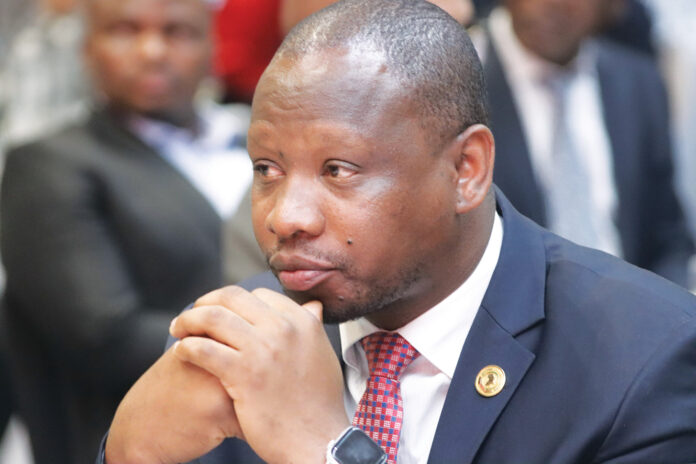
The Southern African Development Community (SADC) must urgently strengthen regional integration and economic self-reliance to withstand global geopolitical shocks that continue to batter economies across the region, according to Lesotho’s Foreign Affairs Minister, Lejone Mpotjoane.
Speaking on the sidelines of the SADC Ministers of Foreign Affairs retreat, Mpotjoane said the ongoing conflicts involving Ukraine, Europe, Russia and tensions in the Middle East have created severe economic pressures for smaller economies in southern Africa.
He described the current situation as a “polycrisis”, saying many countries are battling rising fuel prices, job losses and economic instability all at once.
“The difficulties have been centred around geopolitics and how those conflicts affect the economies within the region,” said Mpotjoane.
“But we are also looking at solutions – how the region can bring together individual synergies to reshape itself in order to withstand those shocks.”
Smaller economies ‘hard hit’
The minister warned that smaller and landlocked economies such as Lesotho have been particularly hard hit by global economic turbulence and changes in international trade relations.
He said Lesotho has already experienced fuel price increases of about 42.5%, which have had devastating ripple effects on transport, agriculture and food production costs.
“One of the mainstays of Lesotho’s economy is textile and apparel production, which exports mainly to the United States market,” he explained.
However, uncertainty surrounding the future of the African Growth and Opportunity Act (Agoa) has left many operators anxious about the sustainability of the sector.
“Factories are now closing because they are uncertain about the market and the future sustainability of the textile and apparel industry,” he said.
Mpotjoane added that rising fuel prices have also increased agricultural production costs, especially for fertilisers and fuel required to operate farming machinery.
Call for stronger intra-regional trade
Despite the challenges, the minister believes SADC has enormous untapped potential if member states focus on strengthening intra-regional trade instead of depending heavily on overseas markets.
“SADC is a region with many potentials. You have oil in Angola, gas in Mozambique, mining in Zimbabwe, Zambia and South Africa, while countries like Lesotho have strong textile industries,” he said.
He argued that the region’s combined market of more than 400 million consumers presents an opportunity for member states to support one another economically.
“When developing products, countries should first look within SADC markets before looking beyond the region,” he said.
‘Improve cross-border mobility’
Mpotjoane also stressed the importance of improving the movement of people, goods and services across borders to unlock economic growth.
“People-to-people movement is very important within the region, as is the movement of goods and services,” he said.
The minister noted that Lesotho, which is entirely surrounded by South Africa, is engaging Pretoria bilaterally to improve cross-border mobility while respecting migration laws of both countries.
“There is a need for free movement to improve between the two countries while ensuring migration laws are respected,” he said.
According to Mpotjoane, improved mobility between Lesotho and South Africa would boost trade, economic growth and regional cooperation.
“We export water to South Africa and also rely on South Africa for access beyond our borders. So we need to revisit our laws,” he said.
- Lesotho's Foreign Affairs Minister, Lejone Mpotjoane, urges SADC to strengthen regional integration and economic self-reliance to withstand global geopolitical shocks, highlighting a "polycrisis" of fuel price hikes, job losses, and economic instability.
- Smaller, landlocked economies like Lesotho are severely affected by global economic turbulence, with a 42.5% fuel price increase impacting transport, agriculture, and the textile sector, which relies heavily on uncertain export conditions under the African Growth and Opportunity Act (Agoa).
- Mpotjoane calls for SADC members to boost intra-regional trade by leveraging the region’s abundant resources and large combined market of over 400 million consumers, rather than depending mainly on overseas markets.
- Improving cross-border movement of people, goods, and services is critical for regional economic growth; Lesotho is working with South Africa to enhance mobility while respecting migration laws to facilitate trade and cooperation.
- Strengthening regional synergies, revisiting laws on mobility, and focusing on internal markets are essential strategies to reshape SADC economies and build resilience against ongoing global economic challenges.


