


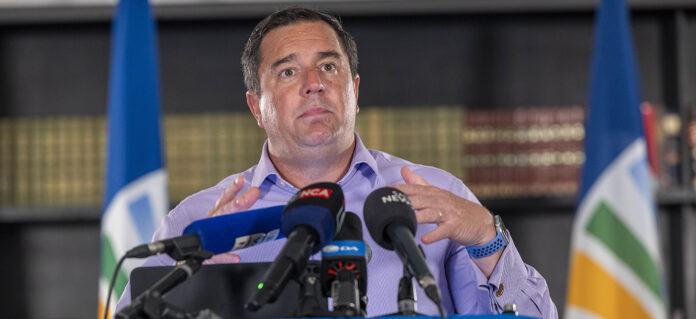
DA leader John Steenhuisen was cleared of misusing party funds but now faces a fresh internal reckoning as questions over his conduct remain, and accusations he may have brought the DA into disrepute still hang over his head.
Senior party sources told Sunday World that there was still a threat of further disciplinary action related to concerns about damage to the party’s reputation linked to a default judgment over nearly R150 000 in unpaid personal credit card debt, and a string of leadership disputes that unsettled key donors and senior figures.
It’s understood if further charges are brought, the ultimate sanction could even be as harsh as termination of party membership.
On Saturday, Steenhuisen’s spokesperson referred queries to DA Federal Council chair Helen Zille, who could not be reached for comment.
Even as he stepped aside this week from contesting the federal leader position, speculation suggests that internal pressure, rather than personal choice alone, ultimately forced his hand.
The charge of bringing the party into disrepute carries a possible sanction of membership termination, said a party insider with knowledge of internal discussions.
“The issue here is that our donors and even ordinary people who give to the DA started calling us, and asking questions about what was going on after the story started making the rounds,” according to the source.
The appointment of a company linked to former DA MP Ryan Coetzee, which was reportedly contracted to provide advisory services within his office in the agriculture ministry, also falls under the scope of baggage still hanging over Steenhuisen.
The position, which was said to be funded by the party, sparked internal discord and intensified unease about governance and accountability at the top of the organisation.
A spokesperson for the DA on Friday sidestepped questions about possible further charges against the outgoing party leader, saying he was exiting the leadership race voluntarily.
“Mr Steenhuisen chose to not make himself available for re-election as leader in April at the Federal Congress, based on his own free will, as he has grown the party’s support, taken the DA from opposition to a party of government and, importantly, now wants to focus all his energy on fighting foot and mouth disease as minister of agriculture.
“The party thanks him for his service; he will forever stand as the first leader in South Africa’s history to take the DA from an opposition party to a party in government,” he said.
Steenhuisen’s announcement this week that he will not seek re-election as federal leader has only fuelled speculation that mounting internal pressure played a decisive role in his departure.
Speaking in Durban on Wednesday, he announced he would not contest a third term at the DA’s upcoming federal congress, bringing an end to his leadership chapter that began in 2019. “I today announce that I will not seek re-election for a third term as DA federal leader,”
he said.
But party insiders paint a more complex picture behind the decision, describing a growing list of controversies that had unsettled major donors and threatened to pull financial support should the minister of agriculture in the GNU remain at the helm of the party.
Among the issues cited were his handling of the foot-and-mouth disease crisis, his public criticism of influential Afrikaans lobby groups, and the allegations raised by former DA finance head Dion George that Steenhuisen had used a party credit card for personal expenses. He was cleared by the DA’s federal legal commission.
“John has upset Afrikaner voters in the DA,” one senior source alleged.
“He has referred to organisations like AfriForum, Solidarity and Sakeliga as part of an ‘Afrimaga’. That is an insult to a constituency that remains very important to the DA.”
The source also said there was dissatisfaction about Steenhuisen’s approach to the foot-and-mouth outbreak, suggesting it echoed the ANC’s style rather than the DA’s traditional emphasis on private-sector partnerships and swift intervention.
“His response was not in the language of the DA. People expected him to move quickly, engage the private sector and procure vaccinations urgently. Instead, animals were dying while the response sounded like government bureaucracy.”
The party is now also assessing whether the highly public fallout between Steenhuisen and George may have caused further reputational damage, compounding concerns already swirling around his leadership.
But DA members in Steenhuisen’s camp had a completely different view of the matter.
“It is definitely the relationship with his Federal Council chair; it was untenable,” one insider said bluntly, pointing to Steenhuisen’s increasingly strained dynamic with Zille.
Sources say Steenhuisen had faced relentless internal resistance from a grouping within the party that had grown more emboldened recently, with right-wing elements emerging and working aggressively to undermine his authority.
Even after he was cleared of allegations of financial mismanagement, the faction refused to accept the outcome, continuing to cast a shadow over his leadership. “It spread beyond the party,” another source said. “It went to donors and eventually into the agriculture industry, where lobby groupings were used to make life hell for him.”
Party insiders say the pressure campaign became impossible to manage, with Steenhuisen facing attacks not only from outside opponents but also from within the DA’s own senior ranks. His departure now opens the door for what is shaping up to be the DA’s most contested leadership race in years, with lists of potential candidates already circulating widely in internal party WhatsApp groups.
According to the names being lobbied by various groupings, the battle lines are forming fast. For the powerful position of federal leader, names being pushed include Cape Town mayor Geordin Hill-Lewis, DA Gauteng leader Solly Msimanga, and senior leader Andrew Whitfield.
Ashor Sarupen is also being touted as frontrunner for the Federal Council chairperson position, currently held by Zille.


