


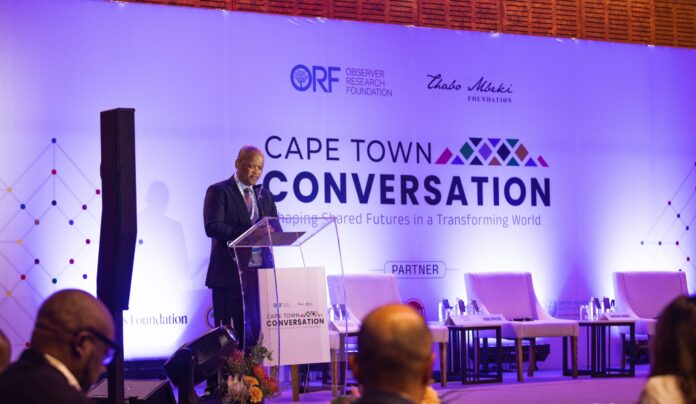
Will Africa remain at the edge or help shape the institutions that govern the world? That is just one of the questions policymakers, business leaders, multilateral institutions, researchers, civil society and other stakeholders are interrogating at the 2026 Cape Town Conversation.
The convening, now in its fourth year, was born out of a partnership between the Thabo Mbeki Foundation and the Observer Research Foundation.
This year’s gathering is taking place against the backdrop of growing global tensions, particularly the closure of the Strait of Hormuz.
For the Global South, it is a moment of reflection to assess the partnerships and institutions needed to navigate and shape an emerging international order. This includes the scope and nature of north-south and south-south cooperation at a moment of profound transition – with the old order neither fully intact nor yet replaced by a new one.
READ: How BRICS is reshaping the Global South’s place in the world
A platform for new partnerships
The convening is designed to spark debate and meaningful dialogue for the advancement of communities, governments and other institutions, particularly in the Global South. The gaps created by the uncertainties brought about by the current geopolitical unrest present an opportunity to advance through new trade, investment, and infrastructure development frontiers.
However, the lingering question is whether the African continent, which boasts the resource of the youngest population, is prepared to seize those opportunities.
In his welcome address, Thabo Mbeki Foundation’s chief executive officer, Max Boqwana, acknowledged the partnership between Africa and India, highlighting its historical roots.
“Our collaboration shows what institutions in Africa and India can do when they make time to understand one another and commit to working together. Through this annual convening, we want to help others build relationships of their own, test ideas with people who see the world differently, and find partners with whom they can think and act.”
India-South Africa ties in focus
Prabhat Kumar, High Commissioner of India to South Africa, echoed the long-existing connection between Pretoria and Delhi, reflecting on the historical significance of holding the annual convening in Cape Town, once a frontier of colonialism.
“Cape Town is where two oceans meet. This is the place where India and SA decided to build something that the world will benefit from … Today, with the Red Sea in turmoil, vessels are again turning south to the Cape of Good Hope.”
Financing the energy transition
Over the two days, the conversations are set to also delve into financing Africa’s energy transition, with one of the key questions being whether the international financing architecture is fit for the scale and nature of today’s challenges.
READ: Eskom chairman warns global data centre electricity demand will more than double by 2030
Harnessing technology for development
On the technological front, the advent of artificial intelligence offers an opportunity for emerging economies to raise productivity, strengthen governance and public services, and create new economic opportunities. Moreover, India’s experience with digital public infrastructure continues to offer important learnings of how technology, when designed for scale and inclusion, can generate broad-based development outcomes.
For Africa, the challenge is to extend these gains beyond pockets of adoption – through affordable connectivity, computing capacity, digital skills, and applications that produce tangible outcomes for communities.
Subscribe To Our Newsletter or get the news delivered to your phone via our WhatsApp Channel.
- The 2026 Cape Town Conversation is a partnership event between the Thabo Mbeki Foundation and the Observer Research Foundation, now in its fourth year.
- The gathering addresses global tensions such as the closure of the Strait of Hormuz and explores north-south and south-south cooperation amid an emerging international order.
- Max Boqwana, CEO of the Thabo Mbeki Foundation, emphasized the historical and ongoing collaboration between Africa and India during the event.
- Key topics include financing Africa's energy transition, with concerns about whether current international financing mechanisms meet today’s challenges.
- The conversation highlights the potential of artificial intelligence and digital public infrastructure to boost productivity and development in Africa, drawing on India’s experience.


