


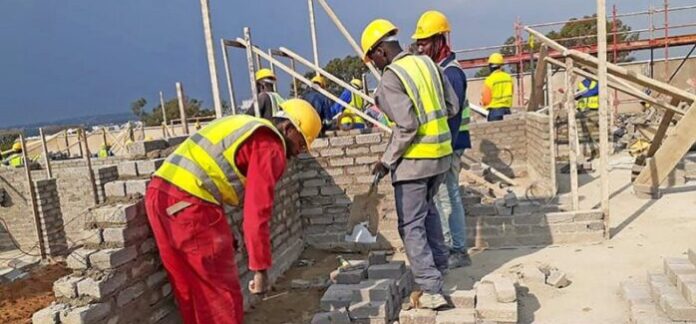
A businessman who arranges financing for enterprises across the built-environment value chain has weighed in on the construction mafia debate, arguing that it is wrong to label communities seeking economic opportunities from developments such as shopping centres and fibre infrastructure projects as part of a “construction mafia”.
Funding partnership targets underserved areas
Andrew Brooking, the founding director of corporate finance firm Java Capital, made the remarks during an interview with Sunday World at the launch of a partnership with Standard Bank in Sandton.
The partnership is expected to unlock billions of rands in funding for property and infrastructure projects across South Africa.
It aims to improve access to capital for developers of affordable housing, student accommodation, shopping centres and fibre infrastructure, particularly in underserved townships and rural areas.
Communities seeking jobs should not be criminalised
Brooking, whose company focuses on project financing instead of construction, said that local communities’ demands for employment opportunities should not be automatically viewed as criminal activity.
“I am not close to all those dynamics [construction projects on the ground], but sometimes I think it is just communities organising themselves and insisting they get the jobs that are building things in their areas,” he said.
“So for me that is not like a construction mafia, it’s just good business. Employ people who are going to be using what they are building, and we have got an unemployment problem, so the demand for jobs is intense.”
READ: NW municipality loses court case against alleged construction mafia members
The term “construction mafia” is commonly used to describe groups that use intimidation, extortion, threats or violence to secure money, contracts, jobs or subcontracting opportunities from construction projects.
In July, Public Works and Infrastructure minister Dean Macpherson said 52 companies have been blocklisted by the department over the past two years in his quest to deal a blow to the construction mafia that has disrupted 180 public infrastructure projects valued at R63-billion.
Unemployment at the heart of tensions
Brooking said communities approaching construction projects in search of economic opportunities reflected South Africa’s broader unemployment crisis rather than organised criminality.
“For people to go to construction developments and look for economic opportunities is really a broader reflection of a problem of unemployment,” he said.
“We have had some politicians make promises, and some of those promises are perceived as support for the construction mafia.”
Community involvement key to project success
According to Brooking, developers who engage meaningfully with local communities are more likely to succeed, particularly in townships and rural areas.
“We do see that if you go into a community to build something, you need to involve the community in what you do. And the best builders in rural and township communities are involved in those communities closely,” he said.
READ: MEC slams ‘construction mafia’ as taxi boss Joe Ferrari Sibanyoni faces extortion charges
“By involving communities in shopping centre or fibre infrastructure developments, the communities will feel a sense of ownership. Their lives are improving because they have got a shop, access to the internet, better roads, and they worked on those projects.”
Brooking said communities should share in the benefits of development projects that transform their areas.
“They need to feel a sense of ownership as a community. And the term ‘construction mafia’, I mean, it is a bad label.”
- Andrew Brooking, founding director of Java Capital, argues it is wrong to label communities seeking jobs from construction projects as part of a "construction mafia".
- Java Capital and Standard Bank launched a partnership in Sandton to unlock billions of rands funding for property and infrastructure projects in underserved townships and rural areas.
- Brooking believes community demands for employment in construction are a reflection of South Africa's broader unemployment problem, not organised criminal activity.
- Public Works minister Dean Macpherson reported 52 companies have been blocklisted in efforts to combat the construction mafia disrupting R63-billion worth of public infrastructure projects.
- Brooking stresses that involving local communities in development projects increases project success and fosters community ownership and improved livelihoods.


