


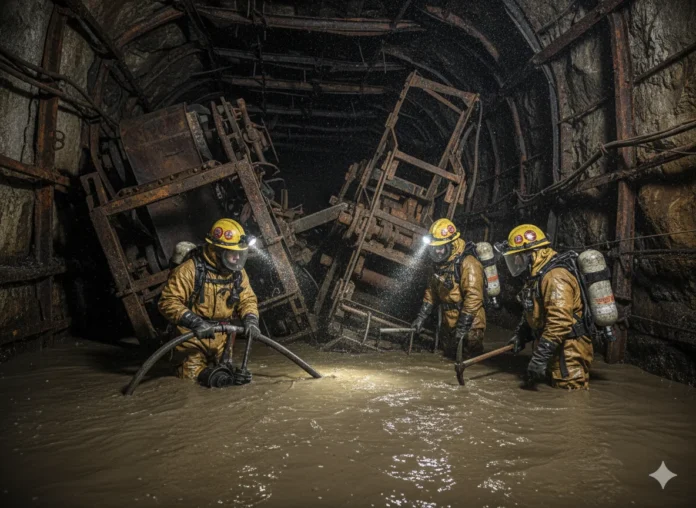
Five mineworkers are presumed dead following a catastrophic mud rush at the Ekapa diamond mine in Kimberley, in what has become one of South Africa’s most serious mining accidents in recent years.
The incident occurred on February 17 when a sudden inrush of mud and water flooded underground workings nearly 900 metres below the surface, trapping the workers and triggering an intensive rescue operation involving specialised mine rescue teams, engineers, and government authorities.
Emergency crews worked around the clock to pump water from the affected shaft and assess access routes, but conditions deep underground have severely hampered progress. Cameras deployed into the flooded sections revealed only mud-filled tunnels, reinforcing fears that survival was unlikely.
Mantashe visits site
Mineral and Petroleum Resources Minister Gwede Mantashe visited the site and confirmed that, “After so many days, we are making a presumption of death as the possibility of death is high and the possibility of life is minimal.” confirming the trapped miners are now presumed dead.
“We can sugarcoat it, but it is quite difficult, as the water is deep and the situation is complex,” he said.
The operation has shifted focus towards recovery and investigation. The Minerals Council South Africa deployed senior safety and modernisation executives to the mine to support emergency efforts and engage with Ekapa management, regulators, and organised labour.
“Our immediate focus is to offer support to Ekapa’s management, the affected operation, its employees, and their families. Finding the five people who are reported missing in the mud rush is the priority,” said Minerals Council CEO, Mzila Mthenjane, in a statement.
The council emphasised that the mine operator and authorities retain responsibility for managing the incident and conducting the formal investigation, while the council’s role is to ensure lessons are shared across the industry to prevent similar disasters.
Mine Rescue Services, government inspectors, and technical specialists have been working continuously to stabilise underground conditions, but persistent water inflows and unstable ground have made access to the affected area extremely dangerous.
Mud rush incidents occur when water-saturated materials suddenly collapse into mine workings, often without warning. These events can be triggered by geological instability, excessive groundwater pressure, or structural failure in underground support systems. Once initiated, mud rushes can move with tremendous force, making escape extremely difficult.
A complex history of EKapa MInerals
In 2016, De Beers Consolidated Mines announced that it had completed the sale of Kimberley Mines (all assets, including the tailings mineral resource) to Ekapa Minerals (Pty) Limited – an investor consortium comprising Ekapa Mining (Pty) (50.1%) and Petra Diamonds Limited (49.9%).
Post-2016 operational risks were largely shaped by legacy mining voids/pits, tailings/slimes handling, interactions with artisanal/illegal mining around dumps and disturbed ground, and old underground infrastructure.
By 2017, hundreds of artisanal miners embarked on a mass action protest against Ekapa Minerals, Kimberley eKapa Mining Joint Venture (KEMJV), among others, opening criminal cases against eKapa accusing them of mining tailings and dumps without permits at various sites in and around Kimberley.
By June 2018, the labour litigation records in the case of Kimberley Ekapa Mining Joint Venture v National Union of Mineworkers reported KEM stating profitability being negatively affected by factors including a “mud-rush in the underground sections of the Bultfontein Mine”. This is alongside a published KEM-JV media statement (and related reporting) describing violent incidents involving illegal miners and mine security in the Greenpoint area.
Then in 2023, Ekapa’s approved Social Labour Plans (SLP) documentation (2023 to 2027) explicitly anticipating the need for mechanisms to manage downscaling, retrenchment or closure closure impacts, including the establishments of a consultation structure (a “Future Forum”), and closure planning principles involving restoration of land surface quality, ecological restorations, and the finding of efficient alternative use of mine infrastructure where it is economically justified.
And so even before the 2016 De Beers transaction, Kimberley’s diamond footprint was characterised by very old workings, disturbed ground, historic dumps/tailings, and ageing underground infrastructure and so eKapa Minerals’ “social licence” remains structurally pressured by a city with deep mining poverty legacies and resources (dumps/tailings/ground) that are physically accessible and economically tempting.
A way forward from the 2026 incident
Ekapa Mining suspended operations immediately following the incident and has pledged full cooperation with regulators and investigators.
“The time passed since the event is a major concern but there is no change in approach to the rescue activities and we are not giving up hope,” said Howard Marsden, General Manager of Ekapa Minerals.
South Africa recorded 41 mining fatalities in 2025, among the lowest annual totals on record, reflecting advances in safety systems, monitoring technologies, and regulatory enforcement. However, the Ekapa disaster highlights the continued vulnerability of underground workers to unpredictable geological and hydrological hazards.
The National Union of Mine Workers has called for a thorough and transparent investigation, while safety experts say the findings will likely influence future industry standards, particularly around water management, underground monitoring, and risk detection.
The Minerals Council reiterated its commitment to the industry’s “Zero Harm” goal, stating that the findings from the Ekapa incident will be shared across mining companies to strengthen safety protocols and prevent recurrence.
A formal report into the causes of the mud rush is expected once recovery efforts conclude and investigators complete their technical assessment.
- Five mineworkers are presumed dead following a catastrophic mud rush at the Ekapa diamond mine in Kimberley, in what has become one of South Africa’s most serious mining accidents in recent years.
- The incident occurred on February 17 when a sudden inrush of mud and water flooded underground workings nearly 900 metres below the surface, trapping the workers and triggering an intensive rescue operation involving specialised mine rescue teams, engineers, and government authorities.
- Emergency crews worked around the clock to pump water from the affected shaft and assess access routes, but conditions deep underground have severely hampered progress.
- Cameras deployed into the flooded sections revealed only mud-filled tunnels, reinforcing fears that survival was unlikely.
- Mantashe visits site Mineral and Petroleum Resources Minister Gwede Mantashe visited the site and confirmed that, “After so many days, we are making a presumption of death as the possibility of death is high and the possibility of life is minimal.” confirming the trapped miners are now presumed dead.


