


The government is still spending approximately R1.2 billion a day servicing government debt in 2026, underscoring the scale of the country’s debt burden despite improving fiscal indicators.
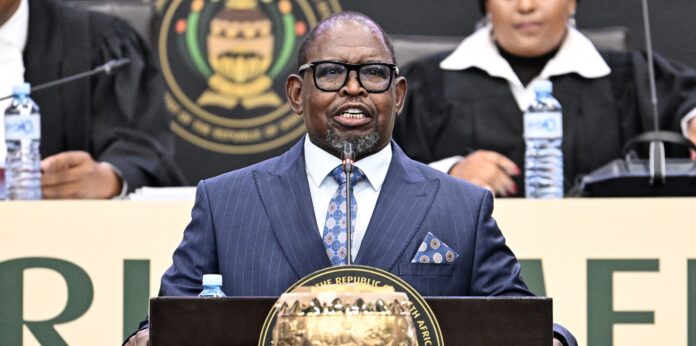
Finance Minister Enoch Godongwana revealed in the Medium-Term Budget Policy Statement (MTBPS) on Wednesday that gross government debt is projected to reach R6.352 trillion in 2026, while debt-service costs are expected to amount to R441.5 billion for the year.
READ: Parliament rejects spending 100% of budget without real service delivery ahead of MTBPS
This translates to roughly R1.2 billion being spent every day on servicing debt, broadly unchanged from the previous year. However, debt-service costs are consuming a smaller share of government expenditure as the overall budget expands and fiscal performance improves.
While debt-servicing costs remain one of the largest items in the national budget, Treasury expects growth in these costs to moderate over the medium term as borrowing requirements decline and the government’s debt burden gradually falls.
Despite the enormous cost of servicing debt, the government has achieved a key fiscal objective, with debt stabilising at 78.4% of GDP in 2025/26 and expected to decline gradually over the medium term.
Supported by stronger-than-expected revenue collections, government recorded a primary budget surplus of R80.8 billion in 2025/26 and plans to increase that surplus from 1.7% of GDP in 2026/27 to 2.9% by 2029/30.
Debt stabilisation marks a key milestone
“For three years, government has run primary surpluses, collecting more revenue than we spend, excluding interest costs. We will continue to build these surpluses to the end of the decade, reducing our borrowing needs and debt-service costs, and creating fiscal space,” Godongwana said.
The minister said the country’s fiscal framework was becoming more resilient and credible, underpinned by three consecutive years of primary budget surpluses.
Fiscal outcomes exceeded expectations in 2025/26, supported by stronger-than-anticipated revenue collections.
The main budget primary surplus reached R80.8 billion, or 1% of GDP, compared with an earlier projection of 0.8%, while the budget deficit narrowed to 4.3% of GDP.
Debt ratio expected to decline
A key milestone was the stabilisation of gross government debt at 78.4% of GDP during 2025/26.
According to the MTBPS, the primary surplus is projected to increase from 1.7% of GDP in 2026/27 to 2.9% in 2029/30.
Over the same period, the main budget deficit is forecast to narrow from 3.7% of GDP to 2.5% of GDP.
Treasury now expects the debt-to-GDP ratio to decline steadily over the medium term as primary surpluses expand and borrowing requirements ease.
Lower debt expected to support investment
Treasury argues that lower debt levels will reduce borrowing costs, improve investor confidence and support higher levels of public and private investment.
READ: Growing debt burden poses significant risk to developing nations, G24 chair says
While debt-service costs remain elevated, their growth is expected to slow to 4.9% over the medium term.
Treasury believes a lower debt burden will create additional fiscal space for growth-enhancing expenditure and service delivery priorities.
Economy expected to grow gradually
The economy is expected to grow by 1.2% in 2026, gradually accelerating to 2% by 2029, as government pursues a strategy centred on fiscal discipline, infrastructure investment and structural reforms.
National Treasury projects nominal GDP will increase from approximately R8.07 trillion in 2026 to R9.34 trillion by 2029, despite a challenging global environment characterised by elevated oil prices and geopolitical uncertainty.
The growth outlook remains modest but reflects an economy that has shown resilience amid external shocks.
The government believes continued implementation of structural reforms will be critical to unlocking faster growth and job creation.
Four pillars underpin growth strategy
The government has positioned fiscal discipline, infrastructure spending and structural reform as central components of its economic strategy.
“The medium-term growth strategy remains anchored by four pillars: maintaining macroeconomic stability, implementing structural reforms, strengthening state capability and supporting growth-enhancing public infrastructure investment,” Godongwana said.
Treasury expects the debt-to-GDP ratio to decline steadily as budget deficits narrow and economic growth strengthens over the forecast period.
Officials argue that improvements in electricity, logistics and broader state capability will help lift growth over time.
Government spending to exceed R3 trillion
Government spending will continue to grow despite ongoing fiscal consolidation.
Consolidated expenditure is projected to rise from R2.72 trillion in 2026/27 to R3.02 trillion in 2029/30, representing average annual growth of 3.6%.
National departments will receive 47.4% of available non-interest expenditure, while provinces will receive 42.6% and municipalities 10%.
Main budget expenditure is expected to reach 30% of GDP in 2026/27, moderating to 28.7% of GDP by 2029/30.
Infrastructure remains a priority
The fastest-growing category of expenditure over the medium term is payments for capital assets, which will grow by 5.3% annually.
“Consolidated expenditure continues to support frontline services, infrastructure and economic recovery,” Godongwana said.
Public entities are expected to play an important role in this investment drive, particularly in road, rail and water infrastructure.
Treasury said future allocations would increasingly be linked to project readiness, procurement capability and the completion of existing projects, with a focus on improving spending effectiveness rather than simply increasing expenditure.
Government targets better spending outcomes
Treasury has placed increasing emphasis on improving the quality of public expenditure.
The MTBPS outlines a shift away from incremental budgeting towards outcome-based spending decisions.
“Improving the quality of spending by allocating funds to programmes that are efficient and effective is a fundamental reform to the budget process, a shift from incremental, input-driven budgeting towards strategic choices about outcomes, affordability and value,” Godongwana said.
Government is reviewing programmes to determine whether they are legally required, aligned with policy objectives and delivering measurable results.
R38.1bn in savings identified
The exercise is intended to ensure that public funds achieve greater value for money while protecting frontline services.
Programme reviews and efficiency measures have already generated R38.1 billion in medium-term savings.
A significant portion, R13.1 billion, comes from improved biometric verification and beneficiary checks within the social grants system.
Government has also identified R7.8 billion for reprioritisation through the redesign of housing delivery programmes, while a further R11.7 billion has been saved through administrative efficiencies and the elimination of programme duplication.
Additional savings to be redirected
Treasury also plans to recover R5.5 billion in accumulated cash surpluses from certain public entities.
Officials say the savings will help fund priority programmes while strengthening fiscal sustainability.
The focus is increasingly on achieving measurable outcomes rather than simply expanding expenditure.
Treasury believes this approach will improve value for money across government.
Inflation expected to ease
While economic growth is expected to improve gradually, inflation remains a concern.
Headline inflation increased from 3% in February 2026 to a peak of 5% in June, before easing to 4.4% in August, largely due to higher global oil prices.
READ: Africa’s economic resilience masks rising inflation threat and fragile buffers, IMF warns
The South African Reserve Bank responded by increasing interest rates by a cumulative 0.5 percentage points, taking the policy rate to 7.25% by September.
“Inflation, which is estimated at 4.4% this year following the oil price shock, is expected to return towards the 3% target in 2029,” Godongwana said.
Labour market remains under pressure
Despite signs of economic stabilisation, the labour market remains under pressure.
South Africa’s unemployment rate increased from 31.4% in the fourth quarter of 2025 to 33.6% in the second quarter of 2026.
Although employment is now 426 000 jobs higher than before the Covid-19 pandemic, labour force growth has outpaced job creation.
Treasury estimates there are now 1.8 million more unemployed people than before the pandemic, with weak private investment and the contraction of labour-intensive sectors continuing to weigh on employment growth.
Risks remain tilted to the downside
Treasury warned that risks to the economic outlook remain predominantly on the downside.
A prolonged conflict in the Middle East, sustained high energy prices, weaker global growth and tighter financial conditions could all undermine South Africa’s recovery.
Domestic constraints, including infrastructure bottlenecks, weak investor confidence and limited fiscal space, also continue to pose challenges.
However, the government believes accelerated reforms and improved state capability could lift growth above current forecasts, supporting stronger investment, employment and economic expansion over the medium term.
- The South African government projects gross debt to reach R6.352 trillion in 2026, with debt-service costs at R441.5 billion, equating to about R1.2 billion daily.
- Debt is expected to stabilize at 78.4% of GDP in 2025/26 and gradually decline as primary budget surpluses increase from 1.7% of GDP in 2026/27 to 2.9% by 2029/30.
- Government spending will grow from R2.72 trillion in 2026/27 to R3.02 trillion in 2029/30, with infrastructure investment being a key priority, particularly in road, rail, and water projects.
- Inflation peaked at 5% in June 2026 due to higher oil prices but is expected to return to 3% by 2029; the Reserve Bank raised interest rates to 7.25% by September.
- Unemployment rose from 31.4% in late 2025 to 33.6% in mid-2026, despite net job gains post-pandemic, with risks to economic recovery including global shocks and domestic constraints.


