


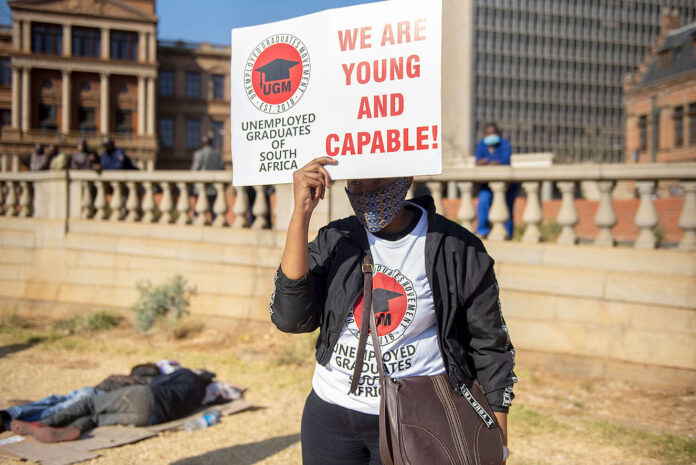
The unemployment rate edged higher in the third quarter, underscoring one of South Africa’s most persistent economic challenges and highlighting the frustration that contributed to the African National Congress (ANC)’s poor showing in last week’s municipal elections.
Data released by Statistics South Africa on Tuesday showed the official unemployment rate rose to 33.7% in the three months to September from 33.6% in the second quarter. The expanded unemployment rate, which includes discouraged work-seekers who have stopped looking for jobs, climbed to 44.0% from 43.8%.
Political and economic pressure
The latest figures are a setback for the ANC-led coalition government, which has prioritised austerity measures, economic reforms and investment-led growth since taking office after the 2024 national election but has struggled to generate enough jobs to absorb new entrants into the labour market.
READ MORE: SA auto industry bodies warn US AGOA blow threatens jobs
The unemployment rate has remained above 30% for six consecutive years and remains among the highest globally, with women, young people and Black South Africans continuing to bear the brunt of the crisis.
Although employment gains were recorded in several sectors, they were insufficient to offset growing labour market pressures.
Mixed picture in the labour market
The finance sector added 111,000 jobs during the quarter, while manufacturing and mining created 33,000 and 31,000 jobs respectively. However, employment declined in private households, agriculture and construction.
The Congress of South African Trade Unions (Cosatu) described the latest data as “beyond depressing” and warned that unemployment had become a national emergency requiring urgent intervention.
“The job losses for 2026 are extremely worrying, with unemployment having increased by 2.4% in the first three quarters of the year,” said Cosatu Parliamentary Coordinator Matthew Parks.
Cosatu calls for intervention
While welcoming the increase of 268,000 formal sector jobs and a net gain of 101,000 employed people, the labour federation said these improvements were not sufficient to keep pace with the growing labour force.
“We cannot continue to normalise 1% economic growth and dangerously high levels of unemployment, poverty and inequality,” Parks said.
READ MORE: IFP’s Hlabisa slams ‘asylum seekers’ who only come to SA for jobs
The federation called for a large-scale economic stimulus package aimed at accelerating growth, rebuilding public and municipal services, expanding public employment programmes and improving access to affordable financing for small businesses and industrial sectors.
Push for a stimulus package
Parks also urged the government to intensify efforts to reduce electricity and fuel costs, restore rail and port infrastructure, invest in economic infrastructure and tackle crime and corruption.
The union federation said it would seek urgent discussions at the National Economic Development and Labour Council (Nedlac) with government and business leaders to mobilise public and private resources to support economic growth and job creation.
Parks said unemployment represented “the single greatest threat to the nation” and called for a response comparable to the measures implemented during the COVID-19 pandemic.
“This is a ticking time bomb we cannot continue to blue tick,” he said.
- South Africa's official unemployment rate increased slightly to 33.7% in Q3 2024 from 33.6% in Q2, according to Statistics South Africa.
- The expanded unemployment rate rose to 44.0% from 43.8%, including discouraged work-seekers who have stopped searching for jobs.
- Employment increased in the finance sector (+111,000 jobs), manufacturing (+33,000 jobs), and mining (+31,000 jobs), but declined in private households, agriculture, and construction.
- COSATU described the unemployment crisis as a "national emergency" and called for a large-scale economic stimulus package and urgent government intervention.
- COSATU plans to seek urgent talks at Nedlac with government and business leaders to mobilize resources for economic growth and job creation.
The unemployment rate edged higher in the third quarter, underscoring one of South Africa's most persistent economic challenges and highlighting the frustration that contributed to the African National Congress (ANC)'s poor showing in last week's municipal elections.
Data released by Statistics South Africa on Tuesday showed the official unemployment rate rose to 33.7% in the three months to September from 33.6% in the second quarter. The expanded unemployment rate, which includes discouraged work-seekers who have stopped looking for jobs, climbed to 44.0% from 43.8%.
The latest figures are a setback for the ANC-led coalition government, which has prioritised austerity measures, economic reforms and investment-led growth since taking office after the 2024 national election but has struggled to generate enough jobs to absorb new entrants into the labour market.
READ MORE: SA auto industry bodies warn US AGOA blow threatens jobs
The unemployment rate has remained above 30% for six consecutive years and remains among the highest globally, with women, young people and Black South Africans continuing to bear the brunt of the crisis.
Although employment gains were recorded in several sectors, they were insufficient to offset growing labour market pressures.
The finance sector added 111,000 jobs during the quarter, while manufacturing and mining created 33,000 and 31,000 jobs respectively. However, employment declined in private households, agriculture and construction.
The Congress of South African Trade Unions (Cosatu) described the latest data as "beyond depressing" and warned that unemployment had become a national emergency requiring urgent intervention.
"The job losses for 2026 are extremely worrying, with unemployment having increased by 2.4% in the first three quarters of the year," said Cosatu Parliamentary Coordinator Matthew Parks.
While welcoming the increase of 268,000 formal sector jobs and a net gain of 101,000 employed people, the labour federation said these improvements were not sufficient to keep pace with the growing labour force.
"We cannot continue to normalise 1% economic growth and dangerously high levels of unemployment, poverty and inequality," Parks said.
READ MORE: IFP's Hlabisa slams 'asylum seekers' who only come to SA for jobs
The federation called for a large-scale economic stimulus package aimed at accelerating growth, rebuilding public and municipal services, expanding public employment programmes and improving access to affordable financing for small businesses and industrial sectors.
Parks also urged the government to intensify efforts to reduce electricity and fuel costs, restore rail and port infrastructure, invest in economic infrastructure and tackle crime and corruption.
The union federation said it would seek urgent discussions at the National Economic Development and Labour Council (Nedlac) with government and business leaders to mobilise public and private resources to support economic growth and job creation.
Parks said unemployment represented "the single greatest threat to the nation" and called for a response comparable to the measures implemented during the COVID-19 pandemic.
"This is a ticking time bomb we cannot continue to blue tick," he said.


