


As we observe International Women’s Day, it is essential to shine a spotlight on the state of women in South Africa and the systemic issues that continue to impede their progress.
The World Economic Forum Global Gender Gap Report (2025) highlights that there is still a combined global average gender gap (measured for 148 countries) of over 30% across four critical dimensions: economic participation and opportunity, political empowerment, educational attainment, and health and survival, and it will take 123 years to reach full parity globally.
Globally, Iceland continues to lead, having closed 92.6% of its gender gap and holding the top spot for sixteen consecutive years. Sub-Saharan Africa ranks sixth globally, with a gender parity score of 68%.
Within the region, Namibia stands out at 81.1% (8th globally). South Africa, at 76.7%, ranks third in the region but 33rd worldwide, reflecting both progress and persistent gaps.
Women worldwide earn approximately 77 cents for every dollar earned by men (UN Women, 2025), highlighting a persistent global wage gap and biases, as women with children earn less than half of their childless counterparts (Columbia University, 2024). In addition, women do 60% more of unpaid labour – from cooking, cleaning, fetching water and firewood and taking care of children and the elderly, women bear a disproportionate burden of unpaid work across the world, thereby limiting the time available for participation in paid work (UN Women, 2016).
The South African picture
For every R100 a man earns, R72.44 is earned by women for the same job (National Business Initiative, 2024). This is also reflected in wage equality, where South Africa ranks 111th (WEF, 2025). This disparity has far-reaching consequences, from deepening economic insecurity for women, to perpetuating generational inequality and diminishing overall economic activity.
According to the IFC (2023) globally, women hold only 23.3% of board seats, 8.4% of board chair posts, 6% of CEO and 17.6% of CFO positions.
Compared to the global average, South Africa fares better. In 2024, women held 36% of board positions in the JSE Top 40, a modest 1% increase from 2023, and 23% of executive positions, a decline of 2% from 2023. Of the top 40 company boards, 12.5% are chaired by women, and women currently hold only 23% of executive management positions (Just Share, 2024).
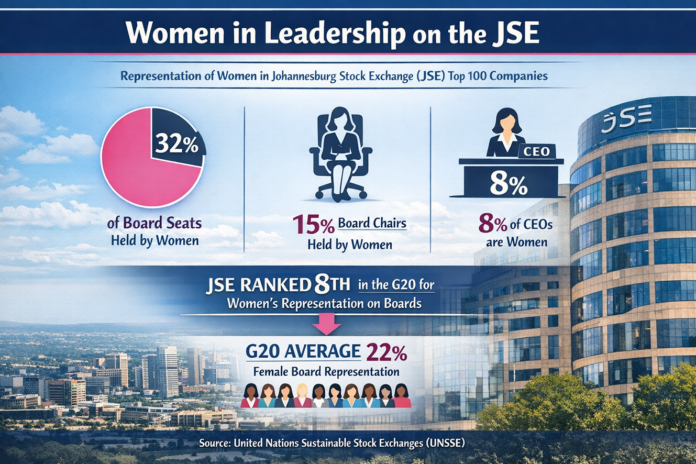
According to the United Nations Sustainable Stock Exchanges (UNSSE) market monitor, which assesses gender equality in corporate leadership across over 2 000 listed companies on the largest stock exchanges in G20 countries, women occupy 32% of board seats in the top 100 JSE-listed companies, hold 15% of board chair positions, and represent just 8% of CEOs.
This analysis ranks the JSE 8th in terms of women’s representation on boards in G20 stock exchanges, with the G20 average for women’s board representation being 22%.
Racialised nature of gender inequality
South Africa’s gender equality journey cannot be understood without recognising the racialised nature of inequality. Post-apartheid, laws enshrined equality, yet economic and leadership spaces remain shaped by historic exclusion.
White women, while facing gendered barriers, have long benefited from racial privilege in education, networks, and access to corporate South Africa. Black African women, by contrast, continue to face a double bind: overcoming both gender discrimination and systemic racial exclusion.
Over the past decade, there have been notable shifts in the racial and gender composition of top management positions in South Africa’s private sector. In 2014, White individuals dominated across both sexes, holding nearly half of all top management positions (47.1% for women, 42.6% for men, and 44% overall).
Black Africans, while forming the majority of the national population, were significantly underrepresented, with only 37.8% of men and 35.2% of women in top positions. Coloured and Indian/Asian groups made up comparatively smaller proportions, typically below 11% across categories.
By 2024, however, the distribution shows a discernible shift. The proportion of black Africans in top management increased across both sexes, reaching 44.4% among women and 41.9% among men, with the overall share for both sexes at 42.8%.
This suggests a slow but steady improvement in addressing historical imbalances and creating greater racial representation in leadership.
Conversely, the proportion of white individuals in top management declined noticeably, falling to 36.2% for men, 38.2% for women, and 36.9% overall. This marks a significant reduction compared to 2014, when whites held the bulk of management positions.
The coloured and Indian/Asian categories show more modest changes.
Indian/Asian representation increased slightly, especially among males (from 10.2% in 2014 to 12.4% in 2024), while coloured representation remained largely stagnant, hovering around 9%–10%, with female representation dropping from 10.4% to 9.4%.
From a gender perspective, female representation in South Africa is rising, and women represent the largest proportion of top management positions in the private sector. More importantly, within female management, the racial shifts are particularly evident: Black African women overtook white women as the largest group in 2024, a reversal from 2014. This is a key milestone in gender–race intersectional progress, highlighting that transformation policies are beginning to be reflected in senior female appointments.
In International Women’s Month, the call is clear to us at the GEPF. The question is no longer whether transformation is necessary; it is whether we are prepared to accelerate it.
The choices made by investors, boards, policymakers, and corporate leaders today will determine whether gender equality remains a distant aspiration or becomes a lived reality within this generation.
At the Government Employees Pension Fund (GEPF), gender equality and leadership are not “women’s issue.” It is an economic imperative, a governance imperative, and a moral imperative. A country that sidelines half its talent cannot compete globally. A corporate sector that fails to reflect the society it serves cannot claim legitimacy. An economy that undervalues women’s paid and unpaid labour cannot unlock sustainable growth.
- Mabesa is principal executive officer of the Government Employees Pension Fund
- As we observe International Women’s Day, it is essential to shine a spotlight on the state of women in South Africa and the systemic issues that continue to impede their progress.
- The World Economic Forum Global Gender Gap Report (2025) highlights that there is still a combined global average gender gap (measured for 148 countries) of over 30% across four critical dimensions: economic participation and opportunity, political empowerment, educational attainment, and health and survival, and it will take 123 years to reach full parity globally.
- Globally, Iceland continues to lead, having closed 92.6% of its gender gap and holding the top spot for sixteen consecutive years.
- Sub-Saharan Africa ranks sixth globally, with a gender parity score of 68%.
- Within the region, Namibia stands out at 81.1% (8th globally).


