


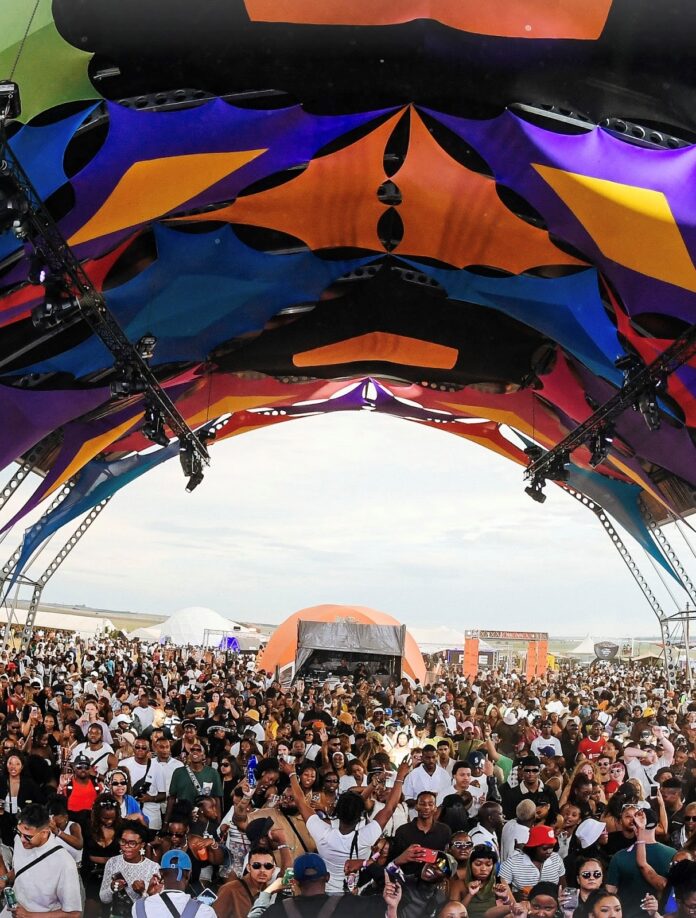
Africa’s tech startup ecosystem is increasingly being organised around large, high-visibility festivals.
From Lagos to Cape Town, Nairobi, Marrakech, and beyond, these events are positioning themselves as deal-making infrastructure—spaces where founders, investors, and corporations transact.
According to sector analysts, tech festivals have become one of the primary arenas through which Africa’s startup ecosystem is organised and shaped.
Alphonce Chinedu, a Nigerian business analyst tracking technology and investment trends across West Africa, notes that the continent’s tech gatherings have undergone a structural shift.
“What we used to have were networking-heavy meet-ups; people exchanged contacts and went home,” Chinedu shared in a WhatsApp call.
“What we are seeing now is a more holistic model. Organisers are building full ecosystem platforms, combining panel discussions with pitch sessions, investor matchmaking, corporate showcases and side events that bring the entire innovation value chain into one place.”
He calls this the festival’s “unification value”: the brief moments when fragmented actors, founders, investors, regulators, and corporates are pulled into the same room and can move from acquaintance to alignment.
Capital meets opportunities
Tech Safari’s founder and CEO, Caleb Maru, shares this perspective: “Tech festivals are now more than networking; they collapse a fragmented ecosystem into a single, visible moment.
“Founders, investors, corporates and regulators come together, accelerating understanding and shortening decision cycles.”
He adds that such events also create pathways for capital to meet opportunities in markets where liquidity flows are slow.
“Africa’s liquidity pipes are clogged. Festivals and curated events create the pressure points where capital actually meets opportunity, helping deals move faster despite structural delays,” Maru said.
This shift is visible in practice at flagship events such as the Africa Startup Festival (ASF) Lagos edition.
Held on Victoria Island in November 2025, organisers report the edition drew 3 000-plus attendees from over 15 countries, with roughly one in three participants at the C-suite level.
The two-day programme featured over 30 speakers and 100-plus curated meetings intended to catalyse investor–founder connections.
Organisers said these metrics were chosen to signal both scale and decision-making capacity in the room.
Festivals can produce outcomes
On the ground, ASF Lagos was staged more like a marketplace. Corporate sponsors and solution providers took prime exhibition space, pitching directly to startups and buyers; payment firms demonstrated cross-border rails; and support bodies announced grants and startup programmes.
Marketing firm St Paul’s Africa, in partnership with Spark Africa, announced a $5 000 (R84 000) marketing grant for early-stage startups, a concrete intervention aimed at lowering the cost of user acquisition.
That mixture of curated investor sessions, corporate activations and grants is the architecture organisers now use to argue that festivals can produce measurable outcomes.
Other examples illustrate what can happen when festivals and deal-making converge.
At the African Startup Conference in Algiers (December 6-8), a large continental forum that reportedly attracted 25 000 participants, including investors, ministers, and ecosystem builders, Algerian travel-tech startup Völz closed a 600-million DZD (about 84-million) Series A led by Tell Group and Groupe Industriel Babahoum Algérie.
Festival-era success
Local reporting frames the deal as a festival-era success, as it marks the first reported exit for Algeria’s state-backed Algerian Startup Fund, which reportedly recorded a 3.35x return on its early investment.
Völz’s product, enabling Algerian customers to book international flights in dinars and offering cash-on-delivery and offline-friendly payment options, addresses a highly localised payment friction and illustrates how event-linked capital can validate market-specific solutions.
Other continental festivals also show measurable follow-on effects.
At GITEX Africa, the Supernova pitch competition is explicitly built as an investor-facing pathway: the 2024 champion, Zambian neobank Lupiya, won a $50 000 prize and, according to follow-up reporting and company statements, used the exposure to secure about $500 000 in follow-on funding while continuing discussions toward larger rounds.
GITEX’s own post-event materials show scale: the 2024 edition hosted nearly 700 startups, 1 500 exhibitors and 30 000-plus visitors, with a substantial investor and buyer presence, conditions that help explain how visibility can turn into traction.
Similarly, B2B-leaning showcases like Africa Tech Summit Nairobi select a small number of vetted ventures (10 in 2025) from hundreds of applicants to present directly to investors, a format designed to compress deal discovery and signal readiness.
“Expanding across Africa isn’t just about raising money; it’s about learning regulations, localising products, and building teams in multiple markets. Events are where this knowledge circulates in real time,” according to Maru.
Industry-level data underline that these festival moments are occurring against an improving funding backdrop.
Billions of dollars raised
Across the continent, startups raised roughly $1.4-billion in the first half of 2025, a rebound that coincided with the run of major summits and investor gatherings—not proof of causation, but a strong correlation that supports the argument that concentrated convenings matter for capital flows.
The global comparative example, Web Summit, reinforces the potential. Nearly 200 startups from its 2024 Startup Programme raised $715.5-million post-event.
The figure demonstrates the magnitude of conference-driven momentum.
Festivals are already evolving into infrastructure by convening buyers, capital, regulators and talent in concentrated time and space.
Maru summarises the effect: “Some of the most valuable outcomes of African tech events aren’t immediate deals, but the conversations, collaborations and ideas that start when the ecosystem shows up in one place.”
“But until organisers and funders commit to transparent post-event tracking and allow independent verification, Africa’s festivals will continue to sit between promise and proof, that is, scaled platforms that clearly matter but whose true economic footprint is only partially visible,” Chinedu concluded.
- Africa’s tech startup ecosystem is increasingly being organised around large, high-visibility festivals.
- From Lagos to Cape Town, Nairobi, Marrakech, and beyond, these events are positioning themselves as deal-making infrastructure—spaces where founders, investors, and corporations transact.
- According to sector analysts, tech festivals have become one of the primary arenas through which Africa’s startup ecosystem is organised and shaped.
- Alphonce Chinedu, a Nigerian business analyst tracking technology and investment trends across West Africa, notes that the continent’s tech gatherings have undergone a structural shift.
- “What we used to have were networking-heavy meet-ups; people exchanged contacts and went home,” Chinedu shared in a WhatsApp call.


