


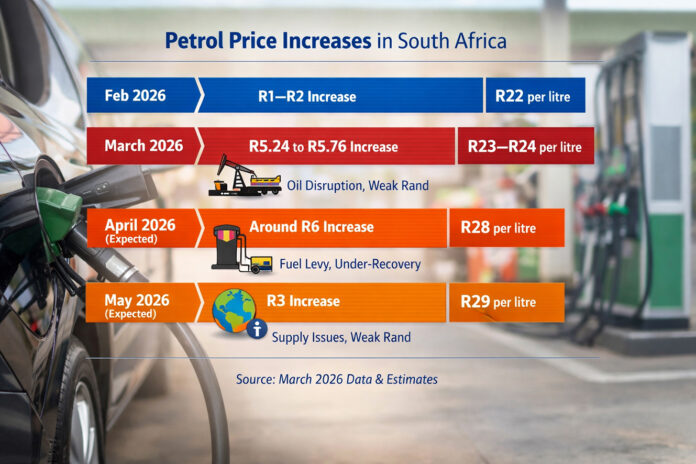
The South African Reserve Bank and National Treasury have been urged to come up with a coordinated response that will cushion the consumers as well as the economy from the anticipated fuel price shock due to the Middle East conflict.
Unisa economics academic Dr Eliphas Ndou is advocating for a fuel price increase that will be staggered over several months instead of once-off lumpsum increase that carries the risk of greater hardship for consumers.
The advice comes after SARB governor Lesetja Kganyago at a briefing to announce the repo rate decision on Thursday presented two scenarios showing that the negative impact of the Middle East conflict on prices of goods would result in the inflation rising to more than the central bank’s target’s tolerance band of 4%. This means the Reserve Bank would have to raise interest rates to tame inflation, and this could happen in the next monetary policy committee meeting taking place in May.
Both scenarios presented by Kganyago on Thursday forecast the inflation reverting to the Bank’s 3% target during the next two years.
Figures published by the Central Energy Fund on Thursday showed that the petrol price would increase by up to R5.81 a litre, while diesel was set to leapfrog by over R10 in April as the Middle East conflict rages on. The war began on February 28, when the US and Israel forces launched airstrikes against Iran, sending oil prices skyrocketing to over $100 a barrel.
On Friday, Iran reaffirmed the Strait of Hormuz, a narrow passage used to ship oil out of the Middle East, closed and threatened countries that were not willing to comply with the order.
Ndou said though both SARB scenarios showed the SARB would not raise rates at an aggressive pace. He said Kganyago should discuss with National Treasury the double whammy effects of raising interest rates on the economy as prices of goods are expected to soar in the
coming months.
Kganyago should advise his principal, finance minister Enoch Godongwana and petroleum resources minister Gwede Mantashe to seek alternative ways to relieve the consumers either through the relaxation of fuel tax levy and/or staggering the increase over a period of months.
“I would advocate for a policy coordination from the National Treasury and the department of minerals, to see how they can spread the price increase of fuel over some time instead of giving people a lumpsum increase of R10, for instance,” he said.
Ndou argued it was not ideal for SARB to consider raising rates where current adverse imported fuel shocks were likely to drive inflation and economic growth in different directions.
“In a case of supply side shock, the inflation goes up and the economic growth goes down. Using interest rates to tame demand is going to worsen economic growth at the expense of lowering the inflation rate. Raising rates when there is a supply side shock is not an ideal approach because it worsens the effects of high inflation on an already weak economic growth.”
“In this case, what SARB is supposed to do is to wait and see if the shock is transitory or it’s going to be permanent because by increasing interest rates SARB is going to worsen economic activity.
“Already inflation is going to be higher which slows down demand, because goods are becoming more expensive and raising interest rates increases the cost of servicing debt. That will be a double charge on the economic growth, which is going to slow down at a bigger pace than before.”
“The high inflation will feed also into workers demanding higher wages, a demand which will result in companies increasing the prices of their goods. This will result in consumers not being able to afford to buy goods at the inflated price and then companies will have to slow down production and lay off workers,”
Another economist Dr Azar Jammine agreed with SARB’s scenarios.
“If the war carries on and the oil prices remain where they are, then fuel prices will be rising and there would be increases in the cost of chemicals that make plastics, which would impact on plastic bags, furniture, cars among other things. And the shortage of gas would result in increases in prices of IT equipment, specifically the microchips. And they will have to raise interest rates, hopefully the war won’t last long and oil prices will fall back quickly.
“It is too soon to raise interest rates right now but I think there is a strong likelihood that we will have an increased interest at the May MPC meeting [if the war continues],” he said.
Jammine shot down the suggestion to have the fuel price increase being phased in gradually over several months. “Then people will complain if oil prices fall, asking why government is still raising the fuel,” he said.


