


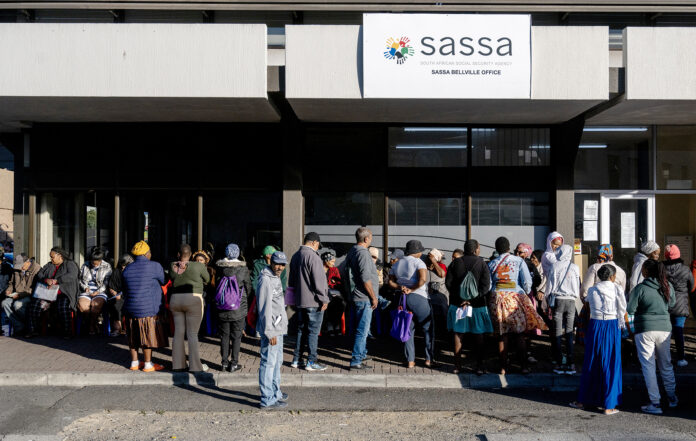
Government plans to link Social Relief of Distress (SRD) grant beneficiaries to job opportunities, skills development and business support as the future of the grant remains contested in court.
In its Medium-Term Budget Policy Statement (MTBPS), government said the grant would be extended for another year while efforts continued to help beneficiaries enter the labour market.
The initiative aims to improve the employment prospects of unemployed people as South Africa continues to grapple with high unemployment.
READ: Cosatu slams ‘Abahambe’ movement: ‘Can’t blame undocumented migrants for joblessness’
“The Social Relief of Distress grant will be extended for another year while work continues on integration with labour market activation, skills development and enterprise support interventions.
“Beneficiaries will be linked to employment, training and business opportunities through MzansiXchange,” the MTBPS document reads.
The extension comes as government continues to argue in court that the grant, introduced as temporary relief during the Covid-19 pandemic, places pressure on the public purse and cannot be extended indefinitely.
Duncan Pieterse, director-general of the National Treasury, said fraud had been identified in the SRD grant system, but investigations by the South African Social Security Agency (Sassa) had helped to curb it.
IEJ calls for a further SRD grant increase
Finance Minister Enoch Godongwana announced a R20 increase in the monthly SRD grant to R370 in his February Budget Speech.
However, the Institute of Economic Justice (IEJ) has argued that the grant should be increased further to provide meaningful support to households struggling with the rising cost of living.
The IEJ wants the Social Relief of Distress (SRD) grant to meet objective standards of adequacy, meaning its value should ideally be raised to meet the official food poverty line, which sits at R855.
Kelle Howson, a labour and social security researcher at the IEJ, has previously argued that direct support through the SRD grant remains an important government intervention to reduce poverty.
She has also raised concerns about the uncertainty created by extending the grant for only one year at a time, arguing that moving away from direct cash transfers could weaken an intervention that has helped people facing poverty.
Pieterse said government was still considering possible alternatives to the grant. However, he stressed that any replacement would have to fit within the available fiscal allocation.
He said government also needed to determine what the grant was intended to achieve, adding that this question had not yet been answered.
Despite the legal challenges, government said it would continue supporting vulnerable households through social grants.
Savings to support fight against GBVF
Government expects the projected decline in beneficiaries to generate R6.2-billion in savings, which will be redirected towards fighting gender-based violence and femicide (GBVF) and tackling child malnutrition and stunting.
As the country continues to face high levels of violence against women and children, government plans to increase the number of sexual offences courts from 55 in 2026/27 to 101 in 2028/29. The number of Thuthuzela Care Centres is also expected to rise from 72 to 80 over the same period.
READ: Ramaphosa announces list of interventions targeting GBV
“A spate of recent murders and attacks on women shines a spotlight on this national crisis. In response, government has reprioritised R3.8-billion over the 2027 MTEF period to appoint 3 552 social workers and strengthen prevention, early intervention, psychosocial support and victim empowerment.
“An additional R157.4-million has been allocated to the Department of Women, Youth and Persons with Disabilities to improve national coordination and oversight.
“To strengthen the criminal justice response, R186-million has been reprioritised for forensic services, investigative capacity and backlog reduction. These allocations complement increasing numbers of sexual offences courts, care centres, victim support programmes and shelters for survivors,” the MTBPS document read.
- Government plans to link Social Relief of Distress (SRD) grant beneficiaries to job opportunities, skills development and business support as the future of the grant remains contested in court.
- In its Medium-Term Budget Policy Statement (MTBPS), government said the grant would be extended for another year while efforts continued to help beneficiaries enter the labour market.
- The initiative aims to improve the employment prospects of unemployed people as South Africa continues to grapple with high unemployment.
- READ: Cosatu slams ‘Abahambe’ movement: ‘Can’t blame undocumented migrants for joblessness’ “The Social Relief of Distress grant will be extended for another year while work continues on integration with labour market activation, skills development and enterprise support interventions.


