


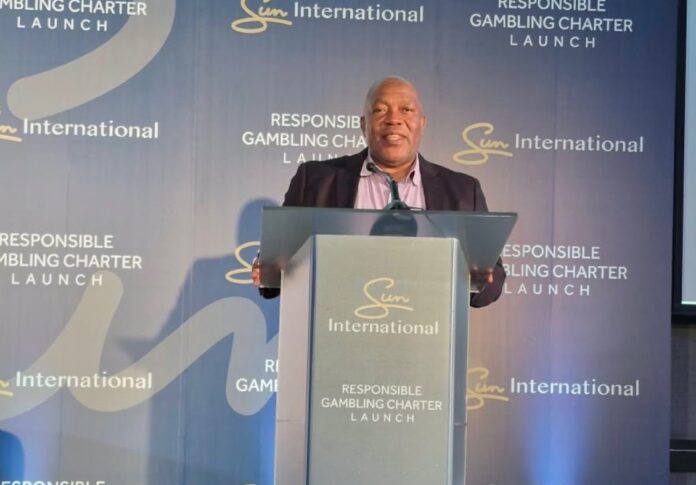
The National Gambling Board (NGB) has expressed concern over a growing number of students and social grant recipients using government-provided funds for gambling activities.
Speaking with Sunday World after delivering a formal address at the launch of Sun International’s Responsible Gambling Charter, acting NGB chief executive Lungile Dukwana said the regulator was increasingly concerned about vulnerable groups being exposed to harmful gambling practices.
“There is a growing prevalence of students and social grant recipients using money received through NSFAS and SASSA for gambling purposes,” Dukwana said.
He said the NGB welcomed initiatives such as Sun International’s Responsible Gambling Charter because irresponsible gambling continued to pose significant challenges for consumers and regulators alike.
“We are supporting the work that Sun International is doing in terms of the Gambling Charter that they have adopted because the challenges we face around gambling are mainly irresponsible gambling but also vulnerable groups that get exposed to gambling,” said Dukwana.
According to Dukwana, vulnerable groups include people under the age of 18, students receiving financial aid through the National Student Financial Aid Scheme (NSFAS), and recipients of South African Social Security Agency (SASSA) grants.
“That’s our concern because if you target those specific groups, it means that the intended purpose for which those funds are provided is undermined. It pushes people into even more difficult circumstances than they would otherwise face.”
Protecting vulnerable consumers
Dukwana said responsible gambling required operators and regulators to actively safeguard vulnerable consumers from harmful gambling behaviour.
“Responsible gambling entails safeguarding vulnerable groups and protecting them from practices that expose them to financial and social harm.”
Read more: A generation at risk: Why South Africa must tighten gambling laws
He said the trend was not new, with regulators having previously identified cases involving university students and social grant beneficiaries spending their income on gambling.
“We have seen this issue before, where young people at universities and social grant recipients have used that money for gambling.”
The NGB has subsequently strengthened its engagement with NSFAS to increase awareness about responsible gambling and financial decision-making.
“That is why the NGB spends a lot of time working with NSFAS to promote awareness around responsible gambling and what it means to gamble responsibly.”
Promoting licensed gambling operators
Dukwana emphasised the importance of consumers using licensed operators, arguing that regulated operators are required to comply with responsible gambling measures and consumer protection standards.
“People need to understand why it is important to gamble with licensed operators. Licensed operators are required to implement safeguards, and responsible gambling forms part of their compliance obligations. If consumers are treated unfairly, they also have avenues for recourse.”
At the same time, he acknowledged that adults have the legal right to gamble and that awareness remained the most effective approach.
“Responsible decision-making is also important. We cannot simply tell people to stop gambling. They are adults and the law allows individuals over the age of 18 to participate. What we must do is ensure there is adequate awareness, and as the NGB we must maximise that awareness.”
Industry undergoing rapid digital transformation
Earlier, when delivering his formal address, Dukwana said the gambling industry was changing rapidly due to technological innovation and the growth of online betting.
Read more: Access to online gambling lures more young people to addiction
“The gambling landscape in South Africa, across Africa and globally, continues to evolve at a rapid pace. Technological advancements are reshaping the industry, with gambling increasingly shifting from traditional land-based venues to digital platforms.”
He noted that betting now accounts for the largest share of South Africa’s Gross Gambling Revenue (GGR), estimated at about R84.5-billion, with around 60% of betting activity taking place online. Gambling participation is estimated at roughly 65% of the population.
“As regulators, our role extends beyond issuing licences and enforcing compliance. We are tasked with ensuring that gambling is conducted fairly, transparently and responsibly, while protecting consumers and preserving public confidence in the industry.”
New generation of gamblers
According to Dukwana, the profile of gamblers has changed dramatically.
“Today’s consumers expect instant access, live betting opportunities, cashless payments, personalised digital experiences and the flexibility to participate whenever and wherever they choose.”
He cited industry data indicating that approximately 95% of active bettors across major African markets, including South Africa, Nigeria, Kenya and Ghana, place wagers using mobile devices.
“Gambling is no longer confined to a particular place or time. It is available in the palm of one’s hand twenty-four hours a day.”
While digital access brings convenience, it also places greater responsibility on regulators and operators.
“The safeguards designed to protect consumers must evolve alongside technology. Responsible gambling can no longer rely solely on information provided at the point of sale. Protection must be embedded throughout the entire customer journey.”
Dukwana said this should include identity verification, affordability assessments, player education, behavioural monitoring, self-exclusion tools and access to support services.
Fighting illegal and offshore gambling
Dukwana identified illegal and offshore gambling as one of the most significant threats facing the industry.
“One of the greatest challenges facing regulators today is the fragmented nature of regulation across the African continent. Offshore operators can reach consumers through websites, mobile applications and international payment systems, often beyond the effective reach of individual national regulators.”
He argued that South Africa should continue working towards greater localisation of gambling activity within the regulated market.
“My view is that we should work towards total channelisation within the regulated local market. Every gap left for unregulated offshore operators becomes increasingly difficult to close.”
The NGB and provincial licensing authorities remain focused on combating illegal gambling and protecting consumers from unregulated operators.
Responsible gambling beyond compliance
Dukwana described Sun International’s Responsible Gambling Charter as an important industry initiative that goes beyond regulatory compliance.
“Technology itself is neither good nor bad. Its impact depends entirely on how it is used. We should embrace innovation, but ensure it serves consumers responsibly and ethically.”
He also voiced concerns over growing levels of gambling advertising and its potential impact on vulnerable groups.
“Advertising has become increasingly widespread and has, in some respects, normalised gambling. This raises concerns, particularly when advertising falls outside the spirit or provisions of existing legislation.”
To address these issues, the NGB has developed advertising norms and standards aimed at protecting minors, students, vulnerable consumers and social grant beneficiaries from harmful gambling marketing.
- The National Gambling Board (NGB) expressed concern about students and social grant recipients using NSFAS and SASSA funds for gambling.
- The NGB supports Sun International's Responsible Gambling Charter to address irresponsible gambling and protect vulnerable groups.
- Online betting accounts for about 60% of South Africa’s betting activity, making up a large part of the estimated R84.5-billion Gross Gambling Revenue.
- The gambling industry is rapidly shifting to digital platforms, with approximately 95% of active bettors in major African markets wagering via mobile devices.
- Illegal and offshore gambling remain major challenges, prompting calls for greater localisation and total channelisation within South Africa's regulated market.


