


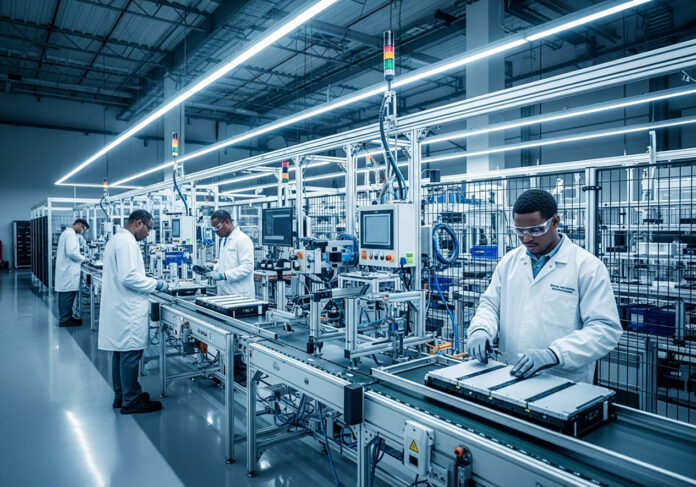
South Africa’s emerging battery-manufacturing industry has taken a decisive step onto the policy stage.
Six domestic manufacturers have formed the South African Battery Manufacturers Association (Sabma), calling on the government to introduce local-content designation for industrial and utility-scale battery energy storage systems (BESS).
Together, they suggest that if South Africa wants to build a competitive green-technology sector, it must protect and promote local capacity before imports displace it.
The founding members, BalanCell, BlueNova Energy, Creslow Energy Solutions, Freedom Won, Maxwell + Spark and Solar MD, represent some of the country’s largest lithium-battery and inverter producers.
Together they argue that South Africa already has the skills, industrial base, and innovation ecosystem to support large-scale manufacturing of energy-storage systems but faces market-distorting pressures from subsidised or underpriced imports dominating the public procurement pipeline.
“Local manufacturers can meet industrial and utility-scale requirements, but we are being overlooked,” says chairperson and initiator of Sabma, Dr Louis Serfontein.
“We are calling for tariff reform and local-content designation to safeguard a strategic sector before the window closes.”
South Africa is accelerating grid-scale storage procurement to stabilise a renewables-heavy energy system from Eskom’s BESS programme to private sector mining, industrial and commercial deployments.
These investments represent billions in future orders.
Sabma reports that local manufacturing of battery systems and inverters could support high-skill jobs in electrochemistry, materials engineering, embedded systems, and advanced manufacturing.
It can also reduce long-term dependency on imports for a technology critical to national energy security and build a competitive manufacturing hub for Africa and global export markets.
Additionally, (it can) leverage local mining strength to expand into upstream value chains, including cathode materials, cell components, and full battery assembly.
Despite growth in assembly and system integration, South Africa lacks commercial production of lithium-ion battery cells used in BESS.
In 2023, the country imported about $1.75-billion (R29.5-billion) of lithium-ion cells and battery packs, according to UNCTAD.
Because the country does not differentiate, under current tariffs, between imported cells (which local firms need to assemble packs) and fully assembled battery systems, local manufacturers argue they are unfairly disadvantaged.
They warn that without a new tariff code to distinguish “cells only” from “complete systems”, there is little incentive to invest in domestic integration and
local manufacturing.
Sabma wants local-content requirements added to all publicly procured industrial and utility-scale BESS projects, aligning with SA’s localisation drive across renewable energy, electric vehicle manufacturing, and grid infrastructure.
This is not protectionism for its own sake. It is an attempt to ensure South African factories survive the surge in cheap foreign systems and public procurement supports the domestic industry, rather than hollowing it out.
The association says it is ready to meet the government halfway by already engaging with the Department of Trade, Industry and Competition, technical colleges, and universities to expand training in electrochemistry, battery design, thermal management, and quality control.
South Africa is well-positioned to become an important player in the rapidly expanding global battery value chain.
The World Bank, drawing on analysis by Customized Energy Solutions, projects that South Africa’s own battery-storage market could surge from 270MWh in 2020 to about 9.700MWh by 2030 in a base case outlook, and up to 15.000MWh in a high-growth scenario.
The analysis also finds that investing in local battery mineral beneficiation and BESS integration can create 25 000 jobs while adding R18.8-billion to the country’s gross domestic product by 2030.
If the country fails to create procurement space for local producers now, Sabma warns, foreign manufacturers will dominate the market before local capacity can scale.
Sabma’s launch signals that local manufacturers are ready to play the long game. What happens next will depend on whether procurement rules, tariff codes, and industrial-policy levers are aligned with that ambition.
Visit SW YouTube Channel for our video content
- South Africa’s emerging battery-manufacturing industry has taken a decisive step onto the policy stage.
- Six domestic manufacturers have formed the South African Battery Manufacturers Association (Sabma), calling on the government to introduce local-content designation for industrial and utility-scale battery energy storage systems (BESS).
- Together, they suggest that if South Africa wants to build a competitive green-technology sector, it must protect and promote local capacity before imports displace it.
- The founding members, BalanCell, BlueNova Energy, Creslow Energy Solutions, Freedom Won, Maxwell + Spark and Solar MD, represent some of the country’s largest lithium-battery and inverter producers.
- Together they argue that South Africa already has the skills, industrial base, and innovation ecosystem to support large-scale manufacturing of energy-storage systems but faces market-distorting pressures from subsidised or underpriced imports dominating the public procurement pipeline.


