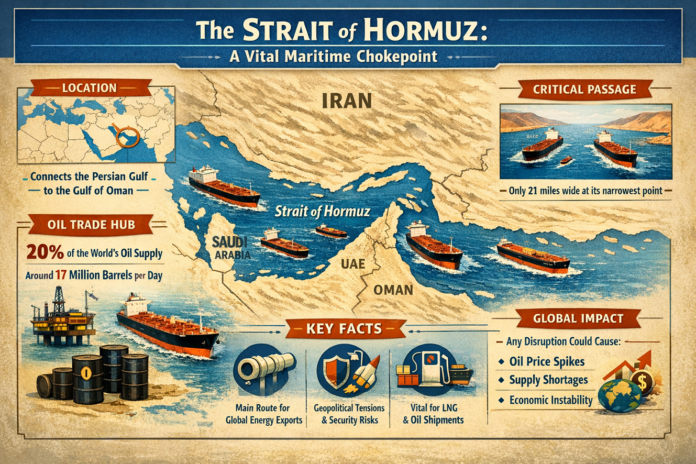

Most South Africans have never heard of the Strait of Hormuz.
Yet, in recent weeks, this narrow stretch of water – barely 30km wide at its tightest point – has reminded the world of a simple but uncomfortable truth: global power is not absolute. It is constrained by geography, by interdependence, and by the fragile systems that keep economies functioning.
For all the rhetoric of dominance and control, even the world’s largest economies are exposed.
The latest Middle East tensions, centred around this critical chokepoint, appear to have forced a sobering realisation in Washington.
It is one thing to project power; it is another to manage the consequences of disruption in a world where supply chains, energy flows, and financial systems are deeply intertwined.
Roughly a fifth of the world’s oil passes through the Strait of Hormuz. That is not just a statistic – it is leverage. It means that a regional conflict can become a global economic event almost overnight.
And that is precisely what we are witnessing.
Oil markets react immediately. Prices rise not only on actual disruption, but on the fear of disruption. And in a world still heavily dependent on fossil fuels, that fear translates directly into inflation, tighter monetary policy, and slower growth.
This is not just about the Middle East. It is about the limits of unilateral power in a multipolar world.
The assumption that any one country can “rule” the global economy is being tested in real time.
The reality is far more complex.
The United States depends on global energy stability. China depends on trade flows. Europe depends on both. And emerging markets, like South Africa, sit at the receiving end of these interconnected pressures.
We are all, whether we like it or not, part of the same system.
The question now is whether this moment becomes a turning point.
History suggests that periods of geopolitical stress often accelerate shifts in economic alliances. Trade routes are reconsidered. Strategic partnerships are redefined. Countries begin to prioritise security of supply over cost efficiency.
We may be entering such a phase.
For the US, this could mean a renewed focus on energy independence and reshoring key industries.
For China, it may reinforce efforts to secure alternative trade corridors and deepen ties within its sphere of influence.
For Brics nations, including South Africa, it raises more complex questions about alignment, strategy, and economic positioning.
Because while Brics has long been framed as an alternative bloc, moments like these expose its internal contradictions. Member countries have differing interests, varying levels of exposure to global shocks, and, in some cases, conflicting geopolitical priorities.
South Africa, in particular, must tread carefully.
Its economic reality is clear: it is a small, open economy, heavily reliant on trade, capital flows, and imported energy. It does not have the luxury of ideological positioning without economic consequence.
If global tensions lead to more fragmented trade systems, South Africa risks being squeezed – caught between competing powers, with limited leverage of its own.
But this is not only a story of risk.
It is also a moment of strategic opportunity – if approached correctly.
For South African companies, the lesson is clear: the future will belong to those who prioritise resilience over efficiency.
For decades, globalisation rewarded cost minimisation. Just-in-time supply chains, concentrated sourcing, and lean operations were the benchmarks of success. But in a more volatile world, those same strategies become vulnerabilities.
The new imperative is diversification.
Diversification of suppliers. Diversification of markets. Diversification of revenue streams.
Companies that rely heavily on a single import source, a single export destination, or a single currency exposure are increasingly at risk. The events around the Strait of Hormuz are a reminder that disruption can emerge quickly, and from unexpected places.
Energy strategy, in particular, will become critical. Businesses that can reduce reliance on volatile fuel inputs, whether through efficiency, alternative energy, or localised production, will have a structural advantage.
There is also a broader strategic shift required.
South African firms need to think globally, but operate pragmatically. This means understanding geopolitical risk, not as an abstract concept, but as a core business variable. It means scenario planning. It means building flexibility into operations.
And importantly, it means recognising that the rules of the game are changing.
Governments, too, have a role to play.
Policy certainty, infrastructure investment, and a clear trade strategy will be essential if South Africa is to navigate a more fragmented global economy. Without this, the private sector will struggle to position itself effectively.
But perhaps the most important takeaway is this:
The world is more interconnected than ever, but also more fragile.
The Strait of Hormuz has simply exposed what was always true. No country operates in isolation. No economy is immune to external shocks. And no amount of political rhetoric can override the realities of global interdependence.
For South Africa, the path forward is not to retreat, but to adapt.
To build resilience. To remain flexible. To engage strategically with a changing world.
Because in an era where a narrow stretch of water can shake the global economy, success will not belong to those who assume stability, but to those who prepare for instability, and position themselves to navigate it.
- Van Doesburgh is head of economics, and a commentator on South Africa’s economic landscape, focusing on financial markets, policy, and business strategy. vandoesburghm@cput.ac.za
- Most South Africans have never heard of the Strait of Hormuz.
- Yet, in recent weeks, this narrow stretch of water – barely 30km wide at its tightest point – has reminded the world of a simple but uncomfortable truth: global power is not absolute.
- It is constrained by geography, by interdependence, and by the fragile systems that keep economies functioning.
- For all the rhetoric of dominance and control, even the world’s largest economies are exposed.
- The latest Middle East tensions, centred around this critical chokepoint, appear to have forced a sobering realisation in Washington.