


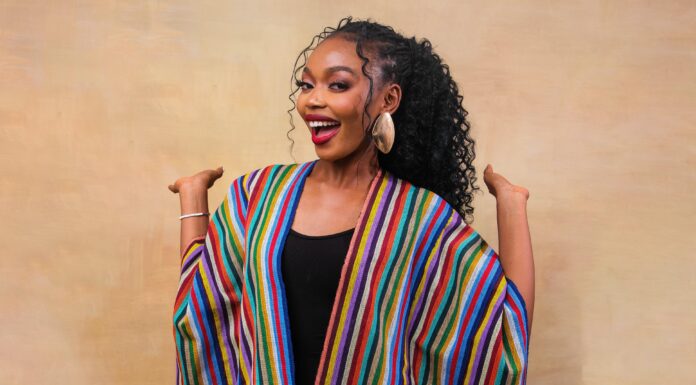
It’s a warm, humid Saturday in Abuja. Hafsat Abdullahi is prepping for a film shoot on location in a quiet neighbourhood.
The cinematographer waits for the director’s call for action. Hafsat takes a deep breath to get into character.
After a few moments, she emerges, not as Hafsat, but as Havfy, a virtuoso spoken word performer (who can also be referred to as a slam poet) who is making waves in Nigeria’s poetry scene.
She performs on stage as well as online, filming her recitations for social media platforms. Havfy has more than 700 videos across multiple online platforms.
Depending on the brief, location and concept, a typical one-day shoot could cost between $400 (R6 807) and $1 000.
Crew size also varies between five and 15 persons. It’s all part of a trend that has seen poets, like Havfy, adding value to Nigeria’s creative industry, also known as the orange economy.
A growing number of Nigerian poets are releasing their work as spoken word albums on streaming platforms or as visual poems on social media.
Alongside Havfy, Nigerian slam poets like Ibquake and TheGlobalPoet have sizeable streaming followers.
Havfy said her net worth as a poet and spoken word performer exceeds 70-million naira (R849 950).
In 2025, TheGlobalPoet, a 22-year-old Nigerian poetess whose real name is Deborah Johnson, won a 30-million-naira cash prize on De9jaspirit Talent Hunt, a Nigerian contest show that features musicians, comedians and dancers competing on the same stage.
The developments speak to the rising appeal of spoken word in Nigeria’s creative and entertainment sectors.
2025 Young Leader for SDGs
Slam poets are frequently employed by civil society and human rights organisations to perform for large audiences, including at events and commemorations organised by the UN.
Havfy was named as a 2025 Young Leader for the Sustainable Development Goals (SDGs) by the UN.
“Before now, I was just a regular girl from northern Nigeria living my life battling school. I was a fresher at Ahmadu University. I do poetry, but it was more of like something I do as a passion and a side hobby,” she told bird.
Havfy’s creative journey began in northern Nigeria, where she was raised in an interreligious home by parents she described as “two adults who are truly in love with each other”.
She said her father, who is Muslim, and her mother, a Christian, taught her to appreciate tolerance.
It was a tough lesson, particularly in northern Nigeria, where strife between Muslims and Christians is rife.
Inspired by the illustrious Nigerian poet Niyi Osundare, she began to hone her performance skills by interacting with poets at the Abuja Literary Society, which regularly organises slams. The competition is usually fierce, and judges announce winners with slim margins.
“I didn’t think too much into what I was doing, but I knew for a certainty that I used my poetry to tackle societal vices; I’ve always done it.
“I didn’t understand why I did it, but I did. Whenever I see something I’m not comfortable with, from rape to any form of injustice that has happened within my small locality, I speak up about it, and the reason I use poetry at the time is because that was the only way that people could actually listen to me. Because it was more like a colorful and catchy way to get people’s attention,” she said.
Havfy has garnered attention not only among fellow poets but also from creatives in other spaces.
Nigerian music executive and producer Don Jazzy reposted a video of Havfy reciting one of her poems on anti-colonialism, and the repost went viral.
He described her as his “new obsession” and invited her for a meeting. The endorsement from one of Nigeria’s biggest entertainers validated the value of poetry.
Power of social media
Dr Bash Amuneni, one of the organisers of the recently held national Slam of Champions, remarked on the leverage that young poets have garnered using social media to amplify their art.
“A lot of them are doing great numbers online. You see a poetry video, and it’s doing 10K views, 20K views, up to 100K views, and it’s amazing to see,” he told bird.
“So, I’m very grateful for what’s going on, and I think it should be something we should look at and encourage, you know.”
Despite the growing visibility of Nigerian poets, their poetry is not featured in the country’s tourism and creative metrics. In the third quarter of 2025, the Nigerian Federal Ministry of Arts, Culture and Creative Economy released a Creative Economy Report that captured and mapped the broad spectrum of the creative industry in Nigeria. Spoken word was overlooked.
The Nigerian government introduced the term “creative economy” in its national policy framework in 2014.
Following the rebasing of the economy within the same year, creative economy indices began with tracking the contribution of the cultural component as a key non-oil revenue to the nation’s GDP.
By 2019, The National Digital Economy Policy and Strategy was launched, with a resultant impact seen in the attention it drew to the digital creative skills.
In 2023, the federal administration of Nigeria’s President Bola Tinubu created the Federal Ministry of Arts, Culture, Tourism and the Creative Economy.
The agency aims to promote and harness the economic potential of what is known as “Nigerian content”.
Within Africa and beyond, Nigerian music, films, and fashion drive pop culture and attract millions of dollars in investment.
The Nigeria Creative Economy Report of 2025 revealed that Nigeria has improved its position on cultural diplomacy when its “Global Soft Power Ranking” rose 16 places from 93rd in 2023 to 77th in 2025.
On the economic front, the same report values the formal, measurable creator economy at $31.2-million, with fashion, music, and Nollywood’s box office contributing the largest chunk.
Other emerging categories, according to the report, include gaming, immersive technological experiences, and homegrown streaming platforms.
The country is marshalling its plans to grow its creative economy to contribute $100-billion to its GDP by 2023.
The plan entails a transformation of the sector from a low-contributing industry to a major economic pillar.
It aims to create well over 2-million jobs in the creative sector yearly by leveraging Nigeria’s music, film, fashion, and digital content.
However, poets assert that the government does not view them as valuable contributors to the economy.
“I think that’s a mistake,” Amuneni told bird. “The poets need encouragement. It’s a struggle just being a poet because people don’t really take you seriously, but we are making many efforts, and we are adding some value.
“Because if poets were not adding value, then you wouldn’t have brands coming around to say, ‘come and be my brand ambassador. Do a commercial using poetry’,” he said.
30-million jobs generated
Abdulmalik Yahya is a Nigerian author, poet, social entrepreneur, and UN SDG advocate with more than seven years of experience in advocacy and community development.
He is the founder and president of the Sahel Scribes Poetry Club, where he mentors over 300 emerging poets in northern Nigeria.
He is passionate about harnessing the potential of slam poetry as a burgeoning industry that can help drive growth in Nigeria’s economy.
“They [poets] are publishing, if you like me to use that word, on platforms like Spotify and what have you.
“And if you look at the data of 2025 alone, Nigerian creatives received royalties as Nigerian creatives,” he said, “You can actually tap into it and get something from it.”
According to the World Bank report, cultural and creative sectors generate 30-million jobs globally and account for 6.2% of all employment.
In 2022, the share of people employed in cultural occupations in low-income countries stood at 25.3% in Uganda, 27.1% in Ghana, and 33% in Pakistan, according to the World Bank.
Nigeria’s slam poetry ecosystem captures not only the poets themselves but also other creatives, such as cinematographers, makeup artists, production managers, and event organizers.
It is a grassroots community that was built about twenty years ago, mainly in Abuja where it was led by the cherished Abuja Literary Society.
Other local organisations like the Sahel Scribes Poetry Club and Naija Poetry Fest in Lagos are leveraging the power of the collective to build a momentum that is slowly propelling what has largely been an “underground” scene into the mainstream creative sector.
The Slam of Champions traveled nationwide. Jeremiah Priest, one of the 15 slam contestants, travelled more than 620km to reach Abuja for a chance to participate in the national championship. He speaks highly of Havfy.
“I know quite a lot of people that look up to Havfy,” he told bird. “So, I think she’s doing well in her field. I think she’s an inspiration, and it’s a pathway, really. She opens pathways, and it’s an excellent thing to see.”
Painting realities in people’s minds
Oreva Olujimi was one of the judges at the Slam of Champions. She is also a finance expert, poet, author, and spoken word artist.
She has two albums on Spotify and Apple Music. She believes that there should be a firm handshake between investment and the arts.
“I think poetry is already contributing as much. Events like these, like the Slam of Champions, are one of the ways we discover art and talent.
“The beauty of our poetry and the beauty of words is that you can paint stories and paint colours and paint realities in people’s minds that otherwise would not have been seen. And I think there’s a place for that. I think there’s a market for that,” she said.
“There’s a bridge that needs to be built between the people who need to recognise us and the talent that we have, and being able to cross that bridge, for example, when the winner goes to South Africa.
“If they do well, that’s a win for Nigeria as a whole. Think of what it will do for just our creative economy,” Olujimi said.
Nigerian poets are not only collaborating with big brands to promote products, but they are also filling venues.
In Abuja’s popular Transcorp Hilton where diplomats and international celebrities lodge, a hall is packed with spectators who eagerly wait for the next slammer to appear.
Havfy walks up and delivers a rousing poem that dazzles the audience.
- It’s a warm, humid Saturday in Abuja.
- Hafsat Abdullahi is prepping for a film shoot on location in a quiet neighbourhood.
- The cinematographer waits for the director’s call for action.
- Hafsat takes a deep breath to get into character.
- After a few moments, she emerges, not as Hafsat, but as Havfy, a virtuoso spoken word performer (who can also be referred to as a slam poet) who is making waves in Nigeria’s poetry scene.


