


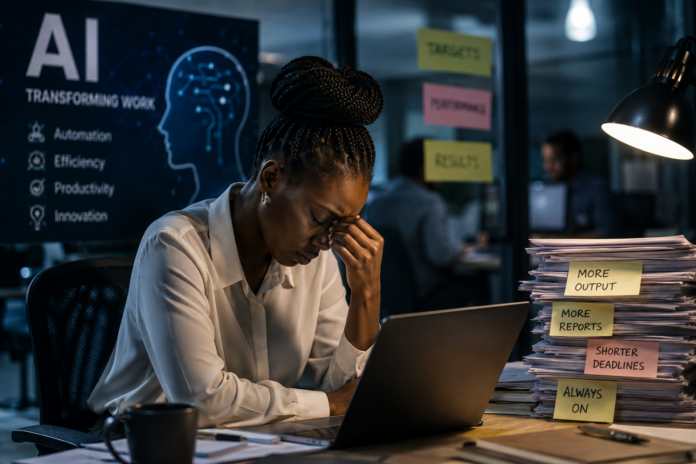
As South African companies race to embrace artificial intelligence (AI) to improve productivity and cut costs, a leading workplace mental health expert has warned that the technology could be accelerating burnout rather than easing employees’ workloads.
While AI has been widely celebrated for boosting efficiency and automating routine tasks, Prof Renata Schoeman, head of healthcare leadership at Stellenbosch Business School, believes organisations are overlooking its growing impact on workers’ mental health.
“We are having extensive conversations about AI governance, ethics and cybersecurity, which are all essential. But we are largely ignoring the human consequences,” Schoeman said.
“AI is not only a technology issue. It is a leadership, mental health and psychosocial risk issue.”
Depression and anxiety
The warning comes as global research estimates that depression and anxiety cost the world economy around US$1-trillion annually in lost productivity, with approximately 12 billion working days lost every year. Heavy workloads and relentless work demands remain among the biggest contributors.
Closer to home, around 13% of South African employees live with a diagnosed mental health condition, while more than a third of workers experience excessive daily stress.
According to Schoeman, the biggest danger posed by AI is not widespread job losses but the way it quietly changes workplace expectations.
“The popular fear is that AI will replace everyone. That makes headlines, but it misses the more immediate threat,” she said.
“The greater risk is that AI quietly intensifies work today. Faster outputs become higher expectations, efficiency gains become pressure to do more and constant connectivity becomes normal. Within that, recovery disappears.”
She warned that employees may find themselves responding faster, producing more and being monitored more closely while becoming increasingly exhausted and psychologically unsafe.
Uncertainty about the future
Schoeman said anxiety surrounding AI often has less to do with the technology itself than with uncertainty about the future.
“Employees do not necessarily fear the tool itself. They fear what the tool represents. They fear becoming obsolete, losing autonomy or being managed by algorithms rather than leaders. They fear that expectations will rise while support declines.”
She added that uncertainty itself places a significant psychological burden on workers.
The concerns are particularly relevant in South Africa, where AI adoption is unfolding against a backdrop of stubbornly high unemployment, widening inequality and ongoing economic pressures.
“In South Africa, AI anxiety lands on top of existing anxiety. People are worried about finances, job security and an uncertain future. AI enters that reality. It does not enter a vacuum,” she said.
Despite AI becoming increasingly common in workplaces, many organisations appear unprepared for the transformation.
Research cited by Schoeman shows that more than 42% of employees believe their employers are not assessing AI’s impact on workplace culture and staff wellbeing.
Among younger workers, almost one-third of Gen Z and millennials believe their organisations are not ready for the changes AI is bringing, while more than 84% of companies have yet to redesign jobs around AI capabilities.
Caution against AI-powered employee surveillance
Schoeman also cautioned against AI-powered employee surveillance, saying constant monitoring can damage trust and reduce psychological safety.
“Surveillance is not the same as support. When employees feel constantly monitored, trust erodes, psychological safety declines and autonomy diminishes. Without trust, performance ultimately suffers,” she said.
Rather than measuring only productivity, organisations should also evaluate whether employees have sufficient time to recover from increasingly demanding workloads.
“The question is not only whether AI improves productivity but whether AI improves recovery,” Schoeman said.
“If people are working faster, answering more emails, attending more meetings and remaining connected for longer hours, then efficiency gains may simply be disguising exhaustion.”
She argued that burnout should not be viewed as an individual’s inability to cope but as evidence that something within the workplace itself needs to change.
“Exhausted people do not need motivational posters. They need healthier work.”
Schoeman urged employers to place psychological safety at the centre of their AI strategies by communicating clearly about workplace changes, investing in employee training, protecting boundaries around after-hours work, involving staff in AI-related decisions and equipping managers to support employees experiencing anxiety about technological change.
“Artificial intelligence has extraordinary potential. But if organisations use it simply to extract more output from already depleted people, we risk creating a future of work that is technologically advanced and psychologically unsustainable.”
Visit SW YouTube Channel for our video content
- Prof Renata Schoeman warns that while AI boosts productivity, it may accelerate employee burnout by intensifying workloads and raising expectations, harming mental health.
- AI increases work pressure through faster output demands, constant connectivity, and closer monitoring, reducing recovery time and psychological safety.
- Anxiety about AI is driven more by uncertainty about the future, fear of obsolescence, and loss of autonomy than by the technology itself, especially in South Africa’s challenging economic context.
- Many South African organizations are unprepared for AI’s cultural and wellbeing impacts, with a significant portion of employees feeling unsupported and jobs not redesigned to leverage AI effectively.
- Schoeman urges employers to focus on psychological safety by involving staff in AI decisions, limiting surveillance, protecting work boundaries, and prioritizing recovery alongside productivity.


