



For many employees, admitting that they are struggling with their mental health at work can feel like a professional risk. They may worry about being judged, losing opportunities or being perceived as incapable of handling their responsibilities. Others may fear that disclosing personal challenges could change how their managers view them.
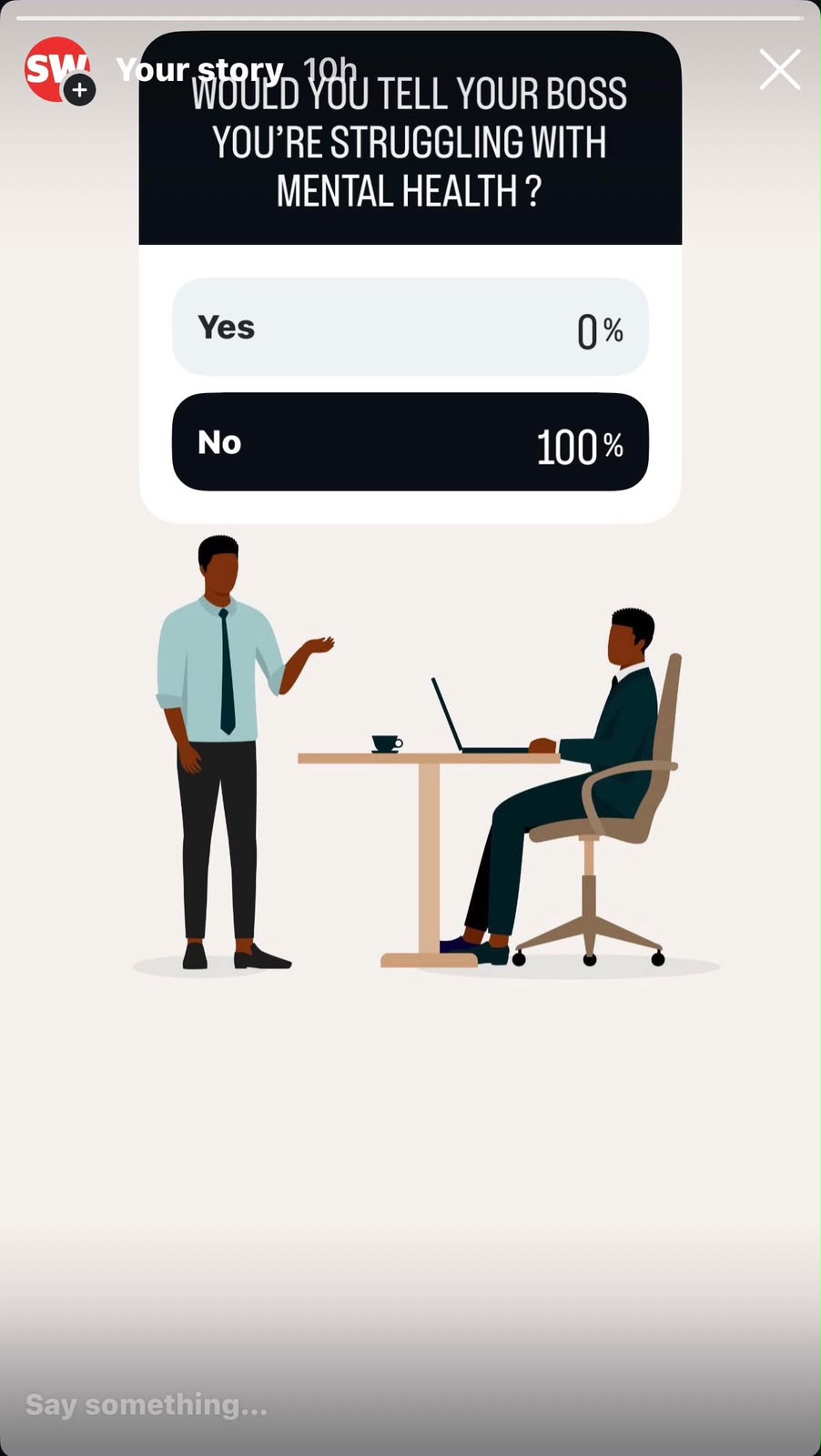
So, even when companies offer wellness programmes, some employees may choose to remain silent rather than ask for help. A Sunday World Instagram Stories poll brought this concern into focus, with 100% of respondents saying they would not feel comfortable telling their employer that they were struggling with their mental health.
The poll reflects the views of those who participated and is not representative of the entire South African workforce. However, it raises an important question: what does this say about workplace culture when employees do not feel safe enough to ask for support?
The answer may partly lie in psychological safety, a concept that goes beyond formal wellness policies to examine whether people feel comfortable speaking honestly, raising concerns and asking for help without fear of humiliation or negative consequences.
A wellness policy is only the beginning
The Sunday World poll offers a snapshot of how uncomfortable participating respondents feel about discussing mental health with their employers. It cannot establish how widespread that fear is, but it highlights a question businesses should not ignore.
A company may have wellness initiatives in place, yet those initiatives can have limited value if employees do not trust the environment in which they are expected to use them. Burger says organisations should ask whether employees actually feel safe enough to use available support, speak up and be honest when they are struggling.
For employers, that means looking beyond policies and programmes to the everyday behaviour that shapes workplace culture.
For employees, it means recognising that asking for help is not a failure of professionalism.
Why employees choose silence over support
Telling a manager that your mental health is suffering can be a difficult decision, particularly in workplaces where long hours, constant availability and high performance are treated as signs of commitment.
Employees may worry that speaking up will affect their career prospects or cause colleagues to question their ability to do their jobs. Others may have witnessed colleagues being dismissed, criticised or treated differently after raising concerns. Even without a direct negative experience, the fear of being labelled unreliable may be enough to keep someone quiet.
Annemie Burger, HR director at brand and communications agency Penquin, says workplace mental health should not be viewed only through the lens of stress and burnout.
“Mental health in the workplace is about much more than whether employees are experiencing stress or burnout,” says Burger.
“It is also about whether people feel safe enough to be honest about how they are doing, to ask for support when they need it and to express an opinion without worrying about how that opinion will be received.”
When employees believe that honesty could carry professional consequences, the existence of a wellness programme may not be enough to encourage them to use it.
And so challenge is not simply whether support is available, but whether workers trust the environment in which that support is offered.
ALSO READ: Mental health is everyone’s business: Why silence is costing lives
What is psychological safety at work?
Psychological safety refers to an environment where people feel able to ask questions, admit mistakes, challenge ideas and seek help without fear of humiliation or unfair repercussions. It does not mean removing accountability, avoiding difficult conversations or expecting managers to agree with every employee.
Instead, it means creating room for people to raise concerns and express different opinions respectfully without being punished simply for speaking up.
Burger says leaders play an important role in shaping this environment because employees pay attention to how managers react when they are challenged or when something goes wrong.
If a manager responds defensively to disagreement, workers may learn to keep their concerns to themselves. If a leader can acknowledge mistakes, listen to criticism and respond constructively, employees receive a different message.
“If someone makes a mistake, our first instinct shouldn’t always be to ask who is to blame. We should also be asking what happened, what can we learn from it and how we prevent it from happening again.”
A culture that focuses only on blame can encourage employees to hide problems. A culture that combines accountability with constructive problem-solving can make it easier to address issues before they escalate.
The cost of a workplace where people stay silent
When employees are reluctant to speak openly, managers may struggle to understand the challenges affecting their teams. Workers may delay asking for assistance, avoid raising concerns about workloads or continue working while overwhelmed.
In team environments, fear of criticism can also discourage people from questioning decisions or suggesting better ways of doing things. For employers, this can undermine communication, collaboration and the early identification of problems.
In creative industries, the consequences can extend to innovation. Employees who fear looking foolish may be less willing to put forward an unconventional idea or challenge an approach that is not working.
“You cannot ask people to be innovative and then create an environment where they are afraid to fail,” says Burger.
The same principle applies beyond creative work – people need room to ask questions, acknowledge uncertainty and raise concerns if organisations expect them to contribute fully.
However, psychological safety is not a substitute for professional mental-health care, fair working conditions or adequate staffing. It is one part of a broader approach to employee wellbeing.
What can employees do if they do not feel safe speaking up?
Employees who are uncomfortable discussing their mental health with a direct manager may consider whether another appropriate channel is available.
Depending on the organisation, this could include human resources, an employee assistance programme, an occupational health professional, a trusted senior colleague or a healthcare professional outside the workplace. Before disclosing personal information, employees can ask what will remain confidential, who may have access to the information and whether the conversation will be formally recorded.
They can also begin by describing the practical support they need, such as help prioritising tasks, a workload discussion or time to attend an appointment, without sharing more personal information than they wish to disclose.
The appropriate option will depend on the circumstances and the level of trust within the organisation. Where employees fear retaliation or believe their rights have been breached, they may need independent advice about their options. Struggling with mental health does not automatically mean someone is incapable of doing their job. People can be skilled, ambitious and committed while still needing support.
ALSO READ: Beyond part of the family: Legal obligations every domestic worker employer must check
What protection do employees have if they speak up?
Fear of professional consequences is an important part of the conversation, but employees also need to understand their options if they believe they have been treated unfairly after raising a mental-health concern.
South African employment and equality laws may provide protections in certain circumstances, including cases involving disability-related discrimination. However, the applicable protection depends on the circumstances, the nature of the treatment and the facts of the case.
Employees who believe they have experienced discrimination, unfair treatment or retaliation should seek advice from a suitably qualified labour-law professional, trade union or relevant employment-rights body to understand their options and any applicable deadlines.
Sunday World has approached a South African labour-law specialist for further comment on employees’ legal protections, employer responsibilities and the steps workers can take if they experience discrimination or retaliation after disclosing a mental-health concern. This section will be updated when the comment becomes available.
The key is in everyday interactions
Building trust requires more than publishing a mental-health policy or organising an annual wellness event. It depends on what employees experience in their everyday interactions with managers and colleagues.
Here are practical steps employers can take:
- Respond without humiliation. Managers should listen to concerns without mocking employees, dismissing their experiences or immediately questioning their competence.
- Make support accessible. Explain what employee assistance programmes and other support services offer, how confidentiality works and who may access information shared.
- Train managers to respond appropriately. Managers do not need to act as therapists, but they should know how to respond when an employee raises a wellbeing concern and where to direct them for further support.
- Encourage honest conversations about workload. Employees should have reasonable opportunities to discuss deadlines, competing demands and challenges before they become unmanageable.
- Apply accountability fairly. Employees still need to meet reasonable expectations, but mistakes and requests for assistance should be addressed constructively rather than automatically treated as evidence of incompetence.
- Follow through on concerns. Inviting employees to speak up means little if their concerns are repeatedly ignored or if they experience negative treatment after raising them.
For Burger, the goal is not to make work comfortable at all times, but to create enough trust for employees to have difficult conversations, challenge one another respectfully and ask for help when necessary.
- A Sunday World Instagram Stories poll revealed that 100% of respondents would not feel comfortable telling their employer they were struggling with mental health.
- Psychological safety in the workplace means employees can speak honestly, admit mistakes, and seek help without fear of humiliation or unfair repercussions.
- Employees often choose silence over support due to fears of being judged, losing opportunities, or being perceived as incapable in demanding work environments.
- Effective mental health support requires more than policies; it depends on everyday interactions and whether employees trust their workplace culture.
- South African employment laws may protect employees from discrimination related to mental health, but individuals should seek legal advice if they believe they have been treated unfairly.


