


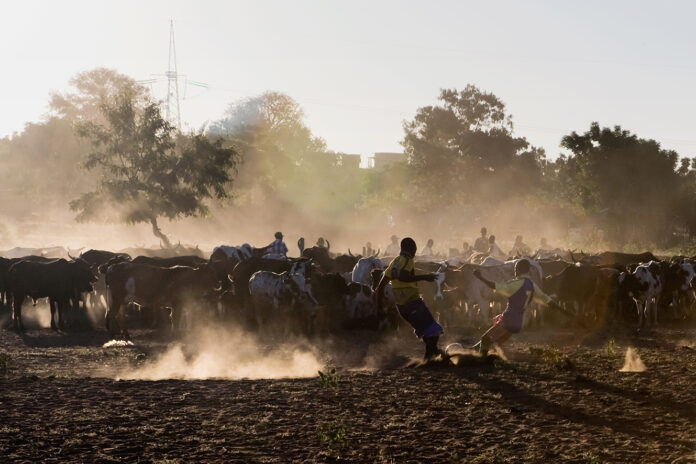
While the world’s attention is fixed on the World Cup and superstar footballers, Belgian photographer Jessica Hilltout invites audiences to look to the dusty village fields, handmade footballs and communities where the beautiful game is played simply for the love of it.
Her exhibition, AMEN | Grassroots Football, currently showing at Gallery F in Cape Town, is the culmination of an extraordinary 20 000km journey through ten African countries documenting football far removed from television cameras and commercial sponsorships.
For Hilltout, the project was born from a lifelong connection with both travel and the African continent.
“When I was young I had quite a nomadic life, living outside Europe until I was 17,” she says. “Africa has a huge place in my heart. We have so much to learn from the continent.”
The seed for AMEN was planted in Madagascar while she was working on a photographic project exploring the idea of imperfection. There, she encountered something that would change the direction of her work: handmade footballs crafted from plastic bags, cloth and string.
“I was fascinated by these little jewels,” she says. “Each football had a soul. They spoke not only about football but also about hope, inventiveness and the incredible ability to do so much with so little.”
A conversation with her father in late 2008 transformed that fascination into an ambitious expedition. Together, they envisioned documenting football as it is experienced by millions across Africa, away from elite competitions and into villages, townships, and remote communities where the sport remains woven into everyday life.
Their timing coincided with the excitement surrounding the 2010 Fifa World Cup in South Africa, providing an opportunity to tell what Hilltout calls “the forgotten stories” of football on the continent.
One of the defining moments of the project came in Chicome, a remote village in Mozambique, where reaching her destination required patience, determination and more than a little faith. After days of waiting for permission from local authorities, navigating rough roads and convincing village leaders to let her stay, Hilltout finally settled into a small hut, but not before emptying hundreds of coconuts stored inside.
“I had been travelling for weeks and hadn’t yet found what I was looking for,” she recalls. “I was beginning to lose confidence.”
Then, at sunrise, everything changed.
The village’s English teacher gathered children by striking an old car rim. Each child arrived carrying a handmade football.
“I was amazed. Every single football was unique,” she says. “I started photographing them as though they were precious jewels.”
As trust developed, Hilltout documented not only the footballs but also the people behind them and the daily rhythm of village life. Every afternoon, as farmers returned from the fields, the community gathered around the football pitch.
“For that moment everyone forgot the hardships of the day,” she says. “It was there that I truly understood the power of football. It wasn’t entertainment. It was a necessity and a pure joy.”
Watching the sun set over the field, Hilltout experienced what would later inspire the exhibition’s title.
“There was something deeply spiritual about it,” she says. “The ball stood in the middle almost like a god, with the goals like shrines.”
The title AMEN also reflects the encouragement she received throughout her travels.
“People would say, ‘Amen to your project.’ My father and his friend came up with the phrase: ‘In Africa football is not a religion, but it’s everything a religion should be.’”
Throughout the journey, the handmade footballs became powerful symbols of resilience.
“These footballs speak of hope, ingenuity and joy despite scarcity,” she explains. “Football is the only sport available to everyone. It can be played anywhere with almost anything that’s round.”
Depending on where children lived, the footballs took different forms. In desert communities they were fashioned from socks or old clothing, while cities provided discarded plastic and other materials that could be transformed into surprisingly durable balls.
“What fascinated me most was that everything had value,” she says. “Nothing was thrown away.”
Beyond documenting remarkable objects, Hilltout says the project became a celebration of human resilience.
“I’ve always been fascinated by people living in the shadows,” she says. “I want to challenge preconceptions and show another way of seeing things.”
That humanity often left a lasting impression.
Although Africa has changed dramatically since she first embarked on the project in 2009, Hilltout believes grassroots football remains remarkably constant. “Football is still a necessity and a passion,” she says. “It always will be.”
She hopes visitors leave the exhibition with something deeper than admiration for striking photographs.
“The business of football has become enormous, but this is where it all began. These communities remind us why people fall in love with the game in the first place.”
- Belgian photographer Jessica Hilltout’s exhibition "AMEN | Grassroots Football" showcases a 20,000km journey across ten African countries, documenting football played in rural communities away from commercialized settings.
- The project began in Madagascar, inspired by handmade footballs made from plastic, cloth, and string, symbolizing hope, inventiveness, and resilience despite scarcity.
- A key moment occurred in a remote Mozambican village where Hilltout documented unique, handcrafted footballs and witnessed football’s deep social and spiritual significance within the community.
- The exhibition highlights football as more than entertainment—it's a vital part of daily life, bringing joy, unity, and a sense of purpose amidst hardship.
- Hilltout aims to challenge perceptions by celebrating grassroots football’s enduring passion and resilience, reminding viewers of the sport’s true origins and heartfelt meaning beyond commercial success.


