


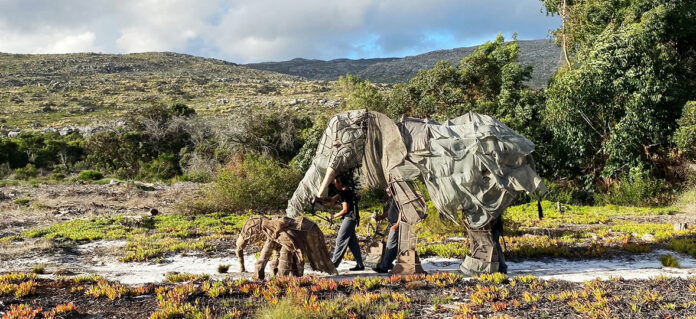
A compelling new short film warns that over 2 000 elephants could be culled despite the availability of proven non-lethal alternatives, highlighting what conservationists consider to be one of the worst dangers to South Africa’s elephant population in decades.
The film, which was commissioned by Humane World for Animals South Africa, depicts the catastrophic effects that a mass slaughter could have on elephant herds using enormous, life-size elephant puppets. The poignant production, filmed near Cape Point, coincides with ongoing provincial and national government debates on controlling elephant populations.
According to the organisation, elephants in the North West’s Madikwe Game Reserve and several reserves in KwaZulu-Natal could face culling over claims that their populations have exceeded sustainable levels.
Instead of using deadly methods, the animal welfare organisation is urging authorities to use science-based conservation methods, such as immunocontraception to reduce breeding, building wildlife corridors for natural migration, and increasing protected habitats.
The giant elephant puppets featured in the film were designed by renowned puppeteer Adrian Kohler of Handspring Puppet Company and built by the Ukwanda Puppets collective, whose work has appeared in internationally acclaimed productions such as War Horse.
Elephant biologist Dr Audrey Delsink, who has spent more than two decades researching elephant population management, believes that returning to practices abandoned decades ago is not the solution.
“We are calling for a complete halt to the idea that elephants need to be mass culled in South Africa,” she said.
“Elephant numbers do need to be managed because their natural range has been vastly limited by humans, but the least we can do is approach this challenge with compassion and respect for their welfare, especially when humane alternatives exist.”
Delsink has led Humane World’s elephant immunocontraception programme for the past 25 years in partnership with the University of Pretoria’s Veterinary Population Management Laboratory. The programme has vaccinated more than 1 800 wild female elephants across 50 reserves.
She argues that governments have delayed implementing humane solutions and are now considering culling as a quicker option.
“Non-lethal methods have existed for decades, but many provincial governments have stalled for years. It is these same governments now advocating for a cull as a quick, cruel fix to their own inertia and as revenue streams for failing budgets,” she said.
Conservationists say South Africa is home to about 44 000 elephants, with roughly 35 000 living in the Kruger National Park while the remainder occupy fenced reserves across the country. The African savanna elephant is currently listed as endangered on the International Union for Conservation of Nature Red List.
South Africa has a painful history of elephant culling. Before a moratorium was introduced in 1995, more than 14 500 elephants were killed in Kruger National Park, drawing international condemnation.
Dr Matthew Schurch, senior wildlife specialist at Humane World for Animals South Africa, stated that observing the puppets replicate the chaos of a cull had a profound impact.
“Witnessing the puppeteers recreate the panic of elephants caught in the crosshairs was incredibly moving. When the puppets fell to the ground, the powerful stillness impacted us all. We must prevent a real-life tragedy from happening to our wild elephants,” he said.
One of the puppeteers, Siphokazi Mpofu, said the project gave artists an opportunity to speak for endangered wildlife.
“The puppets have the unique power to make people stop, look and connect emotionally. They inspire empathy and remind us why protecting these magnificent animals matters,” she said.
Humane World for Animals hopes the film will encourage South Africans to rethink elephant conservation and support humane, science-led approaches rather than returning to mass culling.
The organisation maintains that lethal intervention should only ever be considered as an absolute last resort, arguing that existing non-lethal methods have already demonstrated long-term success in managing elephant populations.
- A new short film commissioned by Humane World for Animals South Africa warns that over 2,000 elephants may be culled in South Africa despite the availability of humane, proven non-lethal alternatives.
- The film uses life-size elephant puppets to highlight the devastating impact of mass culling and coincides with ongoing government debates on elephant population control.
- Conservationists advocate for humane methods such as immunocontraception, wildlife corridors, and habitat expansion, pointing to a 25-year successful immunocontraception program vaccinating over 1,800 elephants.
- Experts criticize government delays in adopting non-lethal solutions, accusing authorities of pushing culling as a quick fix linked to budget issues and inertia.
- South Africa’s elephant population, mainly in Kruger National Park and fenced reserves, faces threats despite being endangered, with a historical moratorium on culling since 1995; the film aims to foster empathy and promote science-based conservation over mass slaughter.


