


Does art imitate life or does life imitate art? This is the debate that has engulfed society since time immemorial.
During the struggle against apartheid, many artists, among them Hugh Masekela, Mirriam Makeba, Jonas Gwangwa and Abdullah Ibrahim, used their talents to conscientise the world about the struggles of the disadvantaged majority in South Africa at the time. The music, the artwork and the writing were specially curated to speak to that struggle.
Similarly for modern artists, art is created for society, in society. Sometimes the message mirrors a larger picture of society; other times, it is about breaking personal barriers.
This week, as part of our Youth Month focus, Sunday World is featuring two young artists who are trying to cement their places in the arts in modern South Africa. One is the daughter of a late former 1980s pop princess who is trying to forge her own identity outside the shadow of a famous parent; the other is a published author from a rural village who amplifies the struggles of his community through his pen.
Their stories symbolise some of the emerging struggles of today’s youth in creative spaces.
The emergentist songstress
For years, South Africans knew Rethabile Khumalo through the constellations surrounding her. She is the daughter of late music icon Winnie Khumalo and the unmistakable voice behind chart-shaking collaborations such as Ntyilo Ntyilo with Master KG and Umlilo with DJ Zinhle.
Her talent was never in question, yet her story has often been attached to somebody else’s name. However, today, the 30-year-old singer, songwriter and musician is soaring into a chapter defined not by inheritance but by identity.
It is why she can perhaps best be described as an emergentist – an artist who emerges from the shadows of powerful influences to become a force in her own right.
Her latest offering, the 11-track mixed-genre album Kwelizayo, is more than a collection of songs – it’s a bridge suspended between memory and tomorrow, between grief and gratitude and between a mother’s departure and a daughter’s arrival.
The album took a year to complete because Rethabile refused to surrender to the modern obsession with speed.
“We are living in a society that is forcing everyone to rush for success but I find inspiration in the biblical passage that says: ‘When the time is right, the Lord will make it happen.’ Timing is everything and you have to just work and be ready when that time arrives,” she said.
But perhaps the most revolutionary aspect of Rethabile’s story is not the music itself. It is ownership.
She has chosen a different route in an industry filled with stories of gifted artists who are left financially broken while others profit from their work.
“I’ve chosen to go independent, using my mom’s company, Winnie K Music Records, which I’m in charge of. I’m finding this journey inspirational because I work at my own pace and take responsibility for everything I do,” she said.
Rethabile, who was born in the Vaal and raised in Mofolo, Soweto, trained at the National School of the Arts, says art chose her long before she chose it.
Kwelizayo is not merely an album. It is a declaration of independence. A daughter preserving a legacy while simultaneously stepping beyond it.
Perhaps that is the true work of an emergentist. Not rejecting the giants who came before. But standing on their shoulders long enough to finally see one’s own horizon.
The word ‘wright’ from Mashishing
In a world obsessed with microphones, stages and viral moments, Sibusiso Mahlangu found power in something quieter: a blank page.
Before he wrote nine books, recorded more than 1 100 YouTube videos and more than 30 podcast episodes, and before newspapers and radio stations began noticing his work, the 24-year-old from Mashishing, formerly Lydenburg, was a shy boy searching for a way to be heard.
“I have never been much of a talker,” Mahlangu said. “Growing up, I was always an introvert and often found it easier to express myself through writing than through conversations. Writing became my voice and a way for me to share my thoughts, ideas and experiences with others.”
Long before Mahlangu dreamt of becoming an author, he filled notebooks with song lyrics.
“I started writing in primary school. I was probably in Grade 6 but I wasn’t writing books. I was writing song lyrics.”
Those early scribbles became the first sparks of a journey that transformed him into one of Mpumalanga’s most prolific young independent writers.
Yet the road was far from smooth. His first book failed to ignite the success he imagined. The formatting was flawed; the marketing was weak; and the publishing process was unfamiliar territory. For many aspiring authors, that would have been the final chapter. For Mahlangu, it became the prologue.
“To be honest, my first book did not perform as well as I had hoped,” he admitted. “At the time, I had very little experience with marketing and book publishing. Looking back, I made many beginner mistakes, but those experiences became valuable lessons.”
That persistence has become the defining rhythm of his life.
Today, Mahlangu writes about personal development, relationships, life experiences and the pursuit of purpose.
His work consistently returns to one central theme: human potential.
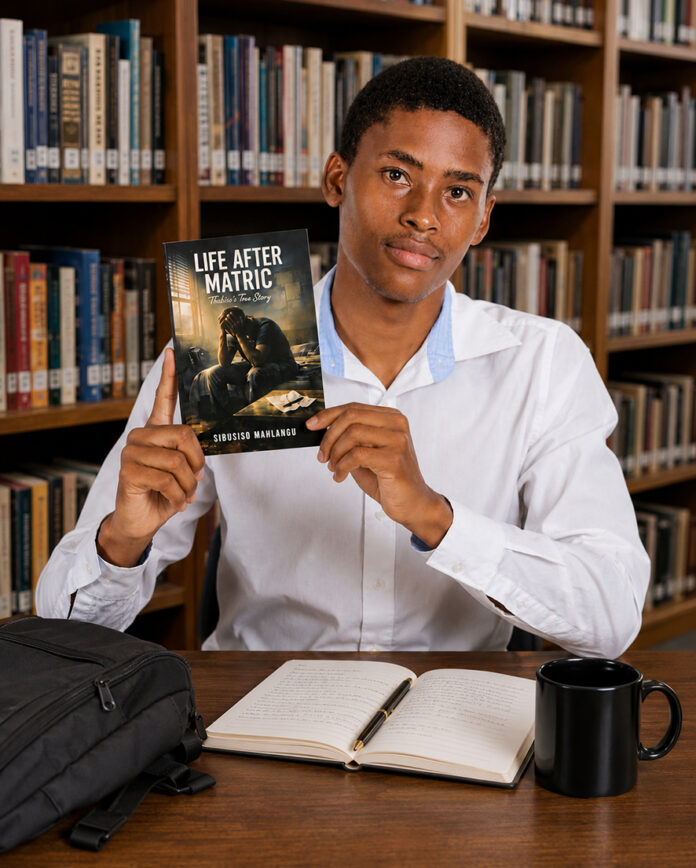
His latest book, Life After Matric: Thabiso’s True Story, might be his most relevant contribution yet.
The book follows a young South African who navigates the uncertainty that often arrives after high school — unemployment, financial struggles, unanswered questions and the crushing pressure to succeed.
It is a story familiar to millions.
“The inspiration behind the book came from observing the struggles that many young people face after matric,” Mahlangu explained.
“I wanted to tell a story that many young South Africans could relate to while also offering hope and encouragement.”
Beyond books, Mahlangu continues to expand his reach through podcasting, content creation and motivational speaking. Regardless of the platform, his mission remains unchanged.
“My mission is to encourage people to believe in their potential and to show that with consistency, dedication and hard work, it is possible to create opportunities regardless of where you come from.”
His advice to aspiring writers reflects the philosophy that carried him this far.
- Does art imitate life or does life imitate art?
- This is the debate that has engulfed society since time immemorial.
- During the struggle against apartheid, many artists, among them Hugh Masekela, Mirriam Makeba, Jonas Gwangwa and Abdullah Ibrahim, used their talents to conscientise the world about the struggles of the disadvantaged majority in South Africa at the time.
- The music, the artwork and the writing were specially curated to speak to that struggle.
- Similarly for modern artists, art is created for society, in society.


