


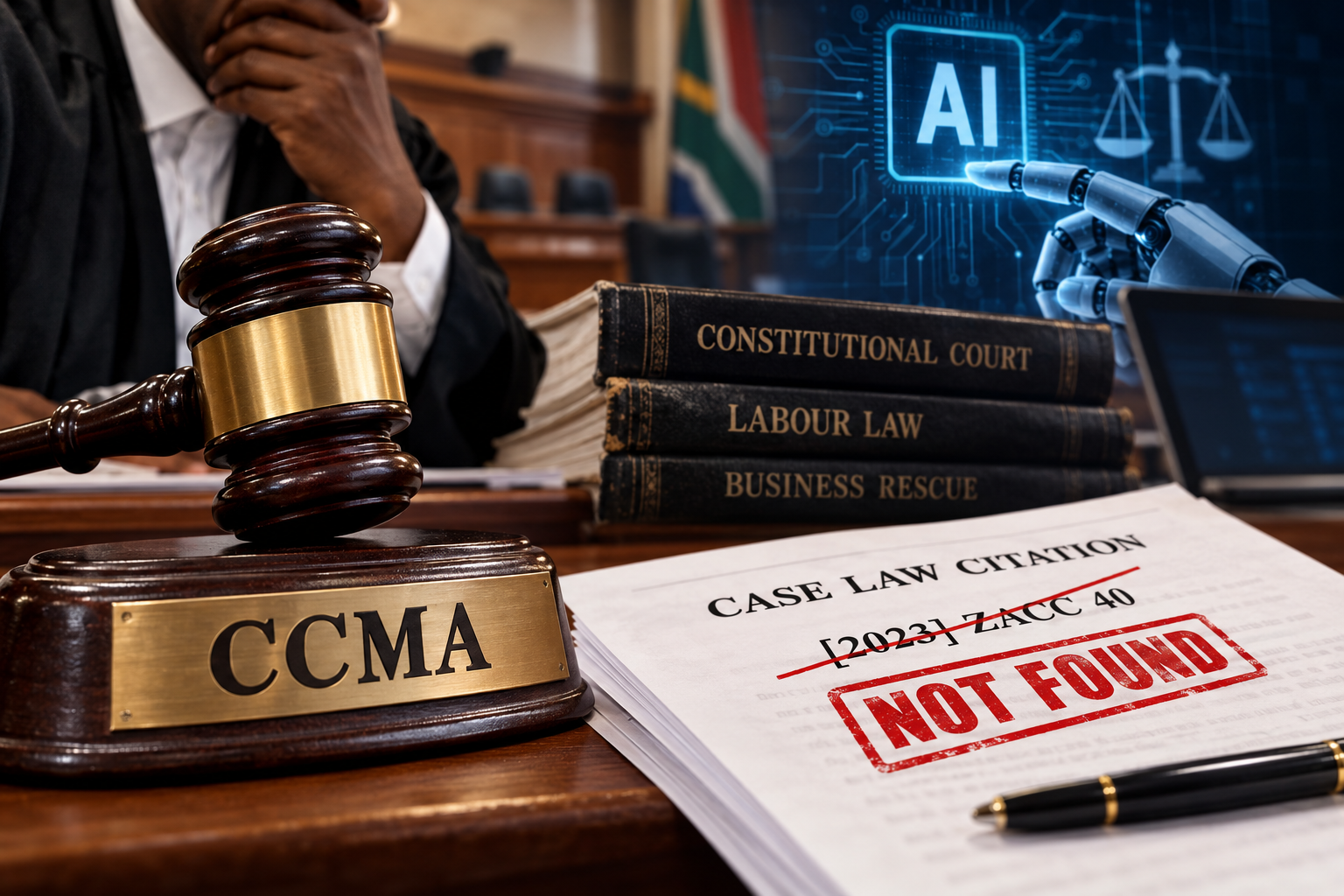
A CCMA commissioner has landed in hot water after apparently relying on artificial intelligence (AI) to cite a Constitutional Court judgment that never existed, prompting a scathing Labour Court rebuke over what a judge described as a fundamental failure of justice.
The commissioner was severely criticised for relying on the fictitious judgment to justify allowing six dismissed South African Post Office (SAPO) employees to proceed with their unfair dismissal dispute despite the financially distressed institution being under business rescue.
In a judgment delivered on Friday, October 23, Acting Judge Sean Snyman opened his ruling with a damning observation about the growing use of fabricated legal authorities in South African courts.
“This appears to be a case involving another AI generated irregularity pertaining to non-existent case law to substantiate a particular finding,” Snyman said.
READ MORE: Home Affairs directors suspended as another AI policy scandal rocks government
He warned that the incident had occurred despite repeated judicial warnings about the improper use of artificial intelligence for legal research, particularly where fictitious judgments were presented as genuine authorities.
Fictitious Constitutional Court judgment exposed
The extraordinary blunder emerged after six SAPO employees, dismissed for alleged misconduct on December 2, 2025, referred an unfair dismissal dispute to the CCMA.
SAPO, which has been under business rescue since July 2023, objected to the arbitration, arguing that the Companies Act prohibited legal proceedings against it without permission from its business rescue practitioners or the High Court.
However, the commissioner dismissed the objection on August 4, ruling that the employees could pursue their claims despite the ongoing business rescue proceedings.
To substantiate his decision, he cited a supposed Constitutional Court judgment titled South African Post Office SOC Ltd (In Business Rescue) and Others v Communication Workers Union and Others, purportedly reported as [2023] ZACC 40.
According to the CCMA ruling, the supposed judgment established that business rescue did not suspend labour legislation or deprive employees of access to statutory dispute resolution mechanisms.
But when SAPO challenged the ruling, the Labour Court discovered that the supposed Constitutional Court judgment was a legal phantom.
“The undeniable reality is that the ruling of the first respondent is squarely founded on purported reasoning contained in a judgment that does not exist,” Snyman said.
The judge personally investigated the citation and established that it actually belonged to an unrelated Constitutional Court judgment concerning immigration legislation and spousal visas.
He also searched the SAFLII database and other legal repositories but found no trace of the purported SAPO judgment.
AI-generated legal research under scrutiny
Snyman concluded that the commissioner appeared to have used AI to find legal authority supporting his interpretation of the law, without independently verifying the information.
“It appears that first respondent must have relied on AI in seeking to find substantiation for his reasoning,” the judge said.
The court did not identify a particular AI platform or establish through direct evidence which technology the commissioner had used.
Nevertheless, Snyman found that the commissioner’s failure to verify the supposed authority constituted a serious breach of the diligence and competence expected of arbitrators.
He said:
“Considering that this non-existed legal authority lies at the heart of the conclusion that he ultimately came to, this is a fundamental failure of justice.”
The judge also drew attention to previous judicial warnings that artificial intelligence could generate seemingly convincing legal arguments supported by entirely fictitious authorities.
Quoting an earlier judgment, Snyman highlighted the danger of accepting machine-generated research without scrutiny.
READ MORE: Panyaza Lesufi dismisses deepfake video promoting get-rich-quick scheme
“Such tools can produce apparently coherent and plausible responses to prompts, but those coherent and plausible responses may turn out to be entirely incorrect.”
He said arbitrators who used AI for legal research were obliged to verify that cited judgments existed and read those judgments to establish whether they supported the propositions attributed to them.
The judge called for a zero-tolerance approach to such failures, warning that they threatened public confidence in labour dispute resolution.
Arbitration halted over legal irregularities
Beyond the fabricated judgment, Snyman found that the CMMA commissioner had materially misinterpreted the Companies Act by disregarding the moratorium on legal proceedings against companies undergoing business rescue.
The commissioner had also failed to address SAPO’s objection that its business rescue practitioners had not been joined to the arbitration proceedings.
The court consequently halted the arbitration pending the determination of SAPO’s separate application to review and set aside the CCMA ruling.
READ MORE: AI cannot be allowed to hide behind humans
However, the six dismissed employees have not lost their unfair dismissal claims. They may pursue them once business rescue ends or obtain the necessary permission to proceed earlier.
Snyman stressed that the workers, who were not legally represented, were not responsible for the commissioner’s failures.
He made no order as to costs, finding that the circumstances did not justify penalising the employees for pursuing their claims.
The judge warned that allowing arbitration proceedings founded on fictitious legal authority to continue would effectively condone illegality and undermine the integrity of South Africa’s labour justice system.
- A CCMA commissioner was severely criticised by the Labour Court for relying on a fictitious Constitutional Court judgment generated by artificial intelligence to allow six dismissed SAPO employees to proceed with their unfair dismissal dispute.
- The supposed judgment, cited as South African Post Office SOC Ltd (In Business Rescue) and Others v Communication Workers Union and Others [2023] ZACC 40, was found to be non-existent and unrelated to the matter.
- Acting Judge Sean Snyman concluded the commissioner likely used AI without verifying the authenticity or relevance of the legal authority, constituting a fundamental failure of justice.
- The commissioner also misinterpreted the Companies Act by ignoring the moratorium on legal proceedings during SAPO’s business rescue and failed to include SAPO's business rescue practitioners in the arbitration.
- The Labour Court halted the arbitration pending a review but allowed the dismissed employees to pursue their unfair dismissal claims after business rescue or with permission, without penalising them for the commissioner's errors.


