


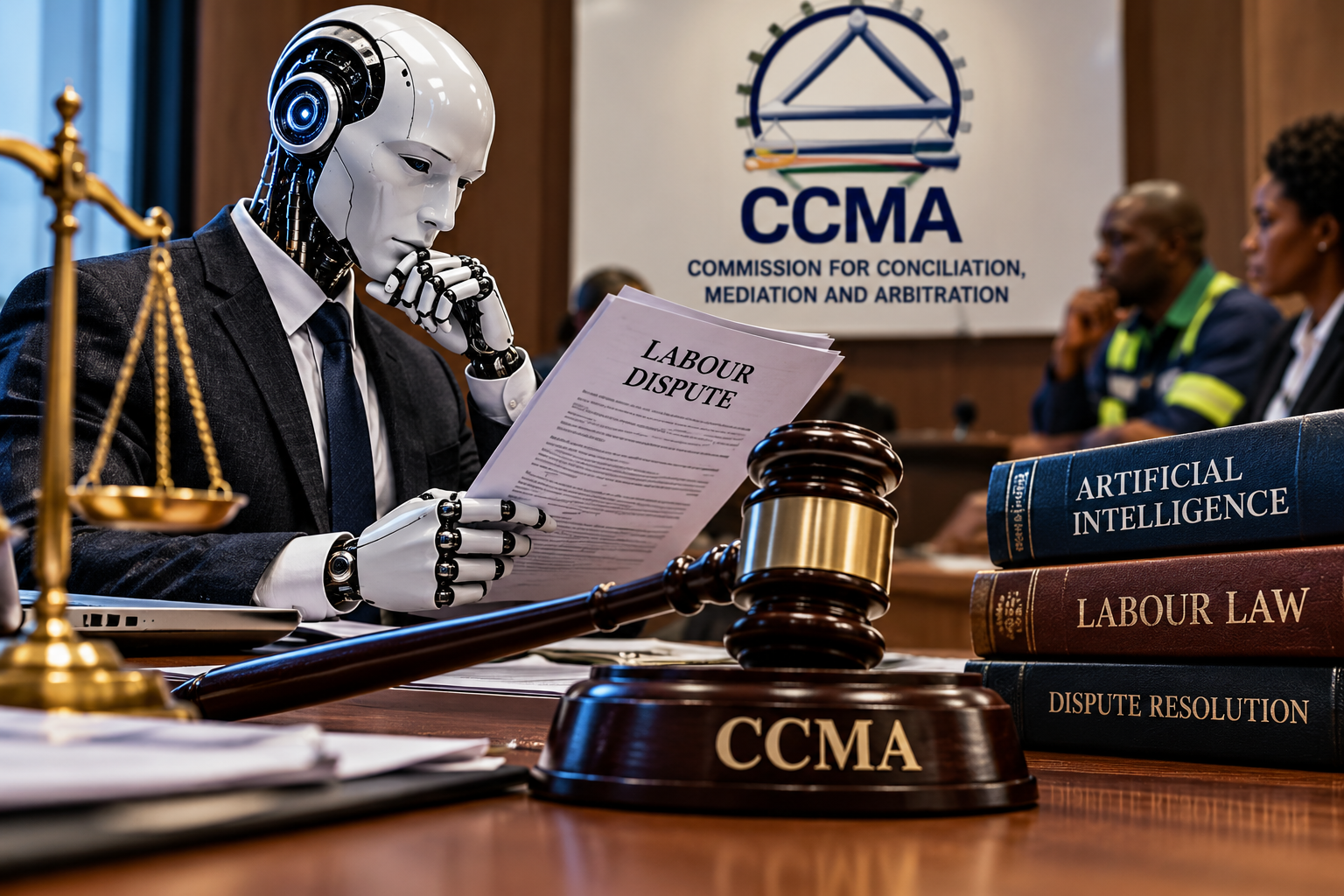
The Commission for Conciliation, Mediation and Arbitration (CCMA) has introduced new rules addressing the use of artificial intelligence (AI) in labour disputes, as a scathing Labour Court judgment exposed the dangers of relying on fictitious AI-generated legal authorities.
The amended rules, published in Government Gazette No. 55620 on October 23, require parties to address AI use during pre-arbitration conferences, although questions have emerged over how the requirement will be enforced.
Rule 20(3)(s) specifically requires parties to attempt to reach consensus on “the use of AI and AI-generated information and the nature and extent of such usage”.
The amendment coincided with the publication of written reasons in a Labour Court judgment criticising CCMA commissioner Menzi Fakude for relying on a nonexistent Constitutional Court judgment in an unfair dismissal dispute involving six former South African Post Office employees.
READ: CCMA commissioner in trouble for citing AI-hallucinated ConCourt case law
Acting Judge Sean Snyman had already granted an order on October 15, halting the arbitration pending a review application. His written reasons were published on October 23, the same day the amended CCMA rules were gazetted.
“If an arbitrator wishes to use AI to conduct research, then the arbitrator is compelled to still verify if the judgment that the AI may come up with exists,” Snyman warned.
The judge criticised Fakude’s failure to verify the fictitious authority before relying on it to justify proceeding with arbitration despite the Post Office’s business rescue proceedings.
Law firm Bowmans similarly emphasised independent verification in its analysis of the amendments.
“Employers are therefore encouraged to establish internal protocols governing AI use in employment disputes and to ensure that all AI-generated outputs are independently verified before being relied upon in proceedings,” the firm advised.
However, Gauteng-based labour relations practitioner Relebogile Kgalane, who has handled hundreds of CCMA cases over the past decade, questioned the practical implications of the new provision.
“What confounds me about the new CCMA Rules is the provision requiring parties to agree on the use of AI. To what end? What happens when parties disagree or simply fail to disclose its use?” Kgalane asked.
“The rule is vague on both the obligation and its consequences. I am still struggling to identify the mischief it seeks to cure.”
Kgalane also questioned why the amendments appeared not to adequately address concerns raised in a separate judgment by Acting Judge Gcinumzi Moshoana concerning the seven-day objection requirement in conciliation-arbitration proceedings.
“We have already seen how the seven-day objection requirement in con-arb proceedings cannot simply override rights conferred by the LRA,” he said.
“Surely amendments of this nature ought to provide legal certainty rather than leave practitioners navigating the same unresolved questions.”
The developments highlight the challenge facing labour dispute resolution: embracing emerging technology without compromising legal certainty, procedural fairness or the reliability of evidence.
ALSO READ: Court sides with former diplomat in long-running C-BRTA dismissal battle
- The CCMA has introduced new rules requiring parties in labour disputes to discuss the use of AI during pre-arbitration conferences, as stated in Government Gazette No. 55620 on October 23.
- Rule 20(3)(s) mandates parties to attempt consensus on the use and extent of AI-generated information in proceedings.
- The rule change followed a Labour Court judgment criticising CCMA commissioner Menzi Fakude for relying on a fictitious Constitutional Court judgment generated by AI.
- Acting Judge Sean Snyman emphasized that arbitrators must independently verify any AI-generated legal information before using it.
- Some practitioners have questioned the practicality and enforcement of the new AI rules, citing vagueness about obligations and consequences when parties disagree or fail to disclose AI use.


