


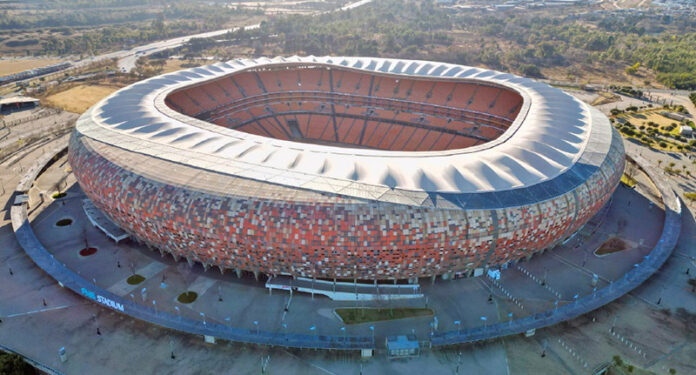
The Stadium Management South Africa (SMSA) is blaming non-compliant spectator behaviour and ticket fraudsters as the major contributing factors in the chaos and disorder that erupted at the Soweto derby between Orlando Pirates and Kaizer Chiefs at the FNB Stadium on Sunday.
The highly charged-up match ended in a 1-1 after 90 minutes of entertaining football, but sadly, the same cannot be said about the organisation of the match outside. Firstly, the match was delayed for 45 minutes for safety and security reasons to allow supporters to enter the stadium.
Even after the lengthy kick-off delay, there were still fans outside at the half-time break. As a result, a section of supporters were seen pushing the gates and security officers as they stormed inside the venue. The traffic jams started as far back as N1 South and also on the M1 South highways. The Main Reef Road was also congested just before kick-off. Tickets, of which are suspected to be fake and counterfeit, were sold on the Riverlea belt towards the stadium.
‘Plans were properly assessed’
The SMSA and its Event Safety and Security Planning Committee (ESSPC) say that public accountability must be balanced, fact-based, and reflective of the full context within which these events are planned and executed.
They say that it is important to place on record that this event was underpinned by extensive, multi-agency planning, incorporating detailed safety, security, traffic management, and access control measures. According to them, these plans were properly assessed, coordinated, and approved through established ESSPC processes, with the primary objective of ensuring spectator safety and preventing any risk of overcapacity within the stadium.
Unticketed individuals
Reads the statement from SMSA: “It is equally important to highlight that the execution of these plans was materially impacted by widespread non-compliant spectator behaviour. This included large volumes of unticketed individuals arriving at the precinct, the circulation and attempted use of fraudulent tickets, and deliberate pressure placed on traffic control points, validation areas, and stadium access gates.
“These risks were anticipated during the planning phase, and accordingly, a structured and tiered set of mitigatory and contingency measures were built into the approved operational plans. The subsequent escalation to these measures was both planned and necessary and was implemented in a controlled manner in response to real-time operational pressures to ensure that safety and capacity thresholds were not compromised.
Illegitimate spectator conduct
“Such illegitimate spectator conduct had a direct and consequential impact on traffic flow, perimeter control, and turnstile operations, necessitating the escalation to contingency and mitigatory measures in line with the approved event plan. While such measures may have affected the experience of compliant, ticket-holding spectators, the ESSPC remains unequivocal: safety of all patrons and the prevention of overcapacity cannot be compromised under any circumstances. In implementation of the approved mitigatory and contingency measures, the stadium was placed under controlled lockdown at 15:53pm.
“The lockdown process was executed within approximately 8 minutes once safe capacity thresholds were reached, reflecting a controlled and coordinated response aligned with the ESSPC’s core mandate to ensure safety and prevent any risk of overcapacity within the venue. The ESSPC further confirms. The integrated safety, security, and traffic management plans were effective in design and, in large part, execution.
“Road closure operations successfully identified and denied access to significant numbers of individuals without valid tickets or parking permits. Digital ticketing systems performed reliably and remain the preferred and future-forward solution for access control. Connectivity, scanning, and turnstile infrastructure functioned within acceptable operational parameters. While not eliminated entirely, the presence of unticketed patrons within the precinct was significantly reduced through the implemented control measures.”
Need for shared accountability
In summary, the statement confirms that the “ESSPC’s post-event assessment confirms that the primary safety objective – ensuring the safety and wellbeing of all spectators within the precinct and inside the venue, including the maintenance of the venue’s safe capacity – was effectively managed and achieved in accordance with the approved event plan and implemented mitigatory measures.
“The operational challenges encountered were largely driven by unlawful and non-compliant spectator conduct. The event underscores the urgent need for shared accountability across all stakeholders, including spectators,” adds the statement.
- The Stadium Management South Africa (SMSA) attributes the chaos at the Soweto derby mainly to non-compliant spectator behavior and widespread ticket fraud, especially counterfeit tickets sold near the stadium.
- The match, which ended 1-1, was delayed by 45 minutes due to safety and security concerns, with fans pushing gates and security to enter even during halftime, causing major traffic congestion around the stadium.
- SMSA highlighted that extensive multi-agency planning had been done to ensure safety, including traffic and access control, but non-compliant behaviors forced the implementation of contingency plans like a controlled stadium lockdown.
- Despite disruptions, the integrated safety, security, and traffic management plans worked effectively, reducing unticketed patrons and maintaining safe capacity limits inside the stadium.
- The post-event assessment confirmed that the primary goal of ensuring spectator safety and venue capacity was achieved, emphasizing the need for shared accountability among all stakeholders, including spectators.


