


Sustainable tourism and conservation are essential to South Africa’s goal of bringing in 15-million foreign tourists by 2030 – and the South African National Parks (SANParks) has positioned itself as an important conduit between the private sector and communities where it operates across the country.
Speaking at the 2026 Africa’s Travel Indaba, SANParks CEO Hapiloe Sello said it was important to get business on board as partners in uplifting small and medium-sized enterprises, especially in the more remote areas of the country. The agency oversees South Africa’s premier conservation areas – 21 national parks and 10 marine protected areas – covering more than 44 595km2 across the country.
“SANParks prides itself on being a great agency aimed at presenting the country’s tourism to the world. We are at the forefront of making sure that our tourism clients get the most amazing experience when they visit our establishments.
“We are also proud to state that during the financial year ending March 31, 2026, SANParks welcomed 6.8-million tourists across all its sites. We believe that we have fully recovered now from the pandemic, and we are going strong to build a great legacy in the conservation space,” she said.
Every year, Africa’s Travel Indaba brings together industry players such as exhibitors, tour operators, small-, medium- and micro-sized enterprises, hospitality and accommodation businesses, and specialised environmental and conservation enterprises to showcase their offerings to international and local buyers and leisure tourism services partners.
This year was no different. The Inkosi Albert Luthuli Convention Centre in Durban again provided a platform for stakeholders in the sector to come together and map a way forward as the deadline of 2030 looms.
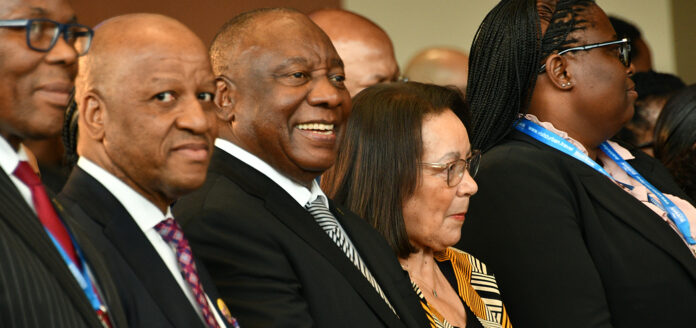
President Cyril Ramaphosa officially opened the conference themed “Unlimited Africa” on Tuesday, where he noted the role of tourism in creating economic opportunities across various value chains in communities across the country.
“We take pride in the partnerships that have carried us through some of the most challenging years the global tourism industry has faced. It is the tourism aspect that can showcase our continent, to show the beauty and the sophisticated cultures of our continent and the heritage, the very rich heritage, of this continent. We are the continent from which humanity originated. That’s what we need to showcase,” said Ramaphosa.
Ramaphosa also noted that the country welcomed 10.5 million tourists, pointing out that this is a great milestone and economic spinner for South Africa.
“When tourists travel, they do not travel empty-handed. They come with foreign exchange, create tax revenues and encourage investment inflows. We are also working to expand our one-stop border posts and develop cross-border itineraries that showcase the richness of our region. When Africans travel within Africa, we strengthen our economies, deepen our cultural ties, and build a more integrated continent,” said Ramaphosa.
Tourism Minister Patricia de Lille reported that the cabinet-approved Tourism Growth Partnership Plan from last year was beginning to yield results.
“We are already seeing investment in tourism products, including the R24-billion expansion of the V&A Waterfront; R10.5-billion is being injected into Winelands Airport, while here in KwaZulu-Natal, the R2.1-billion Club Med Beach & Safari resort, which opens in July, stands as a bastion of successful public-private partnership,” said De Lille.
Over the years, Africa’s Travel Indaba has positioned itself as a platform for exposure for SMMEs.
Elvis Swart from Khomani San, a small business of the indigenous hunter-gatherer community in the Southern Kalahari Desert, Northern Cape, also came to showcase crafts created there. Cultural objects that are pivotal to the community’s survival and heritage, such as bows and arrows; hunting spears; jewellery; and water-storing containers, were on display as part of the education for visitors.
“Our business belongs to the Khomani Communal Property Association, owned by the members of our community. When tourists visit Kgalagadi Transfrontier Park, as Khomani San, we do great business based on the number of tourists coming,” said Swart.
Another small business owner, Tshepo Nake from Tinyiko Kruger Lodge, a private 4-star accommodation located in Marloth Park, right on the southern border of the Kruger National Park, said that for him to be at Africa’s Travel Indaba was a big deal.
“Since we started our business in 2017 with only eight rooms, we have managed to expand, and we now have 16 rooms,” said Nake.
For Nake and others, the marketing opportunities presented by exhibiting at Africa’s Travel Indaba are priceless.
- Mdakane travelled to Africa’s Travel Indaba as a guest of SANParks.
- South Africa aims to attract 15 million foreign tourists by 2030, with sustainable tourism and conservation playing key roles, supported by South African National Parks (SANParks) managing 21 parks and 10 marine areas.
- SANParks CEO Hapiloe Sello emphasized partnerships with businesses to uplift small and medium enterprises (SMMEs), especially in remote areas, after hosting 6.8 million tourists by March 2026, recovering from pandemic impacts.
- The 2026 Africa’s Travel Indaba, held in Durban, gathered tourism industry stakeholders to collaborate on growth strategies, with President Cyril Ramaphosa highlighting tourism's economic impact and its role in showcasing African heritage.
- Tourism Minister Patricia de Lille noted significant investments in tourism infrastructure, including multi-billion rand expansions and new resorts, contributing to sector growth and successful public-private partnerships.
- Indigenous and small business owners like Elvis Swart from the Khomani San community and Tshepo Nake of Tinyiko Kruger Lodge showcased cultural crafts and accommodation services, benefiting from exposure and marketing at the event.


