


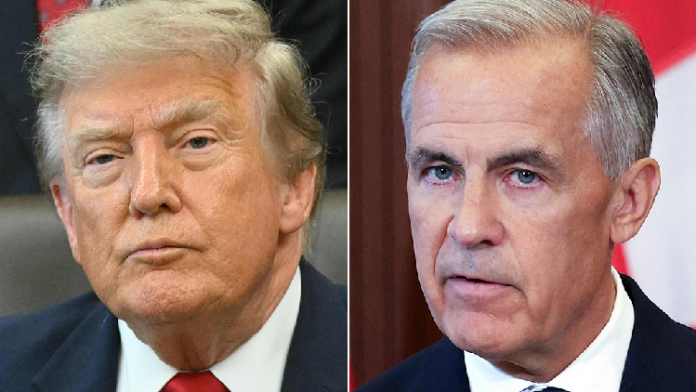
Canadian political leaders have ramped up their response to the latest US tariff measures, with Prime Minister Mark Carney insisting that Canada will only return to trade talks if Washington approaches negotiations as an equal partner.
Speaking in Quebec on Monday, Carney said Ottawa remains open to discussions, but only if the United States changes its approach toward Canadian industries.
“When the Americans go to the negotiating table first, with the right attitude toward our industries and in a true partnership, of course we’ll come to the negotiating table,” he said.
Carney rejected any suggestion that Canada should accept a subordinate position in its economic relationship with the United States.
He said he would not tolerate the view that Canada is “a subsidiary of the United States” or that Canadian businesses should be placed at a disadvantage compared with their American counterparts.
Calls grow for stronger economic retaliation
Finance Minister Francois-Philippe Champagne echoed the tougher tone during consultations in Montreal, arguing that Canada cannot continue to absorb trade pressure without responding.
“At some point you have to say enough is enough,” Champagne said, adding that federal support measures are being prepared for businesses affected by the new 50% tariffs.
He stressed that the government’s long-term strategy remains focused on strengthening Canada’s economic resilience.
“Plan A has always been to build a strong Canadian economy, to remove interprovincial trade barriers, to diversify our economy and to do big things in our country,” Champagne said.
Former Prime Minister Jean Chretien went further, urging Ottawa to impose export taxes on critical commodities shipped to the United States, including oil, natural gas, energy products and potash.
“If we want to stay upright, we have to hit where it hurts,” Chretien said. “That’s where we should tax. The advantage of an export tax is it’s not us who pays, it’s the Americans.”
Provinces back tougher countermeasures
Ontario Premier Doug Ford also advocated a more aggressive response, saying Canada should be prepared to use all available economic tools if tensions continue to escalate.
Ford warned that Ontario could halt exports of critical minerals to the United States and even cut electricity supplies if trade relations deteriorate further.
“I’ll cut them off,” Ford said regarding mineral exports. “You won’t get a grain of sand out of Ontario.”
His remarks reflect growing concern among provincial leaders about the impact of the trade dispute on key Canadian industries.
Trade conflict deepens
The latest round of tensions follows the implementation of 50% US tariffs on approximately $20 billion worth of Canadian goods, which took effect shortly after midnight on Saturday after months of trade negotiations broke down.
Carney previously announced that Canada would introduce retaliatory tariffs beginning on September 8.
Adding to the pressure, US President Donald Trump said on Monday that tariffs on Canadian cars, trucks and auto parts will rise from 25% to 50% starting in January, signalling that the trade conflict between the two countries could intensify in the months ahead.
- Canadian Prime Minister Mark Carney stated Canada will only return to trade talks if the US negotiates as an equal partner with the right attitude toward Canadian industries.
- Finance Minister Francois-Philippe Champagne said federal support measures are being prepared for businesses affected by the new 50% US tariffs.
- Former Prime Minister Jean Chretien urged Canada to impose export taxes on oil, natural gas, energy products, and potash sent to the US to retaliate economically.
- Ontario Premier Doug Ford threatened to halt exports of critical minerals and cut electricity supplies to the US if trade tensions escalate further.
- The US implemented 50% tariffs on about $20 billion of Canadian goods starting Saturday, with plans to increase tariffs on Canadian autos from 25% to 50% in January.


