


South Africans could soon find themselves digging deeper into their pockets for even fewer units of electricity after Eskom outlined another tariff increase for 2027, prompting Members of Parliament (MPs) to question whether struggling households can withstand yet another financial blow.
The proposed 8.83% increase for customers buying electricity directly from Eskom and 8.84% for municipalities has drawn concern from Parliament’s Standing Committee on Appropriations, which warned that relentless electricity price increases were placing considerable strain on household budgets.
The increases are expected to take effect from April 2027 for Eskom’s direct customers, with the final retail tariffs and their application subject to regulatory processes.
Committee chairperson Dr Mmusi Maimane warned that the consequences extended far beyond electricity bills, with families increasingly forced to make difficult decisions about basic necessities.
“Rising electricity costs force households to choose between essential expenses such as school fees, food and electricity. We therefore need decisions that balance financial sustainability with households’ ability to pay,” Maimane said.
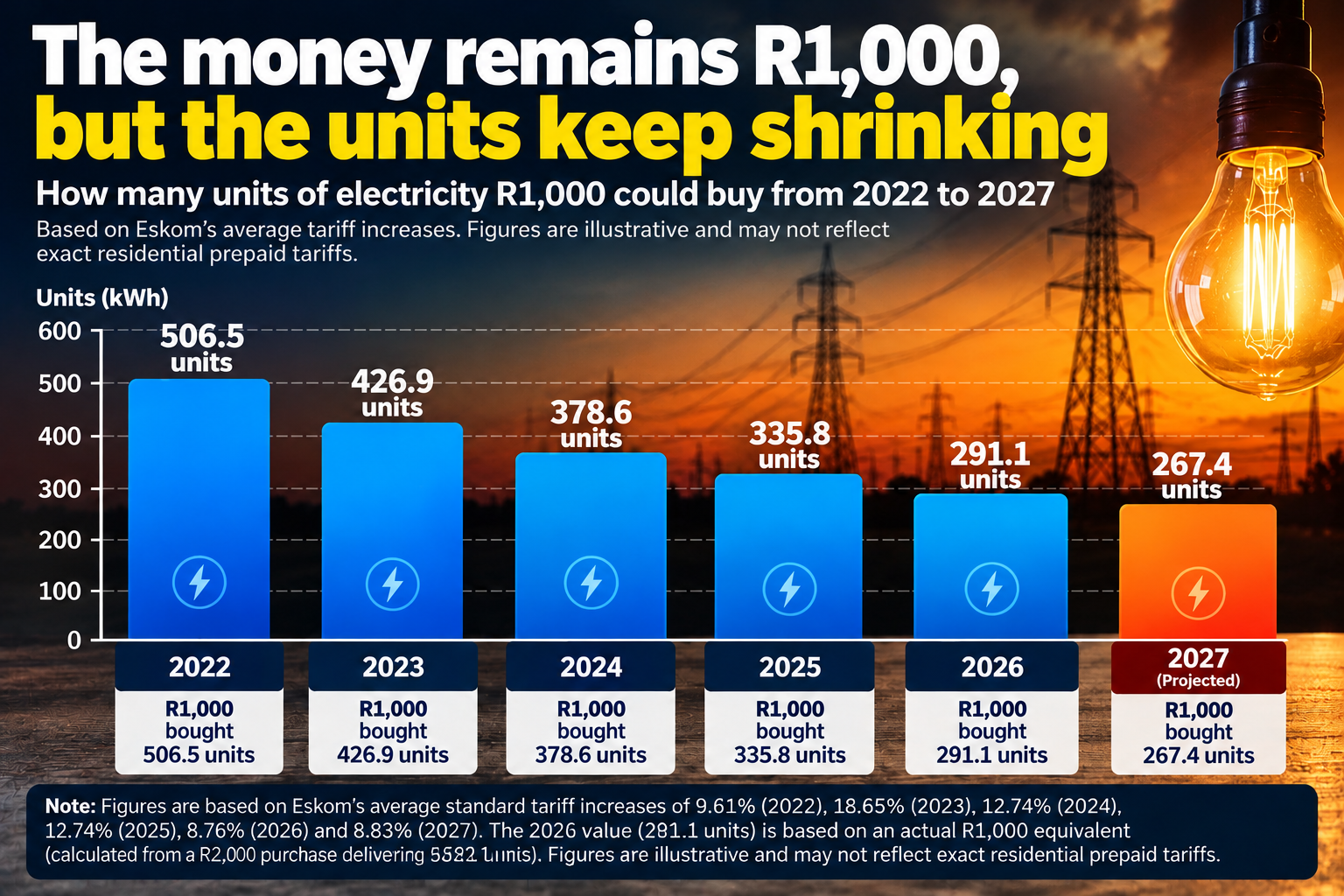
R1,000 remains R1,000, but units keep shrinking
For households relying on prepaid electricity, the effects of successive tariff increases are particularly easy to illustrate.
An actual R2,000 prepaid electricity purchase from Eskom in October 2026 delivered 582.1 units, translating to an average cost of R3.44 per kilowatt-hour, including VAT.
At the same effective rate, a more modest R1,000 purchase would deliver approximately 291 units.
Should the proposed 8.83% increase translate proportionately into the same residential unit tariff, that identical R1,000 would purchase approximately 267 units from April 2027.
That represents a loss of nearly 24 units without the household consuming a single additional kilowatt-hour.
READ MORE: Tshwarelo eseng Mogakane | Kgomo ya Moshate: Could Nersa swing your vote?
Put differently, maintaining the current purchasing power of R1,000 would require approximately R1,088.30 after the proposed increase. For a household spending that amount every month, the additional expense would amount to nearly R1,060 annually.
These figures are illustrative, as the actual cost will depend on the approved residential tariff structure.
Increases hardly an isolated development
Eskom’s average standard tariff adjustments over the past five financial years included 9.61% in 2022, 18.65% in 2023, 12.74% in 2024, 12.74% in 2025 and 8.76% in April 2026.
Compounded, these five annual increases represent an approximately 79.8% rise in the average standard tariff benchmark since before the April 2022 adjustment.
Including the proposed 8.83% adjustment for 2027 would push the cumulative increase to approximately 95.7%.
That means electricity costing R1,000 before the April 2022 adjustment would cost approximately R1,957 in 2027 if all six average increases were applied proportionately.
However, this calculation represents the national average standard tariff benchmark, not the precise increase paid by every household. Individual residential tariffs have followed different trajectories, particularly following changes to Eskom’s domestic pricing structures.
READ MORE: Nersa grants Eskom massive 12.74% tariff increase
The cumulative burden nevertheless illustrates how successive annual adjustments have substantially increased the cost of electricity.
MPs question affordability of electricity
During Eskom’s briefing on Tuesday, committee members questioned whether the proposed increases were compatible with government’s stated commitment to tackling poverty and unemployment.
They argued that households were already contending with persistent living-cost pressures and an economy struggling to provide sufficient relief.
Maimane called for closer scrutiny of the National Energy Regulator of South Africa’s (NERSA) tariff-setting responsibilities and Eskom’s applications for price increases.
The committee also examined Eskom’s mounting municipal debt crisis, which has become another serious challenge to the utility’s financial sustainability.
According to Eskom, municipalities owed the power utility a staggering R122.5-billion by August 2026.
Defaulting metropolitan municipalities have entered payment arrangements intended to settle their obligations over several years, although their success depends on continued compliance and regular payments.
The growing debt burden raises questions about the ability of municipalities to pay Eskom while maintaining electricity infrastructure and delivering services to residents.
READ MORE: Car dealers warn rising electricity and fuel costs could weigh on economy in 2026
Maimane supported a proposal to channel government subsidies intended for indigent electricity consumers directly to Eskom rather than through municipalities.
He argued that this could reduce administrative costs while improving revenue collection and financial planning. However, the committee also acknowledged Eskom’s improved operational performance.
Maimane commended the utility’s leadership for progress in reducing load shedding and stabilising electricity supply, recognising that greater reliability represented an important achievement.
The emerging challenge is whether improved electricity availability can be accompanied by prices that ordinary South Africans can afford.
For millions of consumers, that question will ultimately be answered not through regulatory percentages or parliamentary presentations, but by the number of units appearing on their prepaid electricity receipts.
The money remains R1,000, but the units keep shrinking.
- Eskom has proposed an 8.83% tariff increase for direct customers and 8.84% for municipalities, effective April 2027, pending regulatory approval.
- A R1,000 prepaid electricity purchase will buy approximately 267 units after the proposed increase, down from 291 units in October 2026 at the same effective rate.
- Successive tariff increases since 2022 have raised the average standard tariff benchmark by approximately 79.8%, with the proposed 2027 increase pushing the cumulative rise to about 95.7%.
- Eskom faces a municipal debt crisis, with municipalities owing R122.5 billion as of August 2026, prompting suggestions to direct government subsidies for indigent consumers straight to Eskom.
- Eskom's operational performance has improved, with reduced load shedding and more stable electricity supply, though MPs express concern about the affordability of rising electricity costs for struggling households.


