
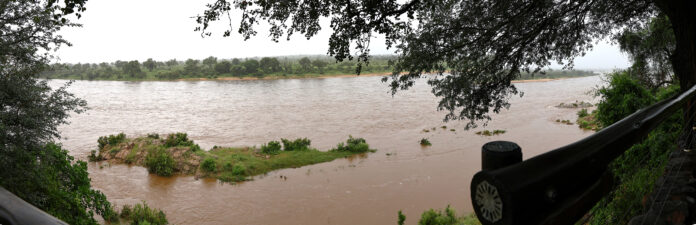
The continued global reliance on traditional energy sources, particularly fossil fuels, collided with a powerful La Niña weather system to unleash a climate “perfect storm” that ravaged large parts of southern Africa, including the Kruger National Park, according to new scientific analysis.
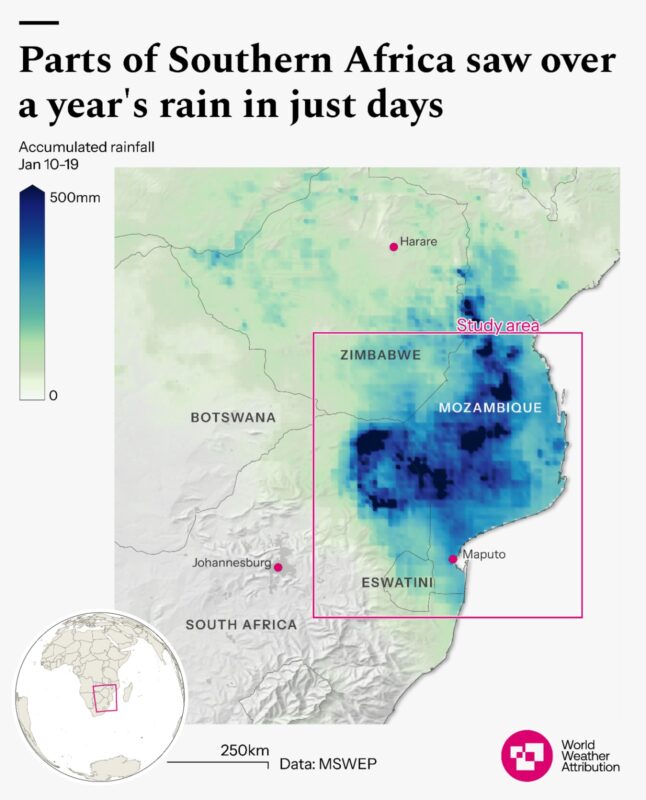
Researchers found that climate change intensified already heavy rainfall patterns, fuelling exceptionally severe downpours that triggered catastrophic flooding across South Africa, Mozambique, Zimbabwe, and Eswatini.
The flooding left hundreds of thousands of people affected, and as many as 200 were dead, while farming areas, health systems, and critical infrastructure were severely damaged.
Burning of fossil fuels to blame
Scientists say the intensity of heavy rainfall has increased by about 40% since pre-industrial times, accelerating the destructive force of La Niña-driven weather systems.
“Human-caused climate change is supercharging rainfall events like this with devastating impacts for those in its path,” said Izidine Pinto, senior climate researcher at the KNMI Royal Netherlands Meteorological Institute.
“Our analysis clearly shows that our continued burning of fossil fuels is increasing the intensity of extreme rainfall and turning events that would have happened anyway into something much more severe.”
The floods forced the closure of the Kruger National Park, South Africa’s flagship conservation and tourism asset, leaving damage estimated in millions of rands.
The destruction has raised concerns about the financial sustainability of the country’s protected areas network.
“This is a textbook case of climate injustice,” said Friederike Otto, professor of climate science at the Centre for Environmental Policy at Imperial College London.
“The people of South Africa, Mozambique, Zimbabwe, and Eswatini have not contributed to climate change, nor are they profiting from using or selling fossil fuels. Yet they are the ones losing their lives, homes, and livelihoods.”
Health impacts were among the most severe, with floodwaters destroying medical infrastructure, cutting off access to clinics, and disrupting medical cold-chain systems, while also threatening drinking water quality and food security.
“When floodwaters destroy medical infrastructure and block access to clinics, the consequences for people living in these communities last long after the water recedes,” said Renate Meyer, technical advisor for climate and conflict and southern Africa focal point at the Red Cross Red Crescent Climate Centre.
“As we continue to move into a climate that is growing ever more volatile, greater investment in community-led preparedness, strengthening transnational early warning systems, and flood-resilient infrastructure is needed to better protect people from future extremes.”
Natural disaster nodal point
The government has warned that the vulnerability of Kruger National Park carries national consequences.
“It is also important to note that Kruger National Park is increasingly a “natural disaster nodal point” due to the confluence of hydrological networks, tourism infrastructure density, and transboundary climatic influences,” said Minister of Forestry, Fisheries, and Environment Willie Aucamp.
He added that “80% of South African National Parks’ (SANParks) operating funds flowed from its own (Kruger National Park’s) activities”.
“The destruction of [SANParks’] tourism flagship puts the sustainability of the entire network of parks at risk,” he said.
Researchers warn that without a rapid shift away from fossil fuels, climate-fuelled disasters of this scale will become more frequent and more destructive.
- The continued global reliance on traditional energy sources, particularly fossil fuels, collided with a powerful La Niña weather system to unleash a climate “perfect storm” that ravaged large parts of southern Africa, including the Kruger National Park, according to new scientific analysis.
- Researchers found that climate change intensified already heavy rainfall patterns, fuelling exceptionally severe downpours that triggered catastrophic flooding across South Africa, Mozambique, Zimbabwe, and Eswatini.
- The flooding left hundreds of thousands of people affected, and as many as 200 were dead, while farming areas, health systems, and critical infrastructure were severely damaged.
- Burning of fossil fuels to blame Scientists say the intensity of heavy rainfall has increased by about 40% since pre-industrial times, accelerating the destructive force of La Niña-driven weather systems.
- “Human-caused climate change is supercharging rainfall events like this with devastating impacts for those in its path,” said Izidine Pinto, senior climate researcher at the KNMI Royal Netherlands Meteorological Institute.