


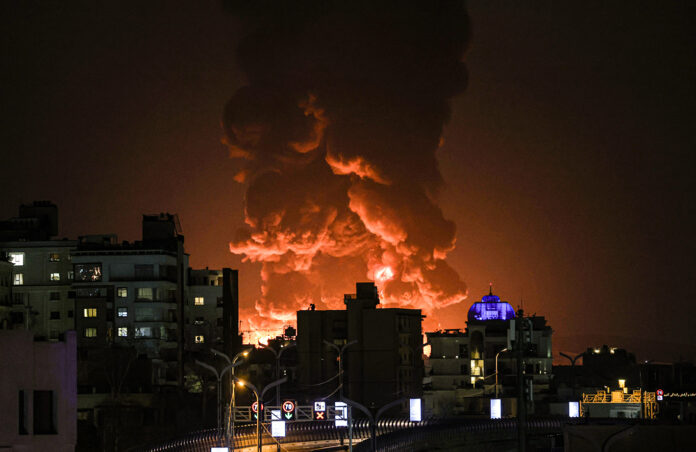
As the conflict drags on between the US, Israel and Iran, experts warn that Africa faces a cascade of consequences threatening its economic stability and regional security. What are the likely scenarios for Africa?
Feeling the pinch
The closure of the Strait of Hormuz – a vital artery for global oil flows and trade – could trigger far-reaching repercussions well beyond the region. Rising oil prices are pushing up the cost of living, fueling inflation and sending shockwaves across Africa.
Dr Mustafa Yusuf Ali, Founder and Chairperson of the Horn Institute for Strategic Studies, notes that while some states were initially somewhat insulated, other parts of the continent are already grappling with rising fuel prices due to supply shortages.
Adding to the economic impact, Chukwumerije Okereke, Professor of Global Governance and Public Policy at the University of Bristol, argues that the effects of the war will not be felt equally across all 54 African nations. For Africa’s major oil-producing countries, the crisis presents a rare, though volatile, fiscal opportunity.
Oil exporters may benefit from increased revenue
Prof Okereke points out that higher global prices could cushion the national budgets of countries that rely on energy exports. In the short term, at least, oil exporters like Nigeria, Angola and Algeria may benefit from increased fiscal revenue.
Conversely, for nations that depend on energy imports to keep their economies running, rising costs are purely detrimental.
Prof Okereke highlights several countries, particularly vulnerable to this price shock, mainly Kenya, Senegal, Morocco and Ghana. For these nations, higher energy costs will inevitably spill over into other sectors, creating a broader economic challenge, which he identifies as a major concern: inflation. As transport and production costs rise, the purchasing power of the average citizen in these importing countries is expected to shrink significantly.
Fragile food security under threat
Beyond the energy sector, Africa’s already fragile food security is also likely to be affected, given its reliance on fertiliser imports from the Middle East, Dr Ali noted. He further stressed that remittances are another concern: millions of Africans work in the Middle East, and the war has effectively tightened the flow of funds back to the continent, placing additional strain on public finances.
Horn of Africa: the geopolitical conduit
With a heavy US military presence already established in the region, the Horn of Africa faces the danger of becoming a geopolitical conduit.
On the security front, Dr Ali argues that the region’s dense military infrastructure, which was once seen as a sign of stability, may now be its greatest liability. Central to this concern is Djibouti, a nation that hosts military bases of major powers, which may actually function as magnets for aggression.
‘Africa could become a conduit for this war’
Zeenat Adam, Deputy Executive Director of the Afro-Middle East Centre, shared his view, “When we look at the expansion of some of the military bases in the Horn of Africa, the risk is that if the Gulf states say that they do not want any of the attacks to emanate from their area and territory, the next closest area would be the Horn of Africa, and with the US having those bases here, we could become a conduit for this war.”
The shifting dynamics of the conflict in Sudan present a rare, if fragile, opening for de-escalation. As Adam explains, the support for warring factions in Sudan is declining as Middle Eastern powers grapple with their own security challenges. “So that might be an opportunity to try and dissipate the conflict in Sudan,” she says.
The ‘Windfall’ illusion
Nigeria’s Foreign Minister, Yusuf Tuga, recently said the country’s untapped reserves offer an alternative source of crude and gas at a time when global flows are vulnerable.
However, Prof Okereke cautions against over-optimism regarding rising oil prices. While a price increase can generate immediate revenue for oil-producing countries, a significant portion of these gains is often “cancelled out” by structural inefficiencies.
“Many of these African countries, even the crude exporters, also import refined oil. So, what may appear to be gained from the increase in crude prices could easily be cancelled out by the increase in refined oil imports, as well as in fertiliser prices,” he says.
Trade disruptions
Another windfall could come from trade disruptions as shipping companies reroute to South Africa. “Strategically, Durban could become a major maritime hub in the world,” Prof Okereke says, adding that supply chains will lengthen, and goods prices will rise as a result.
He emphasises that history is a harsh teacher: immediate windfalls rarely translate to long-term economic stability unless those funds are aggressively reinvested into domestic infrastructure.
Changing world order
The US and Israel attack on Iran puts into question the rules-based order that global institutions were designed to uphold, with the aim of maintaining international peace.
According to Dr Ali, “the rules-based international order is no longer there.” He adds that “multilateralism is dead, not because the UN, AU or EU wanted it dead, but because US President Donald Trump wanted to kill multilateralism so he could have a free hand and do whatever he wanted.”
Dr Ali further says that, “African leaders have to put their houses in order and focus on strengthening the African Union and regional economic blocs to ensure they can contain ongoing conflicts, some of which have been fueled by countries outside Africa.”
‘Need for unified defence strategy’
Adam warns that “the rule of law has been thrown out the window,” specifically citing the humanitarian crisis in Gaza as a turning point. She calls for collaboration within the Global South, pointing to the recently signed South Africa-Brazil defence pact as an example of efforts to prevent “hegemonic takeovers.” Without a unified defence strategy, African nations remain vulnerable to external interference in their domestic leadership.
“If we cannot be unified within the African Union, and external powers continue to interfere with how we manage relations within the continent and how we address conflicts, we’re not going to be able to resolve anything, nor take advantage of the opportunity to rise above what is happening around us,” she says.
Many nations choosing ‘strategic silence’ or impartiality
Despite these vulnerabilities, Dr Ali identifies a silver lining in current African diplomacy: a shift toward strategic non-alignment. While many nations have historical ties to both Iran and the West, they are increasingly choosing “strategic silence” or impartiality.
Rather than being forced into a binary choice, these countries are realigning their strategies by refusing to be drawn into conflicts that do not serve regional interests, keeping doors open to both East and West, and moving away from direct alignment toward a more pragmatic foreign policy.
The cost of hesitation
While the global order shifts, the immediate internal reality for many African nations remains precarious. Zeenat and Dr Ali warn that a “wait and see” approach to global crises is a luxury the continent can no longer afford, especially as economic and food security risks mount.
Zeenat feels that Africa’s current response has been slow and hopes for firmer decision-making, rather than waiting for guidance from external powers.
‘Staggering failure in early preparation’
Dr Ali, for his part, notes a staggering failure in early preparation, revealing that Africa still imports a large proportion of its wheat from Russia and Ukraine, two nations currently engaged in a protracted war. This dependency illustrates a broader trend of “falling short” in preparedness. For him, the lesson is clear: African sovereignty cannot exist as long as the continent’s basic survival depends on the stability of distant powers.
In terms of energy, Prof Okereke also highlights Africa’s unpreparedness: unlike many developed nations that maintain massive reserves to stabilise prices during crises, most African states lack the infrastructure to stockpile energy. Another lesson lies in Africa’s vast renewable energy resources, which remain largely untapped.
“Africa should take this opportunity to engage in deep reflection. Africa has one of the best solar irradiances in the world, yet it has attracted only 2% of global investment in renewable energy. This is a warning that if we continue to neglect our basic resources, wind, solar and geothermal energy, while remaining dependent on oil, we will continue to be highly vulnerable to these kinds of shocks,” Okereke says.
‘Must shift from continental bureaucracy to regional cooperation’
Zeenat argues that while the African Union’s “early warning systems” have historically lacked teeth, the time for passive observation has ended. To avoid political unrest fueled by external shocks, the focus must shift from continental bureaucracy to regional cooperation.
And as the global landscape shifts under the weight of persistent conflict in the Middle East and a crumbling international order, Africa’s challenge is no longer to merely weather the storm, but to ensure that it does not become collateral damage.
- As the conflict drags on between the US, Israel and Iran, experts warn that Africa faces a cascade of consequences threatening its economic stability and regional security.
- What are the likely scenarios for Africa.
- Feeling the pinch The closure of the Strait of Hormuz – a vital artery for global oil flows and trade – could trigger far-reaching repercussions well beyond the region.
- Rising oil prices are pushing up the cost of living, fueling inflation and sending shockwaves across Africa.
- Dr Mustafa Yusuf Ali, Founder and Chairperson of the Horn Institute for Strategic Studies, notes that while some states were initially somewhat insulated, other parts of the continent are already grappling with rising fuel prices due to supply shortages.


